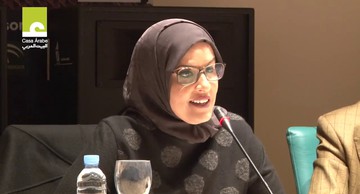


Studying in Lebanon: Challenges to Syrian Refugee Children
Published at 38 12,,, 21 2021
ALL VIDEOS IN THIS CATEGORY
-

Arab and African Migration Towards the EU: Seeking a social focus. Panel 3 + Closure (FRENCH)
2017.07.11. Casa Árabe and the Friedrich Ebert Foundation of Tunisia and Madrid, in coordination with the Labor Union Network of Mediterranean and Sub-Saharan Migrations (RSMMS), organized this seminar, which analyzed the social facet of Arab and African migration towards the EU. With the participation of the main social role-players and institutions involved in fighting for labor dignity and dealing with migrations, the seminar seeks to provide a balanced, constructive, realistic analysis of this topic. Panel 3: Migrations in the EU: Current state of affairs With the cooperation of the European Economic and Social Committee (EESC) + European and African labor union organizations. Closure: Ebert Foundation in Tunisia More info: http://en.casaarabe.es/event/arab-and-african-migration-towards-the-eu-seeking-a-social-focusPublished at 58 25,,, 18 2018 -
Arab and African Migration Towards the EU: Seeking a social focus. Panel 2 (FRENCH)
2017.07.11. Casa Árabe and the Friedrich Ebert Foundation of Tunisia and Madrid, in coordination with the Labor Union Network of Mediterranean and Sub-Saharan Migrations (RSMMS), organized this seminar, which analyzed the social facet of Arab and African migration towards the EU. With the participation of the main social role-players and institutions involved in fighting for labor dignity and dealing with migrations, the seminar seeks to provide a balanced, constructive, realistic analysis of this topic. Panel 2: Migrations within a global context. With the cooperation of the Office in Spain of the International Organization of Migrations (IOM) + European and African labor union organizations. More info: http://en.casaarabe.es/event/arab-and-african-migration-towards-the-eu-seeking-a-social-focusPublished at 57 25,,, 18 2018 -
Arab and African Migration Towards the EU: Seeking a social focus. Opening + Panel 1 (FRENCH)
2017.07.11. Casa Árabe and the Friedrich Ebert Foundation of Tunisia and Madrid, in coordination with the Labor Union Network of Mediterranean and Sub-Saharan Migrations (RSMMS), organized this seminar, which analyzed the social facet of Arab and African migration towards the EU. With the participation of the main social role-players and institutions involved in fighting for labor dignity and dealing with migrations, the seminar seeks to provide a balanced, constructive, realistic analysis of this topic. Opening session Greetings and interventions by the General Director of Casa Árabe and Secretaries General of the labor union organizations of Spain. Panel 1: The fight for labor dignity: forced labor. With the cooperation of the Office of the International Labor Organization in Spain (ILO) + European and African labor union organizations. More info: http://en.casaarabe.es/event/arab-and-african-migration-towards-the-eu-seeking-a-social-focusPublished at 56 25,,, 18 2018 -
Human Rights Council: Taking stock and identifying challenges for 2018-2020
2017.11.12. Casa Árabe and the Human Rights Office of Spain’s Ministry of Foreign Affairs and Cooperation organized this conference as part of the 69th Anniversary of the Universal Declaration of Human Rights. The event was presented by Pedro Martínez-Avial, the General Director of Casa Árabe and moderated by Adela Díaz, Director of the Office of Human Rights, with speeches by Juan Ignacio Morro, the United Nations Director General of Human Rights; Shalva Tsiskarashvili, Vice-President of the Human Rights Council; Walid Doudech, the Permanent Representative Ambassador of Tunisia to the United Nations Office in Geneva, and Esteban Beltrán, director of the Spanish section of Amnesty International. As occurs each year, on December 10 we celebrate the anniversary of the Universal Declaration of Human Rights. Spain’s Ministry of Foreign Affairs and Cooperation is focusing this year’s celebration on the Human Rights Council. Last October 16, Spain was chosen to become a member of this main body for defending and promoting Human Rights around the world, for the time period of 2018-2020. Becoming a member of the Human Rights Council can be seen as an acknowledgment of a State’s commitment in this arena and also provides an opportunity to contribute actively to the Council’s development and work. The round table discussion will attempt to take stock of events and foresee the main challenges to be faced by the Council looking ahead to the upcoming years, from different perspectives: from that of a current member State, that of a future member State and that of the structure of the Council itself and civil society. More info: http://en.casaarabe.es/event/human-rights-council-taking-stock-and-identifying-challenges-for-2018-2020Published at 21 13,,, 17 2017 -
The State of Qatar’s Policies on International Cooperation and Social Work (ARABIC)
2017.23.11. The objective of this conference was to show the efforts made by Qatar’s government on international cooperation, the culture of peace and the rejection of violence. The event was presented by the General Director of Casa Árabe, Pedro Martínez-Avial, and included interventions by Tariq Al-Ansari, an ambassador and the Director of the Department of International Cooperation of the Ministry of Foreign Affairs, and Amal Al-Mannai, CEO of the Qatar Foundation for Social Work. This conference is an attempt to demonstrate the efforts made by the State of Qatar in the field of international cooperation as an important part of its foreign policy, to pass the culture of peace on amongst today’s generations and prepare responsible leaders for the future on dialogue and the rejection of violence. Therefore, the leaders of the State of Qatar have attempted to play an active role in strengthening their position in the political, development and social arenas. These efforts are framed within the strategy of international cooperation led by Qatar’s Ministry of Foreign Affairs as part of the National Vision for Qatar of 2030 which seeks to promote a global association for the creation of safe, peaceful societies headed by institutions which are able to protect stability and serve the different parties in society, with the goal of achieving the 17 United Nations Sustainable Development Goals based on the principles agreed to in the Millennium Declaration, along with the State of Qatar’s social responsibility in terms of humanitarian aid. The scope of action of Qatar’s Foundation for Social Work is social work at the local, regional and international levels. To do so, it has designed policies and strategies for social action, thereby allowing it to consolidate prior achievements, create effective alliances, strengthen the bonds of cooperation and build bridges for coordination with the proper governmental entities, as well as with the most important public and private institutions worldwide, because it wishes to become a role model in the field of social work. This foundation is of a consultative nature on the United Nations Economic and Social Council (ECOSOC). More info: http://en.casaarabe.es/event/the-state-of-qatar’s-policies-on-international-cooperation-and-social-workPublished at 11 12,,, 17 2017