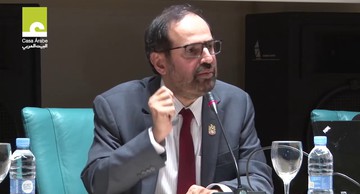


Syria: Prospects ten years after the outbreak of revolution
Published at 10 11,,, 21 2021
ALL VIDEOS IN THIS CATEGORY
-

Fortieth International Day of Solidarity with the Palestinian People (ARABIC)
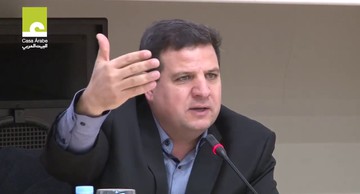
2017.29.11. Casa Árabe and the Diplomatic Mission of Palestine in Spain organized this conference, given by Ayman Odeh, a member of the Knesset and the head of the Joint List. It was presented by Mussa Amer Odeh, the Ambassador of Palestine in Spain, and Pedro Martínez-Avial, the General Director of Casa Árabe. Since 1977, on November 29 of each year, the UN commemorates the International Day of Solidarity with the Palestinian People. The date was selected because of its importance to the Palestinian people, given that three decades earlier, or in other words on that same date in 1947, the United Nations General Assembly enacted Resolution 181, which later came to be known as the “Partition Resolution,” in which the creation of a “Jewish State” and an “Arab State” in Palestine were stipulated, with Jerusalem as an international city. Of the two States foreseen in that resolution, up to now only one has been created: Israel. In a year when the Balfour Declaration has turned one century old, the Nakba occurred seven decades ago, and the Six-Day War took place fifty years back, this anniversary is allowing the international community to focus its attention on the fact that the matter of Palestine has not yet been resolved. Ayman Odeh (Haifa, 1975) is an attorney and politician, as well as member of the Israeli Parliament, or Knesset and the head of the Joint List, a political alliance of four parties dominated by the Arabs: Hadash, Balad, the United Arab List and Ta’al. Odeh, who identifies as a Socialist, joined Hadash and represented it in the Municipal Government of Haifa from 1998 to 2005, before becoming the party’s Secretary General in 2006. Analysts attribute to charismatic Odeh the fact that a more moderate, pragmatic face has been placed on the Arab political union. Odeh was elected to the twentieth Knesset, along with another 12 candidates from the Joint List. More info: http://en.casaarabe.es/event/fortieth-international-day-of-solidarity-with-the-palestinian-peoplePublished at 49 12,,, 17 2017 -
The first Middle East World Cup: An opportunity for co-existence through sports
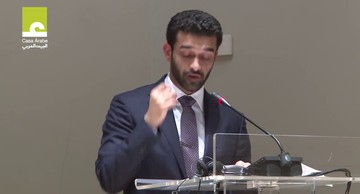
The Secretary General of the Supreme Committee for Delivery and Legacy (Qatar 2022), Hassan Al Thawadi, gave this conference in Madrid on October 31. He was accompanied by Juan Luis Larrea Sarobe, president of Spain's Royal Football Federation. At this conference, Al Thawadi, who was introduced by the General Director of Casa Árabe, Pedro Martínez-Avial, dealt with the importance held by soccer’s World Cup event in 2022, taking place for the first time ever in the Middle East, in an Arab country. This milestone has turned the major event into something truly special this time around, and it will be a great opportunity to achieve understanding between peoples of different cultures, beliefs and past histories. Hassan Al Thawadi highlighted soccer’s potential as a tool to achieve unity, with historical and contemporary references, as well as discussing how Qatar is working to make the 2022 World Cup memorable as a historical event for the region. Hassan Al Thawadi has been, since March of 2011, the Secretary General of the Supreme Committee for Delivery and Legacy of Qatar, the organization responsible for coordinating the public and private entities that will be completing the infrastructures and development projects for hosting the World Cup in Qatar in 2022. Prior to this, he was a senior executive on Qatar’s 2022 Bid Committee, where he worked alongside the Committee’s Chairman, Sheikh Mohammed bin Hamad Al Thani, in the end achieving Qatar’s selection as the World Cup host. Educated as a lawyer, he has also been a general advisor of the Qatar Invest Authority (QIA) and Qatar Holding, entities founded by the State of Qatar in 2005 to strengthen the national economy through diversification and making strategic long-term investments. He is also a member of several significant boards of trustees and committees in Qatar, including Qatar University (College of Business and Economics), Qatar Chamber for Commerce and Industry, Qatar International Islamic Bank, Msheireb Properties and Hassad Foods. More info: http://en.casaarabe.es/event/the-first-middle-east-world-cup-an-opportunity-for-co-existence-through-sportsPublished at 45 02,,, 17 2017 -
Human Rights in Qatar (ARABIC)
10.19.2017. The president of Qatar’s National Human Rights Committee, Ali bin Samikh Al-Marri, gave this conference at the Casa Árabe headquarters in Madrid. Al-Marri was introduced by Pedro Martínez-Avial, the General Director of Casa Árabe. The outlook of Qatar’s National Human Rights Committee is based on the conviction that human rights constitute one of the most important matters in the national community, in particular, and the international community in general. Acknowledging these rights, whether they may be political, civil, cultural, social or economic, and whether they belong to individuals or groups, means making a commitment to equality, justice, freedom and human dignity for all human beings with no discrimination. Qatar’s National Human Rights Committee is an official national committee with a special status that seeks to increase awareness and educate people about rights, providing the necessary protection and support to individuals while developing skills. Ali bin Samikh Al-Marri. He has been the president of Qatar’s National Human Rights Committee (NHRC) since 2009, and as of 2015 is the Vice-President of the Asia-Pacific Forum for National Human Rights Institutions (APF), whose headquarters is located in Sidney, Australia. Similarly, he is a member of the Advisory Board and Scientific Committee of the Arab Institute for Human Rights, with headquarters in Tunis. He was elected Chairman of the Arab Commission for Human Rights at the Arab League in 2012. He earned a PhD in Philosophy and Political Science. More info: http://en.casaarabe.es/event/human-rights-in-qatarPublished at 21 02,,, 17 2017 -
Chant Avedissian: Redressing Identity (ENGLISH)
2017.18.10. Conference given by Nigel Ryan, art critic and cultural editor at the Al-Ahram Weekly newspaperfor for nearly two decades and Sabrina Amrani, a gallery owner, on the occasion of the opening of the exhibition "Chant Avedissian. A Levantine Heading East”. Born in Cairo (1951), Aveidssian is one of the Egyptian artists to have best kept identity and popular traditions, but from a modern perspective. A tireless traveler who has gone from Egypt to Uzbekistan, his observations on decorative and architectural pieces are reflected in his work, made using various techniques: stencil, textile, photography, gouache on cardboard, etc. Art critic Nigel Ryan spoke about this artist's work within the context of art in Egypt during the twentieth century, a period that can be viewed as an attempt to construct a coherent national style. Political engagement and notions of authenticity were central to this endeavour which continues to cast a shadow over contemporary production. In “Redressing Identity”, Nigel Ryan argues that Chant Avedissian’s artistic practice and work constitute a radical critique of a process that resulted in the promotion of exclusion and the straitjacketing of art rather than any expansion of horizons. Nigel Ryan has lived in Egypt since 1989. For 18 years he was the cultural editor and art critic of the Cairo-based newspaper Al-Ahram Weekly. He has written extensively on contemporary Egyptian art and the wider cultural scene, chronicling – among other things – the emergence of independent art spaces in the decade preceding the Arab Spring. His work has appeared in many publications, including Grand Street, New York; Journal of Comparative Criticism, Cambridge University Press, and Alif: Journal of Comparative Poetics, American University in Cairo Press. More info: http://en.casaarabe.es/event/chant-avedissian-redressing-identityPublished at 37 26,,, 17 2017 -
Efforts by the United Arab Emirates to fight extremism (ARABIC)
2017.10.11. Given by Ali Rashid Al-Nuaimi, Chairman of the Board of Directors of Hedayah (International Centre of Excellence for Countering Violent Extremism). Also taking part were Hissa Abdullah A. Al Otaiba, the Ambassador of the United Arab Emirates, and Pedro Martínez-Avial, the General Director of Casa Árabe. Since it was founded in 1971, the United Arab Emirates (UAE) has spared no efforts to fight the scourge of terrorism and extremism. The country has enacted laws and regulations to fight against terrorism and violent extremism by collaborating in the field of international court cooperation not only in the Middle East region, but also at the international level. Within this context, at the initiative of the UAE’s President, Sheikh Khalifa bin Zayed Al-Nahyan, in 2012 the International Centre of Excellence for Countering Violent Extremism (Hedayah) was founded as a center associated with the “Action Group to Counter Violent Extremism” in the United Kingdom. Hedayah was created in response to the increasing will of the members of the Global Counter Terrorism Forum (GCTF) and the international community to set up an independent, multilateral center devoted to dealing with this strategic challenge in the long term. To achieve this, the entity works to design national strategies to fight violent extremism that include not only stemming the recruitment of new combatants, but also dismantling extremist ideologies. With this goal in mind, its experts uphold that it is necessary to work with communities, get religious leaders involved and build alternate narratives. More info: http://en.casaarabe.es/event/efforts-by-the-united-arab-emirates-to-fight-extremismPublished at 38 18,,, 17 2017