

Studying in Lebanon: Challenges to Syrian Refugee Children
Published at 38 12,,, 21 2021
ALL VIDEOS IN THIS CATEGORY
-

From decolonization to the Arab Spring (FRENCH)
04-27-2017: Casa de Velázquez and Casa Árabe organized this round table discussion, the objective of which was to understand the causes, role-players and developments in the “Arab Spring.” It included interventions by Michel Cahen, head researcher at the Centre National de la Recherche Scientifique (CNRS); Pierre Vermeren, department chair of Contemporary History at the Université Paris I, and Bernabé López García, professor emeritus and department chair of Contemporary Islamic History at the Universidad Autónoma de Madrid. Six years after the occurrence of what has been called the “Arab Spring,” this process continues to pose questions. In order to understand its causes, role-players and developments, this round table discussion brought together specialists on the Maghreb region during the colonial era and post-colonial problematics. Through a historical analysis based on the processes of decolonization, three experts attempted to clarify not just the event, but also the phenomenon. The conference toke place as part of the colloquium “Maintaining Public Order in the Spanish and French Empires in the Nineteenth and Twentieth Centuries: Role-players, policies, instruments.” More info: http://en.casaarabe.es/event/from-decolonization-to-the-arab-springPublished at 47 18,,, 17 2017 -
Seven decades of Nakba
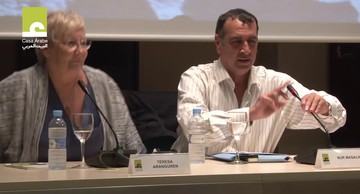
05-16-2017: Casa Árabe is screening the documentary “The Earth Speaks Arabic” and has organized a conference by Palestinian historian Nur Masalha to commemorate this date. The event will be moderated by Teresa Aranguren, a journalist and member of the Board of Directors at RTVE. Why doesn’t the destruction of a large number of Palestinian towns and villages appear in the Western story about the consequences of Palestine’s partition? Commemorating the Nakba, or “catastrophe,” of 1947-48 means making an effort to recover a collective memory and the formation of a group identity, in which Palestine’s oral history holds a special place. Masalha calls it “social history from the bottom up” and argues that writing more sincerely about the Nakba does not mean just practicing professional historiography, but is also a moral imperative. Historians and intellectuals play a basic role when it comes to constructing a national narrative, something which has created yet another battlefield in the Palestinian-Israeli conflict since it first began. More info: http://en.casaarabe.es/event/seven-decades-of-nakbaPublished at 29 18,,, 17 2017 -
Democratic transition and judicial reform in Tunisia (ARABIC)
Ghazi Jeribi, the Tunisian Justice Minister, gave this conference in Madrid. With the participation of Margarita Robles Fernández, President of the Spanish Parliament’s Justice Commission. Six years after the revolution which put an end to the era of President Ben Ali, Tunisia has had the seventh government in its young democracy since late August of 2016. The political developments in Tunisia since 2011 constitute what is perhaps the most hopeful case among the so-called Arab Springs, and its value as a symbol of the potential for change in Arab societies is enormous. One of the conditions necessary for a successful democratic transition, as established by the Tunisian Constitution of 2014, is a reform of the judicial system. The Tunisian Justice Minister, Ghazi Jeribi, in this position since August 2016, and a person with in-depth knowledge about his country’s judiciary, talked to us about this reform, the achievements reached up to now and the difficulties which it is facing. Ghazi Jeribi (Tunis, 1955) has a university degree in Law from the University of Paris, having specialized in Public Law. He has had ties with the Tunisian judiciary since 1984, first with the Administrative Court, where he held several different positions, including that of First President, from 2007 through 2011. In 2014, he was named the Minister of National Defense and a member of the Commission for Democracy through Law (Venice Commission), holding the position of Chairman of the Sub-commission for the Mediterranean Basin. Since 2015, he has been a lawyer at the Court of Cassation. He has had many articles published in domestic and foreign journals and magazines on human rights, public freedoms and transitional justice, as well as other subjects. In 2015, he was decorated with the distinction of the Order of the Republic. More info: http://en.casaarabe.es/event/democratic-transition-and-judicial-reform-in-tunisiaPublished at 35 09,,, 17 2017 -
Radical messages and preventing extremism
The first few years of the twenty-first century have verified that the recruitment and radicalization of young combatants is not just affecting one single region in the world. The phenomenon has spread throughout urban and rural communities, from the heart of Syria and northern Nigeria to the suburbs of Paris and Brussels. With the advent of Jihadist groups such as al-Qaeda, al-Shabab, Boko Haram and the self-proclaimed Islamic State, the impact on vulnerable youths is notable, and diversifying the strategies to prevent extremism has become a necessity. How and where do Jihadists get radicalized, though? And what tools can be developed to neutralize the toxic narratives for luring them in and to reintegrate repentant Jihadists back into society? The conference dealed with these challenges and the ways to channel the action to be taken. Participating in this conference were Ayman Mhanna, executive director of the Samir Kassir Foundation (Lebanon); and Fernando Rivas, an analyst from the Center for Intelligence Against Terrorism and Organized Crime (CITCO). The event was moderated by Karim Hauser, Casa Árabe’s International Politics Coordinator. Ayman Mhanna Since 2011, he has been the executive director of the Samir Kassir Foundation, a notable organization that defends freedom of the press in the Middle East, with its headquarters in Beirut. From January 2016 to February 2017, he was the director of the Global Forum for Media Development (GFMD), a network of 200 organizations which provide support for journalism and media development, with headquarters in Brussels. Prior to that, he worked at the National Democratic Institute for International Affairs (2007-2011) and was a professor of Policy Development and Communications at Saint-Joseph University’s School of Economics in Beirut. He has a Master’s degree in International Affairs from Sciences Po Paris. He is also a member of the steering committee of the pilot study Reception and Perception of Radical Messages. More info: http://en.casaarabe.es/event/radical-messages-and-preventing-extremismPublished at 13 23,,, 17 2017 -
Increasing tourism’s resilience and supporting growth in the Middle East and North Africa (ENG)
Ministerial Round Table Discussion organized by Casa Árabe and the World Tourism Organization (UNWTO) as part of the FITUR International Tourism Fair of 2017. In conjunction with the World Tourism Organization (UNWTO), Casa Árabe organized the fifth edition of a ministerial round table discussion on the prospects for tourism in the Middle East and North Africa, within the framework of the FITUR International Tourism Fair of 2017 in Madrid. As in other years, this gathering included the presence of Tourism Ministers from some of the most important countries which receive tourism in the region. The objective of the event was to offer a space for debate to analyze current trends and short-term prospects for tourism in the region within the current scenario of geopolitical upheaval, challenges at different levels in the field of security and persistent uncertainty about the global economic outlook. The round table discussion reviewed the different possible strategies to improve tourism’s resilience against external shocks, speeding up and consolidating the industry’s recovery while strengthening its contribution to economic growth and sustainable, inclusive development in these countries. More info: http://en.casaarabe.es/event/increasing-tourism’s-resilience-and-supporting-growth-in-the-middle-east-and-north-africaPublished at 21 01,,, 17 2017