

AAU 4.2 La cobertura de los conflictos de Oriente Medio en los medios españoles
Published at 54 13,,, 22 2022
ALL VIDEOS IN THIS CATEGORY
-

“Madrid with Syria” awareness day (ARABIC)
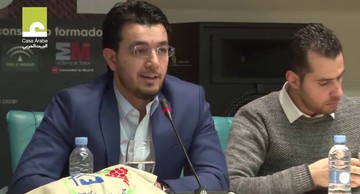
Representatives of the organizations Cascos Blancos (White Helmets), Sham el Jair and the Association of Support for the Syrian People (AAPS) gave testimonials on the situation in the country. Along with Amer Hijazi, president of the AAPS, testimonials were given by Raed Alsaleh, the director of Cascos Blancos; Ahmad Youssef, a volunteer for Cascos Blancos; Halil Resuloglu, president of the Syrian NGO Sham el Jair; Mohamad Alskaf, manager of humanitarian aid for Sham el Jair, and Ignacio Álvarez Ossorio, a professor of Arab and Islamic Studies at the University of Alicante and the Middle East and Maghreb Coordinator for Fundación Alternativas. The event was presented by Karim Hauser, who is responsible for Governability at Casa Árabe. The Association of Support for the Syrian People (AAPS) is the only Spanish NGO that sends humanitarian aid on a regular basis to the interior of Syria, and it works with the cooperation of other NGOs and associations in the field so that the sending of humanitarian aid will be effective and reach those who need it most. More info: http://en.casaarabe.es/event/“madrid-with-syria”-awareness-dayPublished at 59 01,,, 17 2017 -
Humanitarian crisis in the region of Iraqi Kurdistan
The media constantly speak about the operation in Mosul, the war against Daesh (or ISIS, after its acronym in English), but they often leave out the humanitarian consequences. The war has led to the forced displacement of millions of people in Iraq and Syria since 2014. Arab, Christian and Yazidi families have been persecuted, threatened and massacred. Most of those saved have found refuge in the region of Iraqi Kurdistan. There are more than 2 million displaced people, and the number of victims continues to grow each day. The camps are overflowing with people. International humanitarian aid is insufficient and does not even cover the basic needs. This conference invited us to gain first-hand knowledge about the current situation for refugees and the displaced in the region of Kurdistan, to provoke thought with a view to understanding the global consequences of this unprecedented humanitarian crisis and to get a closer look at the charitable initiatives already being implemented in the region.Published at 16 10,,, 17 2017 -
Mysticism in Islam (In Arabic)
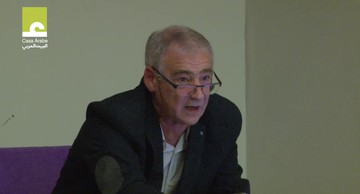
The objective of the conference is to provide an introduction to the history, practices and narratives of Sufism. It will also delve into the topics of spirituality, asceticism and mysticism, and their position within the Islamic world view. Sufism (or tasawwuf in Arabic) is practiced by many Muslims around the world as a personal path towards God. The main Sufi “orders” (tariqa, or in the plural turuq) and the related figures will be explained, as well as discussing whether all of its forms and practices are Islamic per se. Though several Sufi narratives will be covered, a special emphasis will be placed on the life and work of Imam Al-Ghazali. The conference will end with a poetry recitation. The conference, which will be given by Mustafa Abu Sway, a professor of Philosophy and Islamic Studies at Al-Quds University, and will also include interventions by Ricardo Albert, assistant director of the Department of Arab and Islamic Studies and Eastern Studies at the Universidad Autónoma de Madrid. It will be presented by Karim Hauser, who is responsible for Casa Árabe’s Governance Area.Published at 04 14,,, 16 2016 -
“Their Heart in Your Hands”: The history of Islamic manuscript collections in Europe
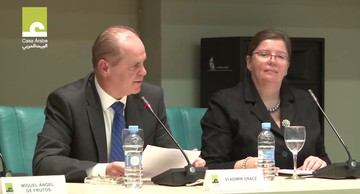
Casa Árabe and the Embassy of Slovakia in Madrid have organized, within the framework of the Slovakian Presidency of the European Union Council, a round table discussion titled “Their Heart Is in Your Hands: Collections of Islamic manuscripts in Europe, with the cooperation of Nuria Martínez de Castilla, a specialist in codicology and the history of manuscripts from the Islamic world. This round table discussion will be devoted to discussing the different journeys and adventures which Arabic and Islamic manuscripts went on until coming to form part of today’s collections in European archives and libraries. In particular, it will deal with the histories of three collections, the Bašagić Collection of Islamic Manuscripts at the Bratislava University Library in Slovakia; the Arabic manuscripts at the University of Leiden Library in Holland, and the Arabic manuscript collection at the Monastery of El Escorial in Spain. During the debate, some of the common problems encountered when determining and recording the history of Islamic manuscripts in Europe will be examined, as well. The round table discussion will be opened by Miguel Ángel de Frutos, an ambassador and international advisor of Casa Árabe, Vladimír Grácz, the Ambassador of Slovakia in Madrid, and Silvia Stasselová, the General Director of the University Library in Bratislava. After a brief documentary about the Bašagić Collection of Islamic manuscripts, part of UNESCO’S Memory of the World International Register, that collection’s history will be told, as will those of the collections at the University of Leiden and in El Escorial, with contributions by Klára Meszárosová, of the Bratislava University Library, Arnoud Vrolijk, conservator of the University of Leiden Library, and Nuria Martínez de Castilla, of the Universidad Complutense de Madrid, in a round table discussion moderated by Marek Brieska, from the Slovakian Embassy in Spain.Published at 51 13,,, 16 2016 -
International Day of Solidarity with the Palestinian People (In Arabic)
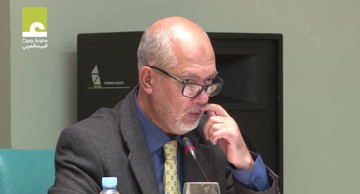
“Today, 136 countries recognize the State of Palestine and its flag flies at the United Nations next to those of all Member States. However, these advances are not felt by children in Gaza, or by the residents of Nablus, Hebron and East Jerusalem [...] let us reaffirm our commitment to bring about the just peace that the peoples of Israel and Palestine deserve.” Ban Ki-Moon, Secretary General of the United Nations (November 29, 2015). In 1977, the UN General Assembly asked for November 29th to become the annual day of observance for the International Day of Solidarity with the Palestinian People. Thirty years earlier, in 1947, the Assembly had approved Resolution 181 on the partition of Palestine, on the very same day of the year. This commemoration is an act in favor of the rights of Palestinians and an opportunity to make the topic of Palestine and Israeli occupation more visible, now that it is becoming more and more overshadowed by the increasing cacophony of international news about the Middle East. The Palestinian refugees’ situation and the marginalization of Palestinians in Israel in 1948 are just a few of the factors that will be dealt with at this event. The conference was given by Talab al-Sana, president of the Arab Democratic Party. It will include participation by Isaías Barreñada, a professor of International Relations at the Universidad Complutense in Madrid. Also taking part are Mahmoud Alwani, top advisor of the Diplomatic Mission of Palestine in Spain. The event was presented by Pedro Villena, the General Director of Casa Árabe.Published at 47 01,,, 16 2016