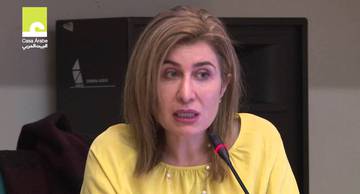


La adaptación al cambio climático en la región MENA: prácticas y lagunas (ESPAÑOL / INGLÉS)
Published at 59 12,,, 20 2020
ALL VIDEOS IN THIS CATEGORY
-

IV Arab-Christian Day: Christian archeology on the Arabian Peninsula
Conference given on April, 13th at Casa Árabe in Madrid, by Julie Bonnéric, a researcher at the French Near East Institute (IFPO)Published at 53 19,,, 16 2016 -
IV Arab-Christian Day: Christian tradition in the Gulf countries. Conference on "Christianity today"
Conference given on April, 13th at Casa Árabe in Madrid, by Michael O’Sullivan, Financial Administrator at the Apostolic Vicariate of Southern Arabia on "Christianity today"Published at 48 18,,, 16 2016 -
Islam and Politics: Mythological constructs, past customs and current practices (French)
Casa Árabe and Casa de Velázquez have organized this conference with a view to analyzing the political changes in the Middle East since the Arab Springs. Both directors, Pedro Villena, the General Director of Casa Árabe and Michel Bertrand, the director of the Casa de Velázquez participated in this round table along with Makram Abbes, a professor of political philosophy at the École Normale Supérieure de Lyon; Nabil Mouline, a professor and researcher at the Institut d'Études Politiques in Paris; Karima Dirèche, director of the Institut de Recherche sur le Maghreb Contemporain (IRMC) in Tunisia, and Éric Gobe, a researcher with the Institut de Recherche sur le Maghreb Contemporain (IRMC). More info: http://en.casaarabe.es/event/islam-and-politics-mythological-constructs-past-customs-and-current-practicesPublished at 47 14,,, 16 2016 -
Arts and Culture: shelter or reflection? (SP/ENG/FR)
Casa Árabe hosted a round table on the role of artists and cultural producers from the Arab world with regards to the current affairs affecting the region. With the participation of Zineb Sedira, artist and founder of ARIA (Artist Residency in Algiers); Ammer Abo Bakr, street artist; Rachida Triki, art critic, curator and Professor specialized in Aesthetics and Philosophy of Art; and Nuria Medina, coordinator of Culture at Casa Árabe. This round table frocused on the role of artists and cultural producers from the Arab world with regards to the current affairs and uncertainties that are affecting the region. We tryed to seek answers to questions such as: where do we stand today, after five years of Arab uprising?; what are the most important issues affecting cultural institutions and artists across the region?; which are the perspectives for the youth, and among them, many artists? Although obstacles, extremism and censorship are increasing and affecting many critical intellectuals and artists in some countries, are there signals of a cultural revolution happening behind the headlines? In this regard, how determinant is being the technological change and global connection? In this context of change and instability, how artists and cultural producers deal with the tradition and memory of their cultures? More information: http://en.casaarabe.es/event/arts-and-culture-shelter-or-reflectionPublished at 40 25,,, 16 2016 -
Arab Dawn: Arab youth and the demographic dividend they will bring
Conference given by Bessma Momani, associate professor of the Political Science Department at the University of Waterloo. During the event, Momani was accompanied by Haizam Amirah Fernández, main researcher for the Mediterranean and Arab World at the Real Instituto Elcano, and Leila Nachawati, a professor of Communication at the Universidad Carlos III of Madrid and co-founder of the portal Syria Untold. The event was presented by Karim Hauser, who is responsible for the Governance Area at Casa Árabe. Though it may seem implausible to some readers, despite the wave of negative news reaching us from the Middle East and North Africa, many youths who went out in the streets to demonstrate in 2011 continue to campaign for change. Their efforts seldom make it into the Western news, but there are stories which demonstrate the will of these generations to continue transforming the societies in which they live, from Saudi women publishing YouTube videos of themselves driving in Riyadh to an Egyptian television star exposing cultural hypocrisy by using hidden cameras. They are much less dramatic stories than the downfall of a dictator at the hands of the raging masses, but they may end up having a greater social impact. Though the wars in Syria, Yemen, Libya and Iraq lead some to see nothing but a lost generation, the Arab world today is an undeniable source of creativity. In her book Arab Dawn, Momani challenges negative stereotypes of the region and proposes a series of positive changes, as well as discussing the hidden potential of Arab youths. More info: http://en.casaarabe.es/event/arab-dawn-arab-youth-and-the-demographic-dividend-they-will-bringPublished at 26 28,,, 16 2016