

Aula Árabe Universitaria: Impacto del covid-19 en el Mediterráneo
Published at 08 10,,, 20 2020
ALL VIDEOS IN THIS CATEGORY
-

The Iraq debacle
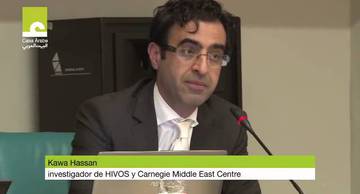
Unity, federalism, caliphate or partition? Several international experts analyzed each of these options. The event included interventions by Hayder el-Khoei, a researcher at Chatham House; Kawa Hassan, a researcher at HIVOS and the Carnegie Middle East Centre, and Mohammad Ali Shabani, a researcher at Cambridge University. It was moderated by Karim Hauser, who is responsible for Casa Árabe’s Governance Area. It was part of the international seminar "Iraq at a crossroads", organized by Casa Árabe, Friedrich Ebert Stiftung and FRIDE.Published at 01 11,,, 14 2014 -
Arabic culture in the Spanish language
Video of the conference held on September 25, 2014 at the Casa Árabe headquarters in Madrid on the occasion of the presentation of the Sheikh Zayed International Book Awards. The event included the participation of Dr. Ali Bin Tamim, Secretary General of the Sheikh Zayed International Book Award; Saeed Madan, Director of the Sheikh Zayed International Book Award; Professor Pedro Martínez Montávez, and Eduardo López Busquets, the General Director of Casa Árabe. This year, the Sheikh Zayed International Book Awards include the category of “Spanish” for the first time ever, within the section of “Arab Culture in Other Languages.” When the conference and presentation came to an end, an “Eastern Flamenco” Arab oud and guitar concert was held, with a performance that explored the common roots shared by flamenco and Arab music. In terms of its melodics, both of these types of music share the same basic scale, which is known as the “Phrygian dominant scale” (the Kurdish hijaz), which evokes the magic of the Middle East and its influence on flamenco music. At the same time, in terms of rhythm, one can find common beats and variations between them, including the rumba and baladi, or the fandango and chaabi music (typical of North Africa). David Durán Gil, a guitarist, and Hames Bitar, who plays the Arab oud, undertook a dialogue based on “Taqsim” (improvisation), in which each musician demonstrated his talent by playing freely with different scales and styles, producing a magical atmosphere that mixed two cultures.Published at 17 26,,, 14 2014 -
The Cordoba Forum
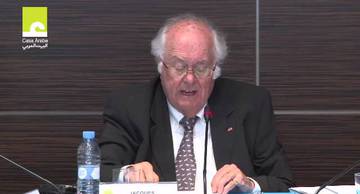
Presentation of “The Cordoba Forum”, held on October 27, 2014 at the Casa Árabe headquarters in Madrid, given by Jacques Moreillon, Vice-President of Foreign Affairs for the Paradigma Córdoba Foundation.The Cordoba Forum is a concept proposed by the Paradigma Córdoba Foundation and by the authorities of the city of Cordoba. It is based on the nexus which universal awareness creates between Cordoba and a time of tolerance in Al-Andalus amongst the three great monotheistic religions.The goal of the Forum is to bring together approximately one hundred international institutions year after year in Cordoba, each from its own specialized field, so as to contribute to the co-existence of ideals, efforts and means. This repetition of meetings, topics and intermediaries all in the same location should bear its fruits in the form of a “Cordoba spirit,” a network of goodwill and a universal dynamic for promoting co-existence.Published at 12 26,,, 14 2014 -
Jerusalem within the framework of World War I
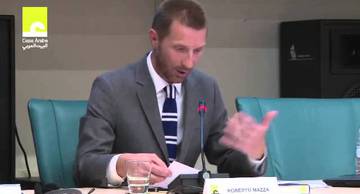
This conference by Roberto Mazza focused on "The Diaries of the Count of Ballobar". It took place the 22nd of October 2014. Roberto Mazza, a History professor at Western Illinois University and a Middle East scholar who specializes in the period lasting from the Ottoman Empire to the British Mandate, focused his conference on the figure of Antonio de la Cierva, the Count of Ballobar.Published at 41 26,,, 14 2014 -
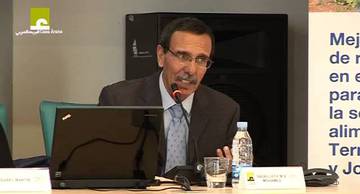
La escasez de agua en Palestina y Jordania / The Water Shortage in Palestine and Jordan
Conferencia celebrada el 8 de abril de 2013 en la sede de Casa Árabe en Madrid bajo el título "Afrontar la escasez de agua en los Territorios Palestinos y Jordania: el uso de las fuentes de agua no convencionales en la agricultura". El acto contó con la participación de Abdellatif M.A Mohamed, vicedirector de la Palestinian Agricultural Relief Committees (PARC) en Territorios Palestinos; Basem Shamoun, director de Proyectos de la Jordan Hashemite Fund for Human Development (JOHUD) de Jordania; Isabel Martín, responsable del Área de Calidad del Agua del Centro de las Nuevas Tecnologías del Agua; e Inmaculada Paniagua, jefe de área de Agua y Saneamiento del Departamento de Cooperación Sectorial de la Agencia Española de Cooperación internacional al Desarrollo. Más información: http://www.casaarabe.es/noticias-arabes/show/la-escasez-de-agua-en-palestina-y-jordania On Monday, April 8 in Madrid, a round table discussion was held on the topic of "Facing the Water Shortage in the Palestinian Territories and Jordan: the use of unconventional water sources in agriculture." The Fundación Promoción Social de la Cultura has organized this round table discussion of the problems related with water shortages in the Middle East, and more specifically in Jordan and Palestine. For more information: http://en.casaarabe.es/news/the-water-shortage-in-palestine-and-jordanPublished at 15 15,,, 14 2014