

Le hirak algérien: une étude de cas sur la mobilisation de la contestation au Maghreb
Published at 06 25,,, 21 2021
ALL VIDEOS IN THIS CATEGORY
-

Conference: "Tea with Nefertiti"
Sam Bardaouil and Till Fellrath, the co-founders Art reoriented, a multidisciplinary curatorial platform based in Munich and New York, talk about their critically acclaimed exhibition Tea with Nefertiti, currently on show at IVAM, Valencia after a successful run at Mathaf, Doha and IMA, Paris. Through discussing the curatorial premise and methodology behind the show, they highlight the ways through which an artwork acquires different meanings and agencies when it travels through time and place. Through employing the Nefertiti bust as a metaphorical thread, and by interrogating the contested history of Egyptian Museum collections from the 19th century onwards, Bardaouil and Fellrath explore how an artwork can become a tool for the writing of much-contested narratives that serve as frameworks through which an image of another culture can be imagined and consequently fixed. More info: http://en.casaarabe.es/news/tea-with-nefertiti-the-creation-of-images-of-culture-through-the-artsPublished at 36 12,,, 14 2014 -
Conferencia: "En primera persona", por Afif Safieh [V.O inglés/español]
Ponencia inaugural de la Semana de Palestina en Casa Árabe, a cargo de uno de los diplomáticos palestinos más experimentados. Afif Safieh ha servido en las tres capitales de mayor importancia política: Londres, Washington y Moscú. Musa Amer Odeh, embajador de Palestina en España, y Eduardo López Busquets, director general de Casa Árabe, presentan el acto.Published at 36 12,,, 14 2014 -
Ministerial Debate Forum on the Future of Tourism in the MENA Region
Casa Árabe and the UN World Tourism Organization (UNWTO) organize a Ministerial Debate Forum on The Future of Tourism in the Middle East and North Africa Region (MENA according to its acronym in English) with the cooperation of Casa Mediterráneo, as well as the support of IFEMA and Fitur 2014. The forum brings together the Tourism Ministers of the countries which receive the most tourism in the region and will be devoted to analyzing the future prospects of the tourism industry in the region. The official opening is presided over by the State Secretary of Foreign Affairs, Gonzalo de Benito Secades, the General Director of Casa Árabe, Eduardo López Busquets, and the Secretary General of the UN World Tourism Organization, Taleb Rifai. More: http://en.casaarabe.es/news/ministerial-debate-forum-on-the-future-of-tourism-in-the-mena-region-Published at 36 12,,, 14 2014 -
Conference: "Microfinance in the Arab World", by Tawfiq Nassar
Conference given by Tawfiq Nassar. Since the earliest experiments carried out in the 1970's to provide small loans to people or groups with few economic resources (usually excluded from the traditional financial system), micro-loans have grown exponentially and have now become a sophisticated industry. However, experiences in the Arab region vary greatly from one country to the next. In terms of products, scale and inclusiveness, microfinancing still has a great deal of potential to be developed in this area. More: www.casaarabe.es/noticias-arabes/show/microfinanzas-en-el-mundo-arabePublished at 34 12,,, 14 2014 -
Conference: "New Art Market Scenarios: The Emerging Scene in Saudi Arabia
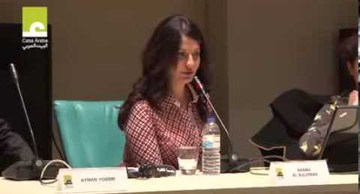
What characterizes the emerging art scene in the Gulf region? What place does Saudi Arabia hold, and more specifically the cities of Riyadh and Jeddah, in its development? In what direction are the artists, collectors and managers who work in the region looking? Taking advantage of the special moment provided by the ARCO International Contemporary Art Fair and the exhibition by Ayman Yossri in Madrid, Casa Árabe and Madrid's Sabrina Amrani Gallery are organizing a round table discussion with role-players who have first-hand knowledge of this cultural reality, which is not commonly experienced within our country's art scene. Visual artist Ayman Yossri converses with collector Basma Al Sulaiman, the founder of Basmoca, Saudi Arabia's first virtual art museum, and with Sara Raza, an art curator and expert on art from Central Asia and the Middle East, with a great deal of experience in the Gulf region. More: en.casaarabe.es/news/new-art-market-scenarios-the-emerging-scene-in-saudi-arabiaPublished at 34 12,,, 14 2014
![Conferencia: "En primera persona", por Afif Safieh [V.O inglés/español]](/images/videoyoutube/2971752/open-uri20210224-22796-stfowl-0-listado?1712907443)