

Exposición "Hassan Fathy: a contracorriente"
Published at 54 16,,, 21 2021
ALL VIDEOS IN THIS CATEGORY
-

Chant Avedissian: Redressing Identity (ENGLISH)
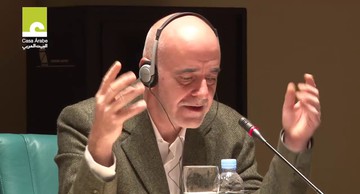
2017.18.10. Conference given by Nigel Ryan, art critic and cultural editor at the Al-Ahram Weekly newspaperfor for nearly two decades and Sabrina Amrani, a gallery owner, on the occasion of the opening of the exhibition "Chant Avedissian. A Levantine Heading East”. Born in Cairo (1951), Aveidssian is one of the Egyptian artists to have best kept identity and popular traditions, but from a modern perspective. A tireless traveler who has gone from Egypt to Uzbekistan, his observations on decorative and architectural pieces are reflected in his work, made using various techniques: stencil, textile, photography, gouache on cardboard, etc. Art critic Nigel Ryan spoke about this artist's work within the context of art in Egypt during the twentieth century, a period that can be viewed as an attempt to construct a coherent national style. Political engagement and notions of authenticity were central to this endeavour which continues to cast a shadow over contemporary production. In “Redressing Identity”, Nigel Ryan argues that Chant Avedissian’s artistic practice and work constitute a radical critique of a process that resulted in the promotion of exclusion and the straitjacketing of art rather than any expansion of horizons. Nigel Ryan has lived in Egypt since 1989. For 18 years he was the cultural editor and art critic of the Cairo-based newspaper Al-Ahram Weekly. He has written extensively on contemporary Egyptian art and the wider cultural scene, chronicling – among other things – the emergence of independent art spaces in the decade preceding the Arab Spring. His work has appeared in many publications, including Grand Street, New York; Journal of Comparative Criticism, Cambridge University Press, and Alif: Journal of Comparative Poetics, American University in Cairo Press. More info: http://en.casaarabe.es/event/chant-avedissian-redressing-identityPublished at 37 26,,, 17 2017 -
Exposición "Un impulso extraño" / Exhibition "An Uncanny Impulse" (ENG)
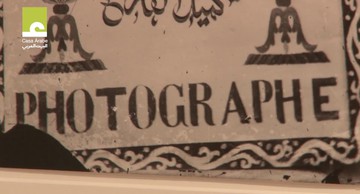
(English version below) Casa Árabe expone desde el 1 de junio de 2017 una selección de la colección de Mohsen Yammine de la Fundación Árabe para la Imagen de Beirut, en el marco de PhotoEspaña. Desafiando el poder destructivo del tiempo, el acto de coleccionar ha sido considerado a través de la historia como un acto de salvación que trata de alojar, de apropiarse y de difundir un cierto conocimiento a través del objeto atesorado. La muestra “Un Impulso Extraño. Colección Mohsen Yammine en la Fundación Árabe para la Imagen de Beirut” explora este acto de coleccionar a través de los ojos de Mohsen Yammine, un hombre libanés que durante años recopiló fotografías de Trípoli y el norte del Líbano llegando a formar un fondo único. Esta colección ha sido un elemento central en la búsqueda de la Fundación Árabe para la Imagen para entender la fotografía como un objeto superviviente sin atender únicamente a cuestiones como el culto al pasado, los orígenes, la identidad o la memoria, sino más bien, como material para el intercambio y de cara al futuro. La exposición, comisariada por Clémence Cottard y Marc Mouarkech y organizada por Casa Árabe con motivo de su décimo aniversario, pretende también subrayar el papel clave de la Fundación Árabe para la Imagen en sus veinte años de existencia, como un punto de encuentro entre las prácticas de archivo y las prácticas fotográficas contemporáneas. Más información: http://www.casaarabe.es/eventos-arabes/show/exposicion-un-impulso-extrano In the context of PhotoEspaña 2017, Casa Árabe shows a selection of the Mohsen Yammine Collection at the Arab Image Foundation of Beirut. Defying the destructiveness of time, the act of collecting has been considered through history as an act of salvation that strives to accommodate, appropriate and spread a certain knowledge through the collected object. The exhibition “An Uncanny Impulse” by the Arab Image Foundation (AIF) in Beirut aims to explore the act of collecting through the eyes of Mohsen Yammine, a Lebanese man who found himself compiling through the years a large collection of photographs from Tripoli and northern Lebanon. This collection made it very central for the Arab Image Foundation’s quest to understand the photograph as a surviving object without only favouring the cult of the past, the origins, the identity and the memory but rather use it as material for exchange, for the future. Curators: Clémence Cottard and Marc Mouarkech. The exhibition, organized by Casa Arabe to mark its 10th anniversary, aims also to underline the key role played by the Arab Image Foundation during its 20 years of existence, as a crossover between archival practices and contemporary photographic practices. http://en.casaarabe.es/event/an-uncanny-impulsePublished at 10 10,,, 17 2017 -
Performance de musicaligrafía en el marco del Brief Festival (versión corta)
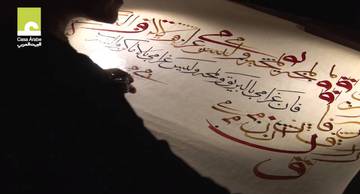
Con motivo de la inauguración del Brief Festival, Nuria García Masip y Bahman Panahi ofrecieron, el 1 de octubre de 2015, este espectáculo en Casa Árabe en Madrid. La musicaligrafía es el termino creado por Bahman Panahi para denominar la conjunción de música y caligrafía en una representación conjunta. Esta representación propone una alianza entre el mundo sonoro y la realización en tiempo real de una caligrafía en gran formato frente al público. En esta representación Bahman Panahi acompañará con el tar iraní (instrumento de cuerda tradicional) a Nuria García Masip, mientras realizan una obra de caligrafía conjunta. Más información: http://www.casaarabe.es/eventos-arabes/show/casa-arabe-colabora-con-el-brief-festivalPublished at 03 22,,, 15 2015 -
Sand in My Eyes (ENG)
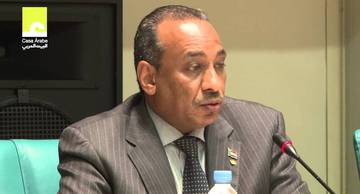
Casa Árabe and the Embassy of the Republic of Sudan in Madrid have organized this exhibition on the cultural and ethnographic wealth of the Sudanese people portrayed through a selection of photographs and texts by author Enikö Nagy. The opening event was held on June 3 at 7:00 p.m. in the Casa Árabe Auditorium, with a few words by the deputy Chief of Mission of the Republic of Sudan in Spain, Aida Abdelmageid Elsheikh, and the General Director of Casa Árabe, Eduardo López Busquets. After this, a short-subject documentary film was shown by the same author, Enikö Nagy. Then those attending moved on to the exhibition hall, where a tour of the exhibition was given. More info: http://en.casaarabe.es/event/sand-in-my-eyesPublished at 48 30,,, 15 2015 -
Sand in My Eyes (ENG)
Exhibition of photographs and texts on Sudan’s oral tradition by Enikö Nagy. Casa Árabe and the Embassy of the Republic of Sudan in Madrid have organized this exhibition on the cultural and ethnographic wealth of the Sudanese people portrayed through a selection of photographs and texts by author Enikö Nagy. The opening event was held on June 3 at 7:00 p.m. in the Casa Árabe Auditorium, with a few words by the deputy Chief of Mission of the Republic of Sudan in Spain, Tarig Abu Saleh, and the General Director of Casa Árabe, Eduardo López Busquets. After this, a short-subject documentary film was shown by the same author, Enikö Nagy. Then those attending moved on to the exhibition hall, where a tour of the exhibition was given.Published at 46 30,,, 15 2015