

Conferences and debates
Index / Activities / Conferences and debates / Arab inscriptions in Christian kingdoms: highlighting and reinterpreting the legacy of Al-Andalus
Arab inscriptions in Christian kingdoms: highlighting and reinterpreting the legacy of Al-Andalus
October 07, 20257:00 p.m.
MADRID
Casa Árabe Auditorium (at Calle Alcalá, 62).
7:00 p.m.
Free entry until the event’s capacity is reached.
In Spanish.
Taking place in Madrid on Tuesday, January 31 will be the sixth conference in the Aula Árabe Universitaria 7 event series, given by Julie Marquer, a professor at the Université Lumière Lyon 2. Come listen to it or watch the live broadcast on YouTube.
The reuse of Arabic inscriptions on objects and monuments in the medieval Spanish kingdoms began in the eleventh century and developed in accordance with Christian territorial advances into Al-Andalus in the second half of the thirteenth century. In the fourteenth century, the integration of Arabic epigraphy into the art of the kingdoms of Castile and Aragon reached its peak, before declining at the end of the fifteenth century.
This reuse can be explained by the fascination aroused by Arabic script, but also by the Christians’ desire to appropriate the cultural references of others in order to show a certain continuity and thus establish their power and legitimacy. The reappropriation of Arabic epigraphy within a context other than Al-Andalus is necessarily accompanied by selections, adaptations and reinterpretations highlighted throughout the research performed in the Script-ARC project.
The long-term goal of the Script-ARC project (Corpus Numérique des Inscriptions Arabes des Royaumes Chrétiens de la péninsule Ibérique - Digital Corpus of Arabic Inscriptions from the Christian Kingdoms of the Iberian Peninsula) is to compile the Arabic inscriptions produced in the Christian kingdoms on the Iberian Peninsula in a comprehensive corpus. Through the use of digital tools, this will highlight their formal, stylistic and symbolic specificities, as well as the changes they underwent from the eleventh to late fifteenth centuries. The corpus will be published in TITULUS, a digital medieval epigraphy project created by the Centre d’Études Supérieures de Civilisation Médiévale de Poitiers (CESCM), with all data in open access, benefiting from the utmost visibility and accessibility.
This conference by Julie Marquer, a professor at the Université Lumière Lyon 2, whose research focuses on the history, archeology and literature of the Christian and Muslim worlds, will be explaining the project, with a specific focus on the monumental inscriptions in Toledo.
Organized with the cooperation of the Master’s degree in Advanced Spanish Art Studies at the Universidad Complutense de Madrid, she will be participating and introducing the speaker Verónica Carla Abenza, a researching professor who works with the Department of Art History at the Universidad Complutense de Madrid. The event will be moderated by Olivia Orozco, Casa Árabe’s Training and Economics Coordinator.
Julie Marquer
Julie Marquer is a professor of Medieval Spanish Language, Literature and Civilization at the Université Lumière Lyon 2. Her research focuses on the use of Islamic artistic heritage by Christians on the Iberian Peninsula and, in particular, on the use of the Arabic language in inscriptions throughout Castile. Her doctoral thesis (Paris Sorbonne University, 2014) dealt with the relations between King Pedro I of Castile and Islam. Since then, she has been interested in the reuse of the Islamic legacy in the Iberian Peninsula’s Christian kingdoms and, more specifically, in the monumental Arabic epigraphy of Castile. She has had several articles published on this topic, in both collective books and journals, including .Al-Qantara, e-Spania and Histories, and she is working on a collaborative project to create a digital corpus of all Iberian Peninsular Arabic inscriptions outside the context of Al-Andalus. She has taken part in various international projects, including: Islamic Legacy Narratives East, West, South, North of the Mediterranean (1350-1750); IS-LE COST Action CA18129 (2019-2023); the project Al-ACMES Al-Andalus, art, science and contexts in an open Mediterranean; From the West to Egypt and Syria, (R+D+i: RTI2018-093880), Universidad Complutense de Madrid, Casa de Velázquez (2019-2022), and the project CallFront Calligraphies in Arabic characters in the border areas of the Islamic world (ANR-22-CE54-0015).
The most notable of her recent publications include “Arabic inscriptions on Iberian Christian buildings (eleventh-thirteenth centuries): a sign of conquest and continuity,” in The Visual Culture of al-Andalus in the Christian kingdoms of Iberia (ninth to thirteenth centuries), Inés Monteira Arias (ed.) (Routledge, 2025) and, in Spanish: “Jesus and Mary between Islam and Christianity in the Arabic inscriptions of the House of the Count of Toledo,” Al-Qantara (2022, 43 (1)), “Islam and political propaganda in the architecture of Peter I of Castile (1350–1369), in Mediterráneos: an interdisciplinary approach to the cultures of the Mediterranean Sea, coordinated by Sergio Carro Martín et al., (Cambridge Scholars Publishing, 2013).
This reuse can be explained by the fascination aroused by Arabic script, but also by the Christians’ desire to appropriate the cultural references of others in order to show a certain continuity and thus establish their power and legitimacy. The reappropriation of Arabic epigraphy within a context other than Al-Andalus is necessarily accompanied by selections, adaptations and reinterpretations highlighted throughout the research performed in the Script-ARC project.
The long-term goal of the Script-ARC project (Corpus Numérique des Inscriptions Arabes des Royaumes Chrétiens de la péninsule Ibérique - Digital Corpus of Arabic Inscriptions from the Christian Kingdoms of the Iberian Peninsula) is to compile the Arabic inscriptions produced in the Christian kingdoms on the Iberian Peninsula in a comprehensive corpus. Through the use of digital tools, this will highlight their formal, stylistic and symbolic specificities, as well as the changes they underwent from the eleventh to late fifteenth centuries. The corpus will be published in TITULUS, a digital medieval epigraphy project created by the Centre d’Études Supérieures de Civilisation Médiévale de Poitiers (CESCM), with all data in open access, benefiting from the utmost visibility and accessibility.
This conference by Julie Marquer, a professor at the Université Lumière Lyon 2, whose research focuses on the history, archeology and literature of the Christian and Muslim worlds, will be explaining the project, with a specific focus on the monumental inscriptions in Toledo.
Organized with the cooperation of the Master’s degree in Advanced Spanish Art Studies at the Universidad Complutense de Madrid, she will be participating and introducing the speaker Verónica Carla Abenza, a researching professor who works with the Department of Art History at the Universidad Complutense de Madrid. The event will be moderated by Olivia Orozco, Casa Árabe’s Training and Economics Coordinator.
Julie Marquer
Julie Marquer is a professor of Medieval Spanish Language, Literature and Civilization at the Université Lumière Lyon 2. Her research focuses on the use of Islamic artistic heritage by Christians on the Iberian Peninsula and, in particular, on the use of the Arabic language in inscriptions throughout Castile. Her doctoral thesis (Paris Sorbonne University, 2014) dealt with the relations between King Pedro I of Castile and Islam. Since then, she has been interested in the reuse of the Islamic legacy in the Iberian Peninsula’s Christian kingdoms and, more specifically, in the monumental Arabic epigraphy of Castile. She has had several articles published on this topic, in both collective books and journals, including .Al-Qantara, e-Spania and Histories, and she is working on a collaborative project to create a digital corpus of all Iberian Peninsular Arabic inscriptions outside the context of Al-Andalus. She has taken part in various international projects, including: Islamic Legacy Narratives East, West, South, North of the Mediterranean (1350-1750); IS-LE COST Action CA18129 (2019-2023); the project Al-ACMES Al-Andalus, art, science and contexts in an open Mediterranean; From the West to Egypt and Syria, (R+D+i: RTI2018-093880), Universidad Complutense de Madrid, Casa de Velázquez (2019-2022), and the project CallFront Calligraphies in Arabic characters in the border areas of the Islamic world (ANR-22-CE54-0015).
The most notable of her recent publications include “Arabic inscriptions on Iberian Christian buildings (eleventh-thirteenth centuries): a sign of conquest and continuity,” in The Visual Culture of al-Andalus in the Christian kingdoms of Iberia (ninth to thirteenth centuries), Inés Monteira Arias (ed.) (Routledge, 2025) and, in Spanish: “Jesus and Mary between Islam and Christianity in the Arabic inscriptions of the House of the Count of Toledo,” Al-Qantara (2022, 43 (1)), “Islam and political propaganda in the architecture of Peter I of Castile (1350–1369), in Mediterráneos: an interdisciplinary approach to the cultures of the Mediterranean Sea, coordinated by Sergio Carro Martín et al., (Cambridge Scholars Publishing, 2013).
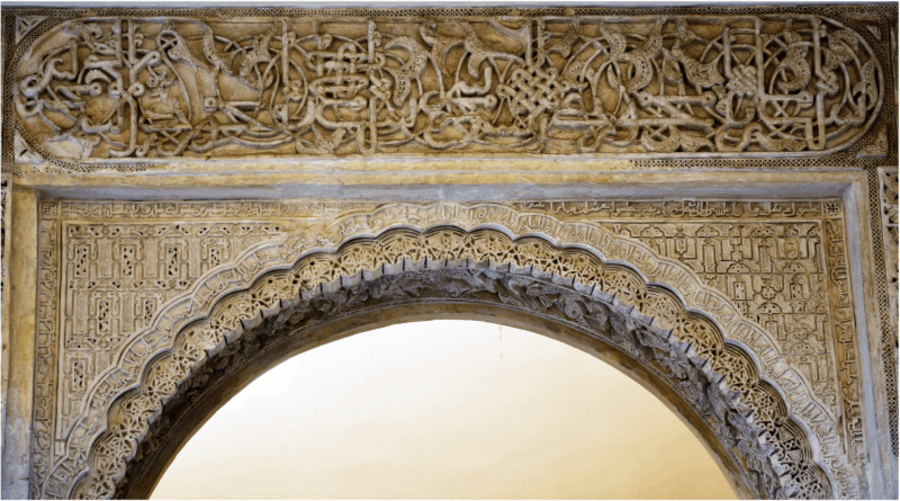
Photo: Casa del Conde, Toledo (Julie Marquer)