

Conferences and debates
Index / Activities / Conferences and debates / Between Europe and the Maghreb: John Leo Africanus and the geography of the Renaissance Mediterranean
Between Europe and the Maghreb: John Leo Africanus and the geography of the Renaissance Mediterranean
April 23, 20267:00 p.m.
CORDOBA
Casa Árabe Auditorium (at Calle Alcalá, 62).
7:00 p.m.
Free entry until the event’s capacity is reached.
In Spanish.
The series devoted to Amazigh Spaces will be continuing on Thursday, April 23, with this conference by Pedro Buendía, in which he plans to speak to us about Al Hasan ibn Muhammad al-Wazzān, also known as “John Leo Africanus.” Come listen to him and discover this figure from the era of Al-Andalus.
Al-Hasan ibn Muhammad al-Wazzān, known in Europe as John Leo Africanus, embodies the complex dynamics and tensions of the Mediterranean in the early sixteenth century like few others. Originally from Al-Andalus, he was born in Granada and later educated in Fez, then traveling extensively across the African continent in his youth. Captured by Christian corsairs and handed over to Pope Leo X, who baptized him and gave him his own name, he brought his knowledge in the Arabic language to the heart of Renaissance Rome, placing it at the service of humanistic circles while acting as a privileged liaison between Islamic intellectual traditions and the European cultural landscape. With first-hand knowledge about the Maghreb, the Sahara and Black Africa—including Timbuktu and various inland political entities—he provided Renaissance Europe with a relatively accurate yet nuanced view of regions that had been virtually unknown up to that time. His most important work, the Descrittione dell’Africa (1526, printed in 1550), was the first major geographical and ethnographic description of the African continent written for a European audience. Divided into several books, it discusses cities, kingdoms, landscapes, customs, traditions, economic structures and trade routes, becoming an essential work of reference on African geography and the Maghreb well into the nineteenth century.
This scientific outreach activity has resulted from the coordinated research project MAGNA II: “Transits and transformations in Maghreb space and population” (TRAMAGHIS. PID2021-122872NB-C21 and DIANA. PID2021-122872NB-C22), funded by MICIN/AEI/10.13039/501100011033 and ERDF. A Way to Make Europe:
Pedro Buendía earned his PhD in Arabic Philology from the Universidad Autónoma de Madrid and is a professor of Arabic and Islamic Studies at the Universidad Complutense de Madrid, where he is currently editor of the journal Anaquel de Estudios Árabes. He has been a professor at the Universities of Cairo and Salamanca, as well as El Colegio de México and the Universidad Nacional Tres de Febrero in Argentina. Specializing in medieval Arabic literature, he has authored numerous publications on history, literature and symbolism in pre-modern Arab societies, as well as completing translations of notable classical Arab works. He was recently given a distinction in the form of the Sheikh Hamad Award for Translation and International Understanding (Doha, Qatar, 2023) for his translation of al-Jahiz’s Book of the Quadrature of the Circle (published in Spanish as “Libro de la Cuadratura del Círculo,” Madrid, Alianza, 2021).
This scientific outreach activity has resulted from the coordinated research project MAGNA II: “Transits and transformations in Maghreb space and population” (TRAMAGHIS. PID2021-122872NB-C21 and DIANA. PID2021-122872NB-C22), funded by MICIN/AEI/10.13039/501100011033 and ERDF. A Way to Make Europe:
Pedro Buendía earned his PhD in Arabic Philology from the Universidad Autónoma de Madrid and is a professor of Arabic and Islamic Studies at the Universidad Complutense de Madrid, where he is currently editor of the journal Anaquel de Estudios Árabes. He has been a professor at the Universities of Cairo and Salamanca, as well as El Colegio de México and the Universidad Nacional Tres de Febrero in Argentina. Specializing in medieval Arabic literature, he has authored numerous publications on history, literature and symbolism in pre-modern Arab societies, as well as completing translations of notable classical Arab works. He was recently given a distinction in the form of the Sheikh Hamad Award for Translation and International Understanding (Doha, Qatar, 2023) for his translation of al-Jahiz’s Book of the Quadrature of the Circle (published in Spanish as “Libro de la Cuadratura del Círculo,” Madrid, Alianza, 2021).
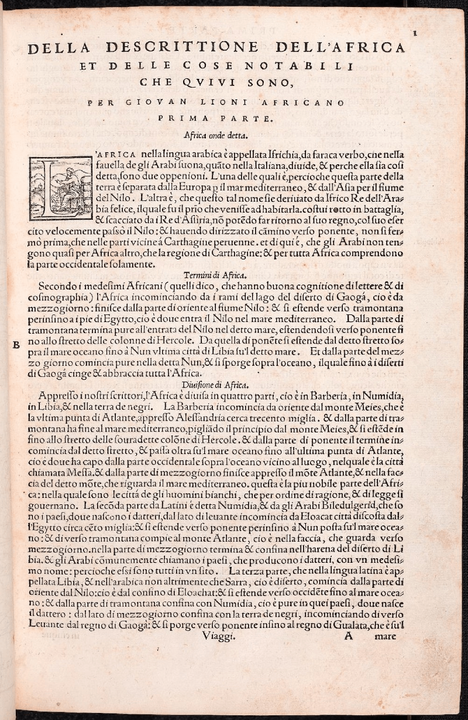
Descrittione dell’Africa (1526-1550).