

Conferences and debates
Index / Activities / Conferences and debates / Exchanges between Islamic Sicily and the Islamic world (ninth–eleventh centuries)
Exchanges between Islamic Sicily and the Islamic world (ninth–eleventh centuries)
April 14, 20267:00 p.m.
MADRID
Casa Árabe Auditorium (at Calle Alcalá, 62).
7:00 p.m.
Free entry until the event’s capacity is reached.
In French, with simultaneous voice translation into Spanish
For the date of Tuesday, April 14, we have organized the thirteenth conference in the event series Aula Árabe Universitaria 7, to be given by Annliese Nef, a professor of Medieval History at the Sorbonne (Université Paris 1). Come watch it in person or see it live on YouTube (in Spanish and French).
This conference by Prof. Annliese Nef will analyze the close connection which Sicily maintained with the rest of the Islamic world during the ninth to eleventh centuries, through both political and military institutions, as well as academic, technical, economic and agricultural exchanges amongst them all.
To give us a better idea of this place and time, Nef will be examining the changes that have taken place in the region since the ninth century in terms of the interpretation of the general history of Sicily and its integration into the Islamic world.
Up to the last third of the twentieth century, the Islamic history of Sicily (827–1060) was viewed primarily from a regional perspective, in relation with the general history of Sicily rather than with the history of the Islamic world in its entirety. Starting in the 1980s, and especially in the 2000s, an effort was made to better integrate the island’s history into the broader history of the Islamic world. This has led to a clearer distinction between the Islamic and Norman periods within the island’s history, which were previously blurred under the term “Arab-Norman.”
Across the past three decades, research has highlighted Sicily’s position along the borders between the Byzantine Empire and the Islamic (Abbasid) Empire up to the year of 910, prior to its inclusion in the Fatimid Empire. This conference will demonstrate how closely Sicily was connected with the rest of the Islamic world.
Annliese Nef’s discussion will allow us to rethink Sicily’s role as a central hub in the political, economic and cultural dynamics of the Mediterranean. Through her approach, the island can be viewed as a territory where contact and articulation took place between these different worlds.
Organized with the cooperation of the bachelor’s degree program in History, the Master’s degree on The Medieval Iberian World: Hispania, Al-Andalus and Sefarad, the bachelor’s degree program in Archeology and the Master’s degree program in Archeology and Heritage at the Universidad Autónoma de Madrid. Presenting the speaker and session in representation of the aforementioned bachelor’s and Master’s degree programs in Archeology will be María Teresa Casal García, a professor of Archeology from that university, with an initial commentary and reaction to the conference by Alejandro Peláez Martín, a professor of Medieval History at the UAM, as well, in representation of the bachelor’s and Master’s degree programs in History. Moderating the session will be Olivia Orozco de la Torre, Casa Árabe’s Training and Economics Coordinator.
Annliese Nef
Annliese Nef Annliese Nef is a professor and department chair of Medieval History at the University of Paris 1 - Panthéon-Sorbonne. In the past, she was also a professor of Medieval History at the University of Paris IV (2008) and a member of the French School of Rome (1999–2002) at the University of Paris-Sorbonne.
Specializing in the Islamic Mediterranean, her research has focused on the Islamic and Norman history of Sicily (ninth–thirteenth centuries), interactions between Byzantium, the Islamic Empire and the Latin West, the history of the central Mediterranean, the Islamization of the Muslim West, and the history of Orientalism. She has been a member of various scientific and editorial committees. For instance, from 2016 through 2022, she was a member of the scientific committee (advisory panel) for the ERC SICTRANSIT project, “The Archeology of Regime Change: Sicily in Transition,” co-directed by Martin Carver (University of York) and Alessandra Molinari (University of Rome Tor Vergata).
She authored the book Conquérir et gouverner la Sicile islamique aux XIe et XIIe siècles (Conquering and Governing Islamic Sicily in the Eleventh and Twelfth Centuries, École Française de Rome, 2011), in which she analyzed how the conquest of Sicily and its administration under Islamic rule, focusing on power and governance structures. And Révolutions islamiques. Émergences de l’Islam en Méditerranée (VIIe-Xe siècle) (Islamic Revolutions: Islam’s emergences in the Mediterranean [seventh to tenth centuries], École Française de Rome, 2021), which studies the expansion and consolidation of Islam in the Mediterranean from the seventh to tenth centuries, as part of a process of political and social transformation. Among other publications, she co-edited with Marie Bossaert Use and Misuse of Medieval History: Mediterranean Europe’s Islam Past and Orientalism during the nineteenth Century (soon to be published), in which she examines how the medieval Islamic past was interpreted and utilized in nineteenth-century Mediterranean Europe, above all from Orientalist perspectives.
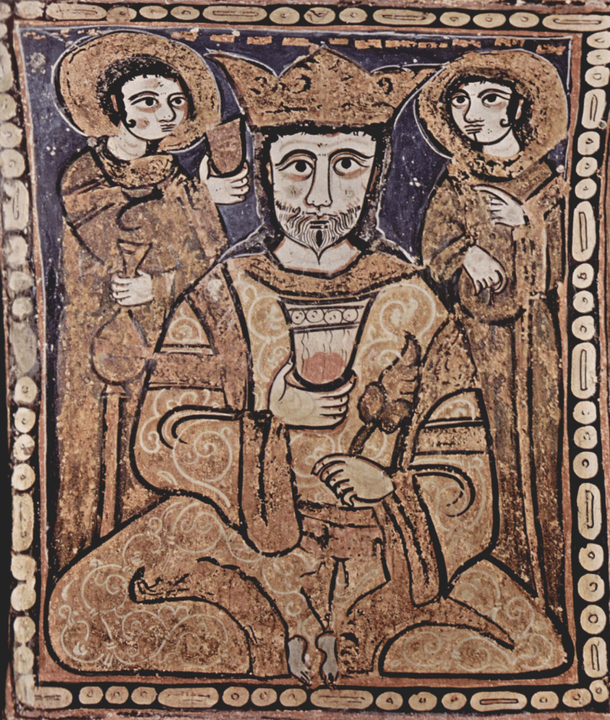
Image: Ruggero II, Palatine Chapel of Palermo, painting on the ceiling of the central nave, scene: ruler drinking in the company of pages or female slaves (circa 1150). The Yorck Project (2002).
To give us a better idea of this place and time, Nef will be examining the changes that have taken place in the region since the ninth century in terms of the interpretation of the general history of Sicily and its integration into the Islamic world.
Up to the last third of the twentieth century, the Islamic history of Sicily (827–1060) was viewed primarily from a regional perspective, in relation with the general history of Sicily rather than with the history of the Islamic world in its entirety. Starting in the 1980s, and especially in the 2000s, an effort was made to better integrate the island’s history into the broader history of the Islamic world. This has led to a clearer distinction between the Islamic and Norman periods within the island’s history, which were previously blurred under the term “Arab-Norman.”
Across the past three decades, research has highlighted Sicily’s position along the borders between the Byzantine Empire and the Islamic (Abbasid) Empire up to the year of 910, prior to its inclusion in the Fatimid Empire. This conference will demonstrate how closely Sicily was connected with the rest of the Islamic world.
Annliese Nef’s discussion will allow us to rethink Sicily’s role as a central hub in the political, economic and cultural dynamics of the Mediterranean. Through her approach, the island can be viewed as a territory where contact and articulation took place between these different worlds.
Organized with the cooperation of the bachelor’s degree program in History, the Master’s degree on The Medieval Iberian World: Hispania, Al-Andalus and Sefarad, the bachelor’s degree program in Archeology and the Master’s degree program in Archeology and Heritage at the Universidad Autónoma de Madrid. Presenting the speaker and session in representation of the aforementioned bachelor’s and Master’s degree programs in Archeology will be María Teresa Casal García, a professor of Archeology from that university, with an initial commentary and reaction to the conference by Alejandro Peláez Martín, a professor of Medieval History at the UAM, as well, in representation of the bachelor’s and Master’s degree programs in History. Moderating the session will be Olivia Orozco de la Torre, Casa Árabe’s Training and Economics Coordinator.
Annliese Nef
Annliese Nef Annliese Nef is a professor and department chair of Medieval History at the University of Paris 1 - Panthéon-Sorbonne. In the past, she was also a professor of Medieval History at the University of Paris IV (2008) and a member of the French School of Rome (1999–2002) at the University of Paris-Sorbonne.
Specializing in the Islamic Mediterranean, her research has focused on the Islamic and Norman history of Sicily (ninth–thirteenth centuries), interactions between Byzantium, the Islamic Empire and the Latin West, the history of the central Mediterranean, the Islamization of the Muslim West, and the history of Orientalism. She has been a member of various scientific and editorial committees. For instance, from 2016 through 2022, she was a member of the scientific committee (advisory panel) for the ERC SICTRANSIT project, “The Archeology of Regime Change: Sicily in Transition,” co-directed by Martin Carver (University of York) and Alessandra Molinari (University of Rome Tor Vergata).
She authored the book Conquérir et gouverner la Sicile islamique aux XIe et XIIe siècles (Conquering and Governing Islamic Sicily in the Eleventh and Twelfth Centuries, École Française de Rome, 2011), in which she analyzed how the conquest of Sicily and its administration under Islamic rule, focusing on power and governance structures. And Révolutions islamiques. Émergences de l’Islam en Méditerranée (VIIe-Xe siècle) (Islamic Revolutions: Islam’s emergences in the Mediterranean [seventh to tenth centuries], École Française de Rome, 2021), which studies the expansion and consolidation of Islam in the Mediterranean from the seventh to tenth centuries, as part of a process of political and social transformation. Among other publications, she co-edited with Marie Bossaert Use and Misuse of Medieval History: Mediterranean Europe’s Islam Past and Orientalism during the nineteenth Century (soon to be published), in which she examines how the medieval Islamic past was interpreted and utilized in nineteenth-century Mediterranean Europe, above all from Orientalist perspectives.
Image: Ruggero II, Palatine Chapel of Palermo, painting on the ceiling of the central nave, scene: ruler drinking in the company of pages or female slaves (circa 1150). The Yorck Project (2002).