

Conferences and debates
Index / Activities / Conferences and debates / From Zawiya to Parliament: Amazigh languages amid culture and politics
From Zawiya to Parliament: Amazigh languages amid culture and politics
March 23, 20266:00 p.m.
MADRID
Casa Árabe Auditorium (at Calle Alcalá, 62).
6:00 p.m.
Free entry until the event’s capacity is reached.
In French, with simultaneous translation into Spanish.
On Monday, March 23, the twelfth session in the Aula Árabe Universitaria 7 series will be taking place in Madrid, led by Malika Assam from the University of Aix-Marseille. She will be addressing the politicization of Amazigh activism and the processes of institutionalization of Amazigh languages. Come see her in person or watch the event live on YouTube (in Spanish or French).
Though often considered limited to the oral tradition, Amazigh (Berber) languages have been used in writing to reflect socio-political issues, even after the Islamization of the Maghreb. Drawing on the written works of Berber scholars from the zawiyas, Malika Assam, a professor of Berber Language and Culture at the University of Aix-Marseille, argues that we can better understand how the nineteenth and twentieth centuries—an era of modern state and nation-building—altered the relationship with languages in this formerly plurilingual and multilingual region.
While encounters with otherness sparked a “Berber cultural awakening” and transformed literary practices, the paradigms of colonialism and nationalism renewed these linguistic challenges. Assam will be taking a look at how the political management of languages by states was met with the politicization of Amazigh activism, leading to processes of these languages’ institutionalization which remain uncertain in the twenty-first century.
Organized with the cooperation of the bachelor’s degree in Political Science and Public Administration at the University of Salamanca, the session will be introduced by Ángela Suárez, a professor of Political Science at that university, representing the program. Moderating the session will be Olivia Orozco, Casa Árabe’s Training and Economics Coordinator.
Malika Assam
Assam is a professor of Berber/Amazigh Languages and Cultures at the University of Aix-Marseille and a research fellow at the Institute for Research and Studies on the Arab and Muslim Worlds (Aix-en-Provence, France). With a bachelor’s degree in Ethnology and a Master’s degree in History from the Université Lumière Lyon 2, Assam also holds a Master’s degree in Social and Environmental Sciences from that university and a PhD in History, Societies and Civilizations from the National Institute of Oriental Languages and Civilizations (INALCO) in Paris.
Her research examines the evolution of Amazigh-speaking societies through various subjects of study (local assemblies, tribes, customary law) and their historical transformations since the nineteenth century within the framework of nation-states, identity affirmation, social movements, and new information and communication technologies (NICTs).
Among her most recent publications along these lines are the book Des tribus en Kabylie ? Les At Zemmenzer, de la tribu précoloniale à la reconstruction identitaire berbère (Tribes in Kabylia?: The At Zemmener, from the pre-colonial tribe to the reconstructions of Berber identity, INALCO, 2022) and a chapter titled “Signs and Heroes for Claiming Identity in Kabylia: Contributions of an anthropology of images,” published in Merolla D., Caubet D., Naït Zerrad K., Cassuto P., Berber Studies in the Era of Tamaziɣt Institutionalization: Texts to pay homage to Salem Chaker and Abdellah Bounfour (L’Harmattan, 2021).
While encounters with otherness sparked a “Berber cultural awakening” and transformed literary practices, the paradigms of colonialism and nationalism renewed these linguistic challenges. Assam will be taking a look at how the political management of languages by states was met with the politicization of Amazigh activism, leading to processes of these languages’ institutionalization which remain uncertain in the twenty-first century.
Organized with the cooperation of the bachelor’s degree in Political Science and Public Administration at the University of Salamanca, the session will be introduced by Ángela Suárez, a professor of Political Science at that university, representing the program. Moderating the session will be Olivia Orozco, Casa Árabe’s Training and Economics Coordinator.
Malika Assam
Assam is a professor of Berber/Amazigh Languages and Cultures at the University of Aix-Marseille and a research fellow at the Institute for Research and Studies on the Arab and Muslim Worlds (Aix-en-Provence, France). With a bachelor’s degree in Ethnology and a Master’s degree in History from the Université Lumière Lyon 2, Assam also holds a Master’s degree in Social and Environmental Sciences from that university and a PhD in History, Societies and Civilizations from the National Institute of Oriental Languages and Civilizations (INALCO) in Paris.
Her research examines the evolution of Amazigh-speaking societies through various subjects of study (local assemblies, tribes, customary law) and their historical transformations since the nineteenth century within the framework of nation-states, identity affirmation, social movements, and new information and communication technologies (NICTs).
Among her most recent publications along these lines are the book Des tribus en Kabylie ? Les At Zemmenzer, de la tribu précoloniale à la reconstruction identitaire berbère (Tribes in Kabylia?: The At Zemmener, from the pre-colonial tribe to the reconstructions of Berber identity, INALCO, 2022) and a chapter titled “Signs and Heroes for Claiming Identity in Kabylia: Contributions of an anthropology of images,” published in Merolla D., Caubet D., Naït Zerrad K., Cassuto P., Berber Studies in the Era of Tamaziɣt Institutionalization: Texts to pay homage to Salem Chaker and Abdellah Bounfour (L’Harmattan, 2021).
Related content
Anterior
Siguiente
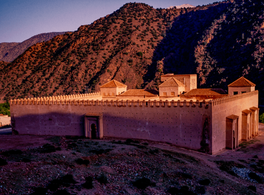
Conference series: Amazigh Spaces: ⵉⴽⴰⵍⵍⵏ ⵏ ⵉⵎⴰⵣⵉⵖ
From March 5 through July 2, we will be hosting this series of
conferences in Cordoba, making it possible to learn more about the
Maghreb region and the history and culture of the Berber/Amazigh
peoples. Check out the full schedule below.
From March 5, 2026 until July 2, 2026
CORDOBA