

Conferences and debates
Index / Activities / Conferences and debates / In Cordoba’s Shadow: Distribution of the Imaziguen in southern Al-Andalus
In Cordoba’s Shadow: Distribution of the Imaziguen in southern Al-Andalus
March 12, 20267:00 p.m.
CORDOBA
Casa Árabe Auditorium (at Calle Samuel de los Santos Gener, 9).
7:00 p.m.
Free entry until the event’s capacity is reached.
In Spanish.
Prof. Virgilio Martínez Enamorado, from the University of Málaga, will explain the presence of the Berbers in the southern part of the Iberian Peninsula under the Umayyad emirate and caliphate. The session will be taking place on Thursday, March 12, as part of the third session of the Amazigh Spaces event series.
During this presentation, we will have the opportunity to listen to an analysis of the presence of the Berbers (Imazighen) in the southern lands of Al-Andalus, understood as being the Guadalquivir valley and the westernmost Baetic mountain ranges throughout the Umayyad period, from 711 to the beginning of the Taifa kingdoms in the first third of the eleventh century. Special mention will be made of the territories closest to the city of Cordoba itself (Valle de los Pedroches, Tākurunnā), where chronicles insist upon the predominance of Berber groups.
This scientific outreach activity has resulted from the coordinated research project MAGNA II: “Transits and transformations in Maghreb space and population” (TRAMAGHIS. PID2021-122872NB-C21 and DIANA. PID2021-122872NB-C22), funded by MICIN/AEI/10.13039/501100011033 and ERDF. A Way to Make Europe.
Virgilio Martínez Enamorado
A specialist in history, historiography and archeology, he has performed notable work on settlement, toponymy and epigraphy from different periods in Al-Andalus and the medieval Maghreb. He holds a bachelor’s and doctorate (completed with honors) in Medieval History from the University of Malaga (UMA) and a diploma in Arabic. He is currently working as a tenured professor at the same university’s School of Education Sciences.
He was also a researcher contracted by the CSIC-School of Arabic Studies in Granada for three years (2008-2011), as well as a visiting professor at various universities in a number of countries. He is a member of various academies and institutions: the Academies of Cordoba, Toledo and Andalusia of History, the Institute of Studies on Ceuta, the Duke of Alba of Ávila, etc. He has held the role of scientific curator for exhibitions in Spain and abroad (Morocco, USA, Tunisia, Algeria, Egypt).
He has had countless books, chapters, scientific and informative articles, catalogue cards for exhibition catalogues, etc. published: having authored 40 monographs, he has been the editor of more than twenty books and is responsible for some 500 research papers of various types. In addition to Spain, he has taken part in scientific events held in Portugal, Tunisia, Greece, Mauritania, Algeria, Egypt, Qatar, the United Kingdom, France, Norway, Iran, Senegal, Chile, Bulgaria, Italy, Mexico, Colombia, Armenia and the United States. He has a special connection to Morocco, where he has directed courses and given lectures in various cities and institutions. Under his supervision, five doctoral theses have been defended at various universities, and he is currently supervising another nine.
This scientific outreach activity has resulted from the coordinated research project MAGNA II: “Transits and transformations in Maghreb space and population” (TRAMAGHIS. PID2021-122872NB-C21 and DIANA. PID2021-122872NB-C22), funded by MICIN/AEI/10.13039/501100011033 and ERDF. A Way to Make Europe.
Virgilio Martínez Enamorado
A specialist in history, historiography and archeology, he has performed notable work on settlement, toponymy and epigraphy from different periods in Al-Andalus and the medieval Maghreb. He holds a bachelor’s and doctorate (completed with honors) in Medieval History from the University of Malaga (UMA) and a diploma in Arabic. He is currently working as a tenured professor at the same university’s School of Education Sciences.
He was also a researcher contracted by the CSIC-School of Arabic Studies in Granada for three years (2008-2011), as well as a visiting professor at various universities in a number of countries. He is a member of various academies and institutions: the Academies of Cordoba, Toledo and Andalusia of History, the Institute of Studies on Ceuta, the Duke of Alba of Ávila, etc. He has held the role of scientific curator for exhibitions in Spain and abroad (Morocco, USA, Tunisia, Algeria, Egypt).
He has had countless books, chapters, scientific and informative articles, catalogue cards for exhibition catalogues, etc. published: having authored 40 monographs, he has been the editor of more than twenty books and is responsible for some 500 research papers of various types. In addition to Spain, he has taken part in scientific events held in Portugal, Tunisia, Greece, Mauritania, Algeria, Egypt, Qatar, the United Kingdom, France, Norway, Iran, Senegal, Chile, Bulgaria, Italy, Mexico, Colombia, Armenia and the United States. He has a special connection to Morocco, where he has directed courses and given lectures in various cities and institutions. Under his supervision, five doctoral theses have been defended at various universities, and he is currently supervising another nine.
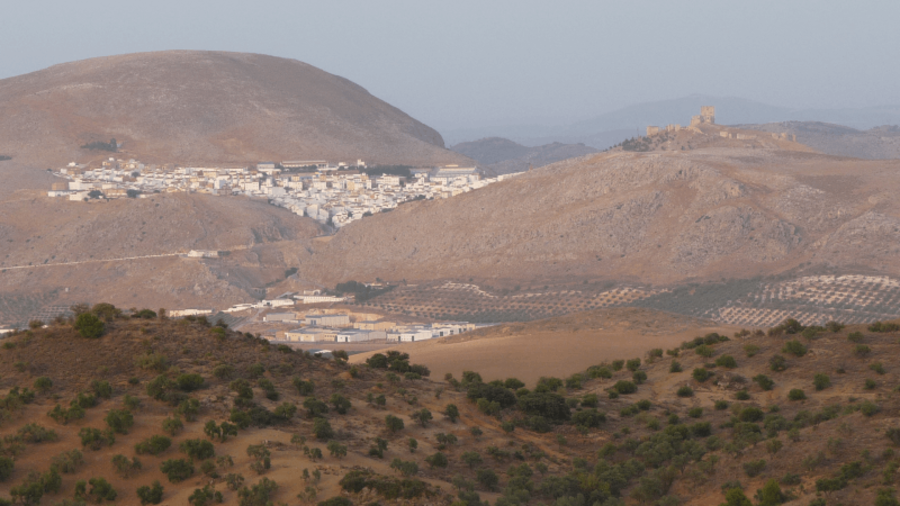
Image: Esteban Lopez García, [PLATE 39] View of the fortress of Teba from Nina Alta, 2022