


Conferences and debates
Index / Activities / Conferences and debates / Islamic law and practice in the pre-modern era
Islamic law and practice in the pre-modern era
February 12, 20267:00 p.m.
MADRID
Casa Árabe Auditorium (at Calle Alcalá, 62).
7:00 p.m.
Free entry until the event’s capacity is reached.
In English with simultaneous live translation.
Prof. Christian Müller (CNRS) will be giving the ninth session in the Aula Árabe Universitaria 7 event series, in which he will be discussing casuistic regulations and the role of legal experts from the eighth to nineteenth centuries. The event will be taking place in Madrid on Thursday, February 12. Come listen to him at our auditorium or watch the event live on YouTube (in Spanish and English).
The conference, given by Christian Müller, a researching professor at the National Center for Scientific Research (CNRS) in Paris, will be analyzing “Islamic Law and How It Is Practiced” as the way key human role-players (such as jurists and judges), Islamic norms (laws) and social performance (court cases) interacted from the eighth to nineteenth centuries.
To do so, Müller examines the system of court rulings and the role of Muslim legal experts (fuqahā’) and the ways in which they were developed and passed down within schools of jurisprudence as social institutions.
He especially focuses on the level of detail in casuistic regulations, which gave authority far beyond religious prescriptions to the decisions made by legal experts in various fields of Law. In particular, court rulings on economic transactions, family life, inheritance, bodily crimes and procedural standards provided a highly sophisticated legal framework which affected people’s daily lives in many ways.
Knowledge about “Islamic Law as a legal system” is based on a variety of abundant sources, including legal manuals, compilations of fatwas, legal documents, bibliographic dictionaries and historical accounts. Drawing on these sources, Professor Müller’s presentation will address two historical transformations: firstly, the emancipation of the schools of jurisprudence from the early caliphs’ legislative power through an authoritarian regulatory system that harked back to “Islamic foundations” from the tenth century onwards. The second was the imposition of the sacred nature of legal doctrines as “sharia” from the thirteenth century on.
These phenomena persisted over time in various forms under different political regimes, from Muslim Spain in the West to Central Asia and Southeast Asia in the East. This will allow us to consider the practice of Islamic law as a key phenomenon in pre-modern history.
Organized with the cooperation of the bachelor’s degree in Semitic and Islamic Studies and the Master’s degree in Contemporary Studies on the Arab World and Muslim Communities: Social Mediation and Conflict Resolution given at the Universidad Complutense de Madrid. Representing that program, the speaker and session will be introduced by Daniel Gil Flores, coordinator of the Master’s program and a professor of Arabic and Islamic Studies at the UCM, with an initial commentary on the presentation by Adday Hernández López, a professor of Arabic and Islamic Studies at that university. Moderating the session will be Olivia Orozco de la Torre, Casa Árabe’s Training and Economics Coordinator.
Christian Müller
Christian Müller is the director of research (researching professor) at the Centre National de la Recherche Scientifique (CNRS) in Paris. PhD by Freie Universität Berlin in 1997, since 2004 he has acted as the head of the Arabic section of the Institut de recherche et d’histoire des textes. He received his PhD in Islamic Studies from the Freie Universität Berlin in 1997, and since 2024 he has been directing the European project MCILRaP (Mapping Change in Islamic Law, Rules and Practices).
Dedicated to the study of Islamic law for more than thirty years, his research focuses on the history of Islam and its legal systems in the pre-modern era, with particular attention to literature on fatwas and legal documents. He is particularly interested in the comparative analysis of legal thought texts and the vestiges of judicial practice, in particular notarial documents and records, as well as the doctrinal evolution of legal casuistry within the framework of Islamic legal systems.
Engaging with the study of Islamic law for over 30 years, his publications, mainly in German, English, and French, include monographs on eleventh-century judicial practices in Muslim Spain based on fatwa literature (1999), the documents of the Haram al-Sharīf in fourteenth-century Jerusalem (2013a), and an exploratory survey on the evolution of the Muslim jurists’ law from early Islam until the nineteenth century (2022a). The originality of his approach is a focus on legal practice that combines the study of original documents and juridical literature with sociological approaches of “law.” Through his research, he ventures to establish the study of Islamic normativity (shariatic law) as a historical discipline distinct from religious perspectives.
Illustration showing a qāḍī (judge) and litigants of “Maqāmāt al-Ḥarīrī.” Paris, Bibliothèque Nationale, arabe 3929, fol. 15v. 12th-13th c. CE.
To do so, Müller examines the system of court rulings and the role of Muslim legal experts (fuqahā’) and the ways in which they were developed and passed down within schools of jurisprudence as social institutions.
He especially focuses on the level of detail in casuistic regulations, which gave authority far beyond religious prescriptions to the decisions made by legal experts in various fields of Law. In particular, court rulings on economic transactions, family life, inheritance, bodily crimes and procedural standards provided a highly sophisticated legal framework which affected people’s daily lives in many ways.
Knowledge about “Islamic Law as a legal system” is based on a variety of abundant sources, including legal manuals, compilations of fatwas, legal documents, bibliographic dictionaries and historical accounts. Drawing on these sources, Professor Müller’s presentation will address two historical transformations: firstly, the emancipation of the schools of jurisprudence from the early caliphs’ legislative power through an authoritarian regulatory system that harked back to “Islamic foundations” from the tenth century onwards. The second was the imposition of the sacred nature of legal doctrines as “sharia” from the thirteenth century on.
These phenomena persisted over time in various forms under different political regimes, from Muslim Spain in the West to Central Asia and Southeast Asia in the East. This will allow us to consider the practice of Islamic law as a key phenomenon in pre-modern history.
Organized with the cooperation of the bachelor’s degree in Semitic and Islamic Studies and the Master’s degree in Contemporary Studies on the Arab World and Muslim Communities: Social Mediation and Conflict Resolution given at the Universidad Complutense de Madrid. Representing that program, the speaker and session will be introduced by Daniel Gil Flores, coordinator of the Master’s program and a professor of Arabic and Islamic Studies at the UCM, with an initial commentary on the presentation by Adday Hernández López, a professor of Arabic and Islamic Studies at that university. Moderating the session will be Olivia Orozco de la Torre, Casa Árabe’s Training and Economics Coordinator.
Christian Müller
Christian Müller is the director of research (researching professor) at the Centre National de la Recherche Scientifique (CNRS) in Paris. PhD by Freie Universität Berlin in 1997, since 2004 he has acted as the head of the Arabic section of the Institut de recherche et d’histoire des textes. He received his PhD in Islamic Studies from the Freie Universität Berlin in 1997, and since 2024 he has been directing the European project MCILRaP (Mapping Change in Islamic Law, Rules and Practices).
Dedicated to the study of Islamic law for more than thirty years, his research focuses on the history of Islam and its legal systems in the pre-modern era, with particular attention to literature on fatwas and legal documents. He is particularly interested in the comparative analysis of legal thought texts and the vestiges of judicial practice, in particular notarial documents and records, as well as the doctrinal evolution of legal casuistry within the framework of Islamic legal systems.
Engaging with the study of Islamic law for over 30 years, his publications, mainly in German, English, and French, include monographs on eleventh-century judicial practices in Muslim Spain based on fatwa literature (1999), the documents of the Haram al-Sharīf in fourteenth-century Jerusalem (2013a), and an exploratory survey on the evolution of the Muslim jurists’ law from early Islam until the nineteenth century (2022a). The originality of his approach is a focus on legal practice that combines the study of original documents and juridical literature with sociological approaches of “law.” Through his research, he ventures to establish the study of Islamic normativity (shariatic law) as a historical discipline distinct from religious perspectives.
Illustration showing a qāḍī (judge) and litigants of “Maqāmāt al-Ḥarīrī.” Paris, Bibliothèque Nationale, arabe 3929, fol. 15v. 12th-13th c. CE.
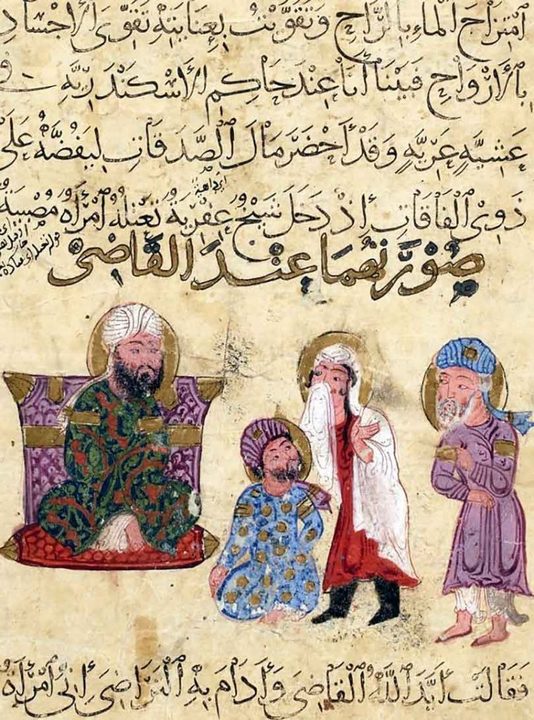
Illustration of a qāḍī (judge) and litigants from “Maqāmāt al-Ḥarīrī”. Paris, Bibliothèque Nationale, arabe 3929, fol. 15v. 12th-13th c. CE..