

Special programs
Index / Activities / Special programs / Our most important events in 2025
Our most important events in 2025
From December 19, 2025 until January 18, 2026
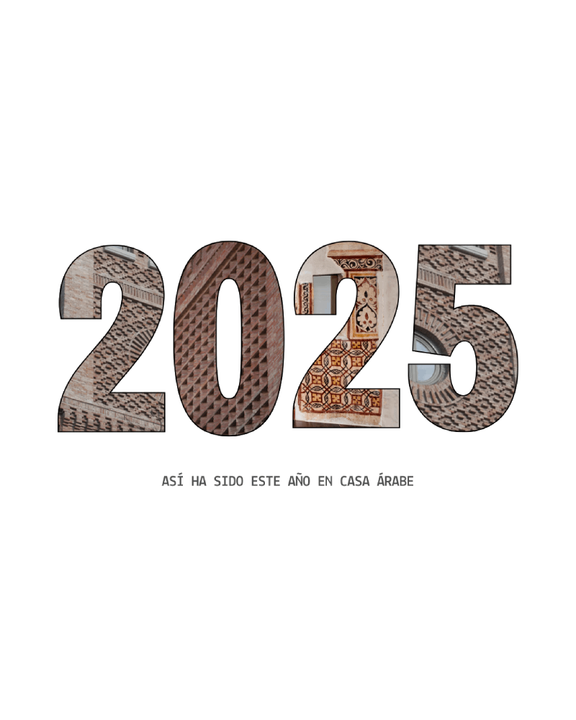
For yet another year, we would like to bid you farewell with a summary about the highlights of all the events and programs that have taken place at Casa Árabe over the last twelve months. Take a look and you will probably remember all the activities you enjoyed the most! We look forward to seeing you in 2026 with exciting new plans.
We started 2025 out with Casa Árabe’s “Friendship” Award Ceremony, and this second edition of the prize was given to Prof. Waleed Saleh Alkhalifa, from the Universidad Autónoma de Madrid, for being one of the great promoters of the Arabic language and culture in Spain. The jury also decided to give an honorary mention of the Prize posthumously to Federico Arbós Ayuso, a translator and professor at the Universidad Complutense de Madrid. Now, the third edition of the Friendship Award has begun, and the deadline for submitting candidacies is January 23. You can read the conditions for taking part in the process here.
Tunisia and Oman have played the starring role in our “Country Focus” over the last twelve months. As regards Tunisia, we welcomed that country’s Minister of Foreign Affairs, Migration and Tunisians Abroad, Mohamed Ali Nafti, who gave a speech about the relations between Tunisia and Spain, as well as holding a meeting with Spanish companies that have interests in his country. Along with the Museum of Modern and Contemporary Art (MACAM Tunis), Tunisia’s Ministry of Cultural Affairs and the Tunisian Embassy in Spain, we organized the exhibition “Tunisian Enlightenments,” which showcased a carefully curated selection of works by Tunisian artists. Music also held a place at our headquarters. The concert and master class by artist Syrine Ben Moussa in Cordoba and the session of electronic music by Azu Tiwaline were two examples of this in Madrid. Similarly, we hosted a show of dance performances by the group Al Badil organized to mark International Museum Day, and some of our film screenings, which included Silences in the Palace, by Moufida Tlatli, Bab ‘Aziz, the Wise Sufi, by Nacer Khemir, with whom we then held a colloquium, as well as Les Enfants Rouges, by Lotfi Achour, all formed part of the African Film Festival of Tarifa-Tangier. Every one of these activities has allowed us to get a closer look at the contemporary Tunisian cultural scene through its main role-players.
Along with Tunisia, Oman was in the spotlight at Casa Árabe during the second half of 2025, on the occasion of the visit by HE Sheikh Khalifa al Harthy, Secretary of State for Political Affairs of that country. Along with the Minister of Culture, Sports and Youth, and with the Bait Al Zubair Foundation, we presented the exhibition “Images of the Land of Oman” in Madrid and Cordoba, featuring photographs of the Gulf country that allowed us to discover its diverse landscapes and expressive architecture. Oman’s First Royal Orchestra of Oriental Music and Folklore gave a concert titled “Musical Bridges: From Oman to the Mediterranean”, whereas with Mahmood Al Abri Secretary General of the Omani National Commission for Education, Culture and Science, and Khalid Al Maamari, an assistant professor at the University of Sohar’s School of Education and Arts, we got the chance to take a closer look at the historical figure Ibn al Dhahabi, an Omani explorer and navigator.
And though it did not form part of a “Country Focus”, Palestine has continued to feature prominently in our schedule of events. We hosted the recognition that the State of Palestine, through its ambassador to Spain, Husni Abdel Wahed, bestowed upon Josep Borrell, by granting the Grand Star of the Order of Jerusalem, in the presence of Spain’s Minister of Foreign Affairs, European Union and Cooperation, José Manuel Albares. In the spring, we presented the exhibition “Palestinian Comics: Individual voices, collective cry,” hosted by Casa Árabe as part of the program “Culture for Peace: Spain-Palestine” organized by the Spanish Ministry of Culture and the Palestinian Embassy in Spain. In Cordoba, we dedicated an entire exhibition to Palestinian cinema, which allowed us to learn about filmmakers and realities in this Mediterranean country over the course of fifteen sessions. Other manifestations of Palestinian culture were given a space, as well, including embroidery (tatreez) and traditional dance (dabke) that have given a closer look at that country’s heritage. The project “Threads of the Diaspora” (2024), was completed with the collective work “Embroidering Dreams of a Palestinian Garden,” developed at our workshops with the help of professor and artist Maysun Cheikh Ali Mediavilla. It was put on display at our headquarters in Madrid and Cordoba. Maysun herself, along with artists Almudena and Begoña Castillejo, created a work that interweaves memory, resistance and the avant-garde, merging elements of Palestinian and Cordovan heritage, in a large-sized installation that was revealed to the public at the same time as the Festival of Patios in Cordoba. The arrival of autumn ushered in a new edition of our embroidery workshops, this time with the help of Palestinian refugee women: Dalia K. Hammad y Avo Zoughbi, with whom we got a closer look at the harsh realities in Gaza and Bethlehem, in addition to learning about embroidery. Added to these events were those involving traditional Palestinian dance: dabke, under the guidance of Francisco Montero Lahsen, in which participants learned the value of this dance as a symbol of resistance, as well as its basic movements and steps.
These were not the only workshops that we organized either. In the fall, we started up “Decorated Cities,” a series of meetings designed to teach families about the Neo-Mudéjar architecture that is so characteristic of our Madrid headquarters, while the children who participated got the chance to develop their motor skills. Also based on crafts have been our ”Workshops with History,” which we organized in Cordoba together with Sexto Mario, allowing us to learn more about the past and cultural practices during the era of Al-Andalus. In that same city, we held a new edition of our art education course which this time around was devoted to Mozarabic Art, guided once again by Prof. Marisa Campillo,
When it comes to our courses, there is no way we could leave out our Arabic Language Center (CLA), which gained great momentum in 2025. Our educational offerings just continued to grow, with our conversation meet-ups known as Dardasha, our intensive courses and the city summer camp we held for children as of the age of 3. Moreover this year the King Salman Global Arabic Language Academy (KSGAAL) in Saudi Arabia chose our center to host its traditional “Arabic Language Month,” which gave our students and teachers the opportunity to take part in several competitions and training sessions. If in 2026 you have the goal of learning Arabic, whether you are in Madrid or anywhere else, our registration period is now open for the courses beginning as of January 9.
Education plays a very important role at Casa Árabe. That is why we continued to organize our Aula Árabe Universitaria event series throughout 2025. During the first half of the year, its sixth edition came to a close, giving way to the seventh in September, with several sessions yet to be held in 2026. New university programs, international speakers and conferences of great interest in Madrid, Cordoba and Granada have allowed us to address issues such as contemporary Arab thought, the UN and the Palestinian question, climate change and environmental struggles in the region, the situation in Sudan, the feminist movement in the Arab Levant, the case of Lebanon as a model of political regulation of cultural diversity, and the practice of photojournalism in countries in conflict such as Palestine and Syria, among others. You can see the complete calendar and check the upcoming sessions here.
Focusing on the era of Al-Andalus, we have hosted conferences as part of our event series “Semblances of Cordoba: the Umayyad era in the first person,” which continued in Cordoba throughout 2025 with sessions dedicated to chroniclers, legal experts, ambassadors, poets, theologians, scientists, doctors, perfumers, scholars and members of the Christian community who were relevant during the period of Al-Andalus, giving us the chance to learn about life and times of these historical figures.
We also presented a new edition of the “Palatine Annals of the Caliph of Cordoba al-Hakam II,” a work which is essential for understanding the political and cultural splendor of Cordoba from 971 to 975. It is now being republished by Almuzara. This is one of the books that has accompanied us throughout the year. Through essay, poetry and narrative, we have taken a closer look at the situation in Palestine, we have discovered the reasons for The West’s Failure in Africa and The Power of Mothers. We also celebrated the twentieth anniversary of the journal “Hesperia: Cultures of the Mediterranean”, and we presented a new Spanish-Arabic bilingual edition of the Spanish Constitution. With our participation in the Madrid Book Fair, a “must” among the city’s events each year, and through the proposals made by our Reading Club, which will be hosting new sessions in 2026, literature has become a bridge used to cross over towards works and authors who write from and about the Arab world. These include writer María Dueñas and her books, which tell us about an episode in the history of Spain that we also learned about in the exhibition “On Exodus and Wind: Spanish exile in the Maghreb (1939-1962).” After passing through our headquarters in Madrid, it ended up being shown in Cordoba, where it could be visited until October.
In terms of our exhibition activities, our participation in PhotoEspaña continued for yet another year. In March, the jury’s decision came out on the fifth edition of the “Nur / Luz” call for curators , to present the winning project as part of the festival in June: “What Lies in Between / Lo que queda entre medias.” A proposal in which the artists Taysir Batniji, Tanya Traboulsi and Tamara Kalo invited us to contemplate on the complex reality of their corner of the Arab world, marked by reconstruction, loss and resilience. Another collective exhibition was From Alif to Zain: Calligraphic art in motion, curated by Toufik Douib, bringing together works by ten artists from the region and the diaspora. They highlight the versatility and richness of contemporary Arabic representation.
In addition to PhotoEspaña, throughout 2025 we continued to collaborate with major events on the national scene. For the second year in a row, we contributed to the Festival of Ideas, an essential meeting point in Madrid’s fall calendar, when ideas take to the streets so that the public can learn more about them. Our proposal for this year’s edition took shape in the form of a conference by Egyptian writer and essayist Ahdaf Soueif about memory, the colonization of memories, and the meaning and relevance of the great museums of the world’s empires. For yet another year, Casa Árabe collaborated with the Tarifa-Tangier African Film Festival (FCAT), with screenings of three films from Tunisia, Algeria and Egypt at our headquarters in Madrid, and a meeting with directors in Cordoba. In the same city, we took part in The White Night of Flamenco with a concert by the group Yaleili, led by the flamenco singer of Syrian origin Ebla Sadek. And for the Cordoba Guitar Festival, the forth-fourth edition of which was celebrated this year, we proposed a fusion between the band Sinouj and guitarist Antonia Jiménez, at a grassroots sound meet-up. Also in Cordoba, during the month of September, we joined in the activities scheduled for Heritage Night, an event that allows us to open our spaces to the public of Cordoba to rediscover culture and history through heritage each year. The same idea is what lay behind the initiatives Open House Madrid, the Madrid Architecture Weekand Madrid Otra Mirada, to which we contributed in 2025, as well. In addition to Madrid and Cordoba, we have also had a presence in Melilla thanks for our collaboration with the Iwa Fest, the festival of diversity and contemporary culture that allowed us to meet Tunisian musician Ghoula.
Throughout the year, we tried to provide acknowledgment to important personages from both past and present. In order to do so, we celebrated a tribute to Professor Pedro Chalmeta Gendrón, Dean of Spanish Arabists, who was devoted to the history of Al-Andalus in medieval Spain, the subject of study throughout the professor’s long career. Also focusing on the era of Al-Andalus were our conferences titled “The Footprint of Ziryab,” which allowed us to learn more about this poet, musician and innovator through an interdisciplinary program that combined research, heritage, music and documentary film.
Because film also held a presence on our screens throughout 2025. In addition to the screenings already mentioned above were other movies that included Anatomy of Control and The Right to Watch, by Gazan director Mahmoud Alhaj, ”The Roof” (Al Sateh) by Kamal Aljafari with whom we then held a colloquium, and the Oscar-winning No Other Land, by No Other Land,by Basel Adra and Yuval Abraham, we discovered many different aspects of the conflict. And on the tenth anniversary of the Syrian revolution, we screened Jonathan Millet’s each year (Les fantômes), by Jonathan Millet.
At the same time as dealing with cultural issues, we placed under the spotlight topics in the field of economic and business diplomacy, by holding events like the one on arbitration as the economic engine in relations between Morocco and Spain, and Libya as a strategic market for Spanish companies in different industries. In much the same way, we examined the Omani Lawyers Association and the Spanish business fabric, and held the presentation of the Report on Economic and Business Relations between Spain and the Gulf Cooperation Council, to name a few examples, all seeking to promote and support the internationalization of Spanish companies in the region.
Last of all, we remained committed to European projects as a way to deepen the Arab heritage and presence on the continent. In doing so, Casa Árabe took part in the initiative known as Mosaïc, the program Culture Moves Europe / Creative Europe —with the artist-in-residency program by Salima Hamrini and Nasri Sayegh— and the project Green Heritage. All of these initiatives aim to raise awareness among young Europeans about our country’s Arab heritage and encourage reflection on it through culture, art and sustainability.
This is what 2025 brought to us here at Casa Árabe. You can take a look back and remember these and other activities by going to the video list on our YouTube channel. But if you’re more into podcasts, you can listen to us on Soundcloud and Spotify.
We look forward to seeing you in 2026 with a whole new set of activities. If you don’t want to miss out on any of them, please sign up for our weekly newsletter or follow our channels on Whatsapp and Telegram. And follow us on our social media: Twitter, Bluesky, Facebook, Instagram, Tiktok and Linkedin.
Tunisia and Oman have played the starring role in our “Country Focus” over the last twelve months. As regards Tunisia, we welcomed that country’s Minister of Foreign Affairs, Migration and Tunisians Abroad, Mohamed Ali Nafti, who gave a speech about the relations between Tunisia and Spain, as well as holding a meeting with Spanish companies that have interests in his country. Along with the Museum of Modern and Contemporary Art (MACAM Tunis), Tunisia’s Ministry of Cultural Affairs and the Tunisian Embassy in Spain, we organized the exhibition “Tunisian Enlightenments,” which showcased a carefully curated selection of works by Tunisian artists. Music also held a place at our headquarters. The concert and master class by artist Syrine Ben Moussa in Cordoba and the session of electronic music by Azu Tiwaline were two examples of this in Madrid. Similarly, we hosted a show of dance performances by the group Al Badil organized to mark International Museum Day, and some of our film screenings, which included Silences in the Palace, by Moufida Tlatli, Bab ‘Aziz, the Wise Sufi, by Nacer Khemir, with whom we then held a colloquium, as well as Les Enfants Rouges, by Lotfi Achour, all formed part of the African Film Festival of Tarifa-Tangier. Every one of these activities has allowed us to get a closer look at the contemporary Tunisian cultural scene through its main role-players.
Along with Tunisia, Oman was in the spotlight at Casa Árabe during the second half of 2025, on the occasion of the visit by HE Sheikh Khalifa al Harthy, Secretary of State for Political Affairs of that country. Along with the Minister of Culture, Sports and Youth, and with the Bait Al Zubair Foundation, we presented the exhibition “Images of the Land of Oman” in Madrid and Cordoba, featuring photographs of the Gulf country that allowed us to discover its diverse landscapes and expressive architecture. Oman’s First Royal Orchestra of Oriental Music and Folklore gave a concert titled “Musical Bridges: From Oman to the Mediterranean”, whereas with Mahmood Al Abri Secretary General of the Omani National Commission for Education, Culture and Science, and Khalid Al Maamari, an assistant professor at the University of Sohar’s School of Education and Arts, we got the chance to take a closer look at the historical figure Ibn al Dhahabi, an Omani explorer and navigator.
And though it did not form part of a “Country Focus”, Palestine has continued to feature prominently in our schedule of events. We hosted the recognition that the State of Palestine, through its ambassador to Spain, Husni Abdel Wahed, bestowed upon Josep Borrell, by granting the Grand Star of the Order of Jerusalem, in the presence of Spain’s Minister of Foreign Affairs, European Union and Cooperation, José Manuel Albares. In the spring, we presented the exhibition “Palestinian Comics: Individual voices, collective cry,” hosted by Casa Árabe as part of the program “Culture for Peace: Spain-Palestine” organized by the Spanish Ministry of Culture and the Palestinian Embassy in Spain. In Cordoba, we dedicated an entire exhibition to Palestinian cinema, which allowed us to learn about filmmakers and realities in this Mediterranean country over the course of fifteen sessions. Other manifestations of Palestinian culture were given a space, as well, including embroidery (tatreez) and traditional dance (dabke) that have given a closer look at that country’s heritage. The project “Threads of the Diaspora” (2024), was completed with the collective work “Embroidering Dreams of a Palestinian Garden,” developed at our workshops with the help of professor and artist Maysun Cheikh Ali Mediavilla. It was put on display at our headquarters in Madrid and Cordoba. Maysun herself, along with artists Almudena and Begoña Castillejo, created a work that interweaves memory, resistance and the avant-garde, merging elements of Palestinian and Cordovan heritage, in a large-sized installation that was revealed to the public at the same time as the Festival of Patios in Cordoba. The arrival of autumn ushered in a new edition of our embroidery workshops, this time with the help of Palestinian refugee women: Dalia K. Hammad y Avo Zoughbi, with whom we got a closer look at the harsh realities in Gaza and Bethlehem, in addition to learning about embroidery. Added to these events were those involving traditional Palestinian dance: dabke, under the guidance of Francisco Montero Lahsen, in which participants learned the value of this dance as a symbol of resistance, as well as its basic movements and steps.
These were not the only workshops that we organized either. In the fall, we started up “Decorated Cities,” a series of meetings designed to teach families about the Neo-Mudéjar architecture that is so characteristic of our Madrid headquarters, while the children who participated got the chance to develop their motor skills. Also based on crafts have been our ”Workshops with History,” which we organized in Cordoba together with Sexto Mario, allowing us to learn more about the past and cultural practices during the era of Al-Andalus. In that same city, we held a new edition of our art education course which this time around was devoted to Mozarabic Art, guided once again by Prof. Marisa Campillo,
When it comes to our courses, there is no way we could leave out our Arabic Language Center (CLA), which gained great momentum in 2025. Our educational offerings just continued to grow, with our conversation meet-ups known as Dardasha, our intensive courses and the city summer camp we held for children as of the age of 3. Moreover this year the King Salman Global Arabic Language Academy (KSGAAL) in Saudi Arabia chose our center to host its traditional “Arabic Language Month,” which gave our students and teachers the opportunity to take part in several competitions and training sessions. If in 2026 you have the goal of learning Arabic, whether you are in Madrid or anywhere else, our registration period is now open for the courses beginning as of January 9.
Education plays a very important role at Casa Árabe. That is why we continued to organize our Aula Árabe Universitaria event series throughout 2025. During the first half of the year, its sixth edition came to a close, giving way to the seventh in September, with several sessions yet to be held in 2026. New university programs, international speakers and conferences of great interest in Madrid, Cordoba and Granada have allowed us to address issues such as contemporary Arab thought, the UN and the Palestinian question, climate change and environmental struggles in the region, the situation in Sudan, the feminist movement in the Arab Levant, the case of Lebanon as a model of political regulation of cultural diversity, and the practice of photojournalism in countries in conflict such as Palestine and Syria, among others. You can see the complete calendar and check the upcoming sessions here.
Focusing on the era of Al-Andalus, we have hosted conferences as part of our event series “Semblances of Cordoba: the Umayyad era in the first person,” which continued in Cordoba throughout 2025 with sessions dedicated to chroniclers, legal experts, ambassadors, poets, theologians, scientists, doctors, perfumers, scholars and members of the Christian community who were relevant during the period of Al-Andalus, giving us the chance to learn about life and times of these historical figures.
We also presented a new edition of the “Palatine Annals of the Caliph of Cordoba al-Hakam II,” a work which is essential for understanding the political and cultural splendor of Cordoba from 971 to 975. It is now being republished by Almuzara. This is one of the books that has accompanied us throughout the year. Through essay, poetry and narrative, we have taken a closer look at the situation in Palestine, we have discovered the reasons for The West’s Failure in Africa and The Power of Mothers. We also celebrated the twentieth anniversary of the journal “Hesperia: Cultures of the Mediterranean”, and we presented a new Spanish-Arabic bilingual edition of the Spanish Constitution. With our participation in the Madrid Book Fair, a “must” among the city’s events each year, and through the proposals made by our Reading Club, which will be hosting new sessions in 2026, literature has become a bridge used to cross over towards works and authors who write from and about the Arab world. These include writer María Dueñas and her books, which tell us about an episode in the history of Spain that we also learned about in the exhibition “On Exodus and Wind: Spanish exile in the Maghreb (1939-1962).” After passing through our headquarters in Madrid, it ended up being shown in Cordoba, where it could be visited until October.
In terms of our exhibition activities, our participation in PhotoEspaña continued for yet another year. In March, the jury’s decision came out on the fifth edition of the “Nur / Luz” call for curators , to present the winning project as part of the festival in June: “What Lies in Between / Lo que queda entre medias.” A proposal in which the artists Taysir Batniji, Tanya Traboulsi and Tamara Kalo invited us to contemplate on the complex reality of their corner of the Arab world, marked by reconstruction, loss and resilience. Another collective exhibition was From Alif to Zain: Calligraphic art in motion, curated by Toufik Douib, bringing together works by ten artists from the region and the diaspora. They highlight the versatility and richness of contemporary Arabic representation.
In addition to PhotoEspaña, throughout 2025 we continued to collaborate with major events on the national scene. For the second year in a row, we contributed to the Festival of Ideas, an essential meeting point in Madrid’s fall calendar, when ideas take to the streets so that the public can learn more about them. Our proposal for this year’s edition took shape in the form of a conference by Egyptian writer and essayist Ahdaf Soueif about memory, the colonization of memories, and the meaning and relevance of the great museums of the world’s empires. For yet another year, Casa Árabe collaborated with the Tarifa-Tangier African Film Festival (FCAT), with screenings of three films from Tunisia, Algeria and Egypt at our headquarters in Madrid, and a meeting with directors in Cordoba. In the same city, we took part in The White Night of Flamenco with a concert by the group Yaleili, led by the flamenco singer of Syrian origin Ebla Sadek. And for the Cordoba Guitar Festival, the forth-fourth edition of which was celebrated this year, we proposed a fusion between the band Sinouj and guitarist Antonia Jiménez, at a grassroots sound meet-up. Also in Cordoba, during the month of September, we joined in the activities scheduled for Heritage Night, an event that allows us to open our spaces to the public of Cordoba to rediscover culture and history through heritage each year. The same idea is what lay behind the initiatives Open House Madrid, the Madrid Architecture Weekand Madrid Otra Mirada, to which we contributed in 2025, as well. In addition to Madrid and Cordoba, we have also had a presence in Melilla thanks for our collaboration with the Iwa Fest, the festival of diversity and contemporary culture that allowed us to meet Tunisian musician Ghoula.
Throughout the year, we tried to provide acknowledgment to important personages from both past and present. In order to do so, we celebrated a tribute to Professor Pedro Chalmeta Gendrón, Dean of Spanish Arabists, who was devoted to the history of Al-Andalus in medieval Spain, the subject of study throughout the professor’s long career. Also focusing on the era of Al-Andalus were our conferences titled “The Footprint of Ziryab,” which allowed us to learn more about this poet, musician and innovator through an interdisciplinary program that combined research, heritage, music and documentary film.
Because film also held a presence on our screens throughout 2025. In addition to the screenings already mentioned above were other movies that included Anatomy of Control and The Right to Watch, by Gazan director Mahmoud Alhaj, ”The Roof” (Al Sateh) by Kamal Aljafari with whom we then held a colloquium, and the Oscar-winning No Other Land, by No Other Land,by Basel Adra and Yuval Abraham, we discovered many different aspects of the conflict. And on the tenth anniversary of the Syrian revolution, we screened Jonathan Millet’s each year (Les fantômes), by Jonathan Millet.
At the same time as dealing with cultural issues, we placed under the spotlight topics in the field of economic and business diplomacy, by holding events like the one on arbitration as the economic engine in relations between Morocco and Spain, and Libya as a strategic market for Spanish companies in different industries. In much the same way, we examined the Omani Lawyers Association and the Spanish business fabric, and held the presentation of the Report on Economic and Business Relations between Spain and the Gulf Cooperation Council, to name a few examples, all seeking to promote and support the internationalization of Spanish companies in the region.
Last of all, we remained committed to European projects as a way to deepen the Arab heritage and presence on the continent. In doing so, Casa Árabe took part in the initiative known as Mosaïc, the program Culture Moves Europe / Creative Europe —with the artist-in-residency program by Salima Hamrini and Nasri Sayegh— and the project Green Heritage. All of these initiatives aim to raise awareness among young Europeans about our country’s Arab heritage and encourage reflection on it through culture, art and sustainability.
This is what 2025 brought to us here at Casa Árabe. You can take a look back and remember these and other activities by going to the video list on our YouTube channel. But if you’re more into podcasts, you can listen to us on Soundcloud and Spotify.
We look forward to seeing you in 2026 with a whole new set of activities. If you don’t want to miss out on any of them, please sign up for our weekly newsletter or follow our channels on Whatsapp and Telegram. And follow us on our social media: Twitter, Bluesky, Facebook, Instagram, Tiktok and Linkedin.