

Shows
Index / Activities / Shows / Syria’s voice
Syria’s voice
April 11, 2025 8:00 p.m.
MADRID
Casa Árabe Auditorium (at Calle Alcalá, 62).
8:00 p.m.
10 euros: general tickets at the box office.
9 euros if purchased online. Tickets sold on this website up to the day
of the event at 2:00 p.m., or until sold out. Those tickets which have
not been sold online will be sold as of one hour before the event at the
entrance to Casa Árabe’s premises (in cash or by credit card) for the
price of 6 euros (5 euros for officially unemployed persons, students of
Casa Árabe’s Language Center and Youth Card holders. You must
demonstrate this status by showing the proper document in order to
receive the discount). Assigned seating with tickets.
Syrian singer Linda al-Ahmad will be performing in Madrid on Friday, April 11, with accompaniment by musicians Layth Sidiq, Hames Bitar, Kaveh Sarvanian and Luis Taberna. Buy your ticket now for this concert, at which music will build a bridge between nostalgia and hope.
Being a male or female singer in exile from Syria means carrying the voice of a people marked by uprooting and resistance. Far from their land, music becomes a bridge between nostalgia and hope, echoing the identity which the war has attempted to silence. Each tune can evoke the sounds of Damascus, Aleppo or Homs, while the lyrics tell stories of loss, love and struggle. In faraway settings, singing forms an act of remembrance, a reminder of Syria’s beauty and pain, a way to keep its culture alive despite being exiled.
This cultural offering by Linda Al-Ahmad and the four musicians who accompany her uses music to reflect upon her personal experiences during her exile and that of her family in Spain. They are personal compositions based on the lyrics by the writer and companion of the performer Rafi Wahbe, to combined with by others from the traditional Syrian repertoire, including several folk songs from various regions in the country. These melodies convey the particular features of these lands and talk about the stories, customs and traditions of their people. Once again singing these songs is an affirmation of the true identities of the country’s inhabitants, constituting a form of artistic resistance against the attempts to sully the cultural richness and diversity of the regions of Syria, reducing them to political stereotypes or sides in a battle. The music group that will be accompanying Linda, which includes Layth Sidiq, Hames Bitar, Kaveh Sarvanian and Luis Taberna, is also proof that the language of music transcends borders and works as a healing balm in times of adversity. As a backdrop, visitors can also see a projection by Syrian conceptual artist Kinda Youssef and creative engineer Rohit Gupta.
In his poem Drawing Lesson, the great Syrian poet Nizar Qabbani stated it quite accurately:
“[…] I used to know the shape of ears of wheat,
the shape of a loaf, the form of a rose,
but in these hard times
the trees in the forest have joined the militia,
and the rose endures obtuse fatigues
in this time of armed shoots,
of armed birds,
of weaponized culture
and religion,
you can’t buy a loaf of bread
without finding a gun inside,
you can’t pick a rose in the countryside
without its thorns pricking your face,
you can’t buy a book
without it exploding in your hands.
Linda Al-Ahmad is an artist who combines talent in both music and drama. An expert at classical Arabic singing, she has experience in theater, film and television. She seeks to connect with the contemporary scene through her own personal vision: with a conviction that everything we experience is intrinsically linked to our past and future, and that we are all interconnected in various ways, regardless of our identities and origins. Art and music are, in essence, creative tools for finding meaning within this connection.
Hames Bitar is a musician, composer and soloist. Born into a family with a tradition of music in its past, in Syria in 1968, Hames Bitar learned to play the Arabic oud from his father and has thus been involved in music from a very young age. His curiosity led him to explore Western music through the guitar, and he became interested in flamenco when he came to Spain. He has form part of many different music groups and taken part in Arab music performances, both as an Arabic oud player and a musical director, recording alongside many performers like Radio Tarifa, Javier Paxariño and Michael Oliver, as well as others. He recorded the album “Puertas de Oriente” with the foundation “El Legado Andalusí,” and together with other musicians, he formed the group DARAWISH, which released its first album, “MADAR,” in 2020.
Kaveh Sarvarian is a musician and composer. Born in Tehran in 1976, at the age of sixteen he was already self-taught, playing the tombak and the ney, two of the most commonly used instruments in Persian music. He later studied Persian classical music at the Tehran University of Arts. In 1998, he won First Prize for the best flautist in the national university student competition. After completing his Master’s degree in Composition, he worked as a teacher at the Tehran Conservatory and Tehran University of Arts for four years, as well as becoming a flautist for the National Symphony Orchestra. He has released several albums: “Parisan,” “Moonlight Sky,” “Ofogh,” “Sound of the East,” “Kereshmeh,” “Madar” and “When the Sun Rises,” in which he seeks to create a dialogue between Arab and Persian music. Since 2011, he has been living in Spain and contributing to various ancient music projects and festivals.
Layth Sidiq is an award-winning violinist, composer and teacher, as well as having become the artistic director of the New York Arab Orchestra. He has toured the world, performing with such great artists as Simon Shaheen, Danilo Pérez, Javier Limón and Jack Dejohnette, among others, and has performed at great venues like the London Jazz Festival, Boston Symphony Hall, WOMEX Expo, BBC Proms, Detroit Jazz Festival, Montreal Jazz Festival and Dominican Republic Jazz Festival. Layth is featured on many award-winning albums, and his first album,
“Son of Tigris,” premiered at the Montreal Jazz Festival in 2016.
A Jordanian with Iraqi roots and the son of musician parents, Layth began his musical training at the National Conservatory of Music in Amman and completed his bachelor’s degree at the prestigious Chethams School of Music in Manchester (United Kingdom). A scholarship recipient of the Berklee College of Music in Boston, he traveled to the US to complete his Bachelor’s degree in musical performance in 2014 and his Master’s degree at the Berklee Global Jazz Institute in 2016. In 2018, Layth was one of the winners of the Zbigniew Seifert International Jazz Violin Competition, thus becoming the first and only Arab ever to participate at that time. He then presented his compositions, a mix of Eastern and Western styles performed in a way that perfectly describes the diversity of his childhood and his musical taste. In addition, he was recently named “International Artist of the Year” at the 2020 Boston Music Awards.
Luis Taberna is a percussionist who specializes in percussion instruments from the Middle East. Having lived in Tunisia and traveled extensively in Turkey, the Caucasus and the Balkans, he has received training from renowned masters such as Glen Velez, Ruben Van Rompaey, Zohar Fresco and Yshai Afterman. He currently contributes to many different projects that work with ancient music, music from Al-Andalus, Sephardic music, folklore, world music and fusion. He also teaches percussion and rhythm, giving classes at institutions like the TAI (Escuela Universitaria de Artes de Madrid), Casa Árabe Madrid and the Berklee College of Music in Valencia.
This cultural offering by Linda Al-Ahmad and the four musicians who accompany her uses music to reflect upon her personal experiences during her exile and that of her family in Spain. They are personal compositions based on the lyrics by the writer and companion of the performer Rafi Wahbe, to combined with by others from the traditional Syrian repertoire, including several folk songs from various regions in the country. These melodies convey the particular features of these lands and talk about the stories, customs and traditions of their people. Once again singing these songs is an affirmation of the true identities of the country’s inhabitants, constituting a form of artistic resistance against the attempts to sully the cultural richness and diversity of the regions of Syria, reducing them to political stereotypes or sides in a battle. The music group that will be accompanying Linda, which includes Layth Sidiq, Hames Bitar, Kaveh Sarvanian and Luis Taberna, is also proof that the language of music transcends borders and works as a healing balm in times of adversity. As a backdrop, visitors can also see a projection by Syrian conceptual artist Kinda Youssef and creative engineer Rohit Gupta.
In his poem Drawing Lesson, the great Syrian poet Nizar Qabbani stated it quite accurately:
“[…] I used to know the shape of ears of wheat,
the shape of a loaf, the form of a rose,
but in these hard times
the trees in the forest have joined the militia,
and the rose endures obtuse fatigues
in this time of armed shoots,
of armed birds,
of weaponized culture
and religion,
you can’t buy a loaf of bread
without finding a gun inside,
you can’t pick a rose in the countryside
without its thorns pricking your face,
you can’t buy a book
without it exploding in your hands.
Linda Al-Ahmad is an artist who combines talent in both music and drama. An expert at classical Arabic singing, she has experience in theater, film and television. She seeks to connect with the contemporary scene through her own personal vision: with a conviction that everything we experience is intrinsically linked to our past and future, and that we are all interconnected in various ways, regardless of our identities and origins. Art and music are, in essence, creative tools for finding meaning within this connection.
Hames Bitar is a musician, composer and soloist. Born into a family with a tradition of music in its past, in Syria in 1968, Hames Bitar learned to play the Arabic oud from his father and has thus been involved in music from a very young age. His curiosity led him to explore Western music through the guitar, and he became interested in flamenco when he came to Spain. He has form part of many different music groups and taken part in Arab music performances, both as an Arabic oud player and a musical director, recording alongside many performers like Radio Tarifa, Javier Paxariño and Michael Oliver, as well as others. He recorded the album “Puertas de Oriente” with the foundation “El Legado Andalusí,” and together with other musicians, he formed the group DARAWISH, which released its first album, “MADAR,” in 2020.
Kaveh Sarvarian is a musician and composer. Born in Tehran in 1976, at the age of sixteen he was already self-taught, playing the tombak and the ney, two of the most commonly used instruments in Persian music. He later studied Persian classical music at the Tehran University of Arts. In 1998, he won First Prize for the best flautist in the national university student competition. After completing his Master’s degree in Composition, he worked as a teacher at the Tehran Conservatory and Tehran University of Arts for four years, as well as becoming a flautist for the National Symphony Orchestra. He has released several albums: “Parisan,” “Moonlight Sky,” “Ofogh,” “Sound of the East,” “Kereshmeh,” “Madar” and “When the Sun Rises,” in which he seeks to create a dialogue between Arab and Persian music. Since 2011, he has been living in Spain and contributing to various ancient music projects and festivals.
Layth Sidiq is an award-winning violinist, composer and teacher, as well as having become the artistic director of the New York Arab Orchestra. He has toured the world, performing with such great artists as Simon Shaheen, Danilo Pérez, Javier Limón and Jack Dejohnette, among others, and has performed at great venues like the London Jazz Festival, Boston Symphony Hall, WOMEX Expo, BBC Proms, Detroit Jazz Festival, Montreal Jazz Festival and Dominican Republic Jazz Festival. Layth is featured on many award-winning albums, and his first album,
“Son of Tigris,” premiered at the Montreal Jazz Festival in 2016.
A Jordanian with Iraqi roots and the son of musician parents, Layth began his musical training at the National Conservatory of Music in Amman and completed his bachelor’s degree at the prestigious Chethams School of Music in Manchester (United Kingdom). A scholarship recipient of the Berklee College of Music in Boston, he traveled to the US to complete his Bachelor’s degree in musical performance in 2014 and his Master’s degree at the Berklee Global Jazz Institute in 2016. In 2018, Layth was one of the winners of the Zbigniew Seifert International Jazz Violin Competition, thus becoming the first and only Arab ever to participate at that time. He then presented his compositions, a mix of Eastern and Western styles performed in a way that perfectly describes the diversity of his childhood and his musical taste. In addition, he was recently named “International Artist of the Year” at the 2020 Boston Music Awards.
Luis Taberna is a percussionist who specializes in percussion instruments from the Middle East. Having lived in Tunisia and traveled extensively in Turkey, the Caucasus and the Balkans, he has received training from renowned masters such as Glen Velez, Ruben Van Rompaey, Zohar Fresco and Yshai Afterman. He currently contributes to many different projects that work with ancient music, music from Al-Andalus, Sephardic music, folklore, world music and fusion. He also teaches percussion and rhythm, giving classes at institutions like the TAI (Escuela Universitaria de Artes de Madrid), Casa Árabe Madrid and the Berklee College of Music in Valencia.
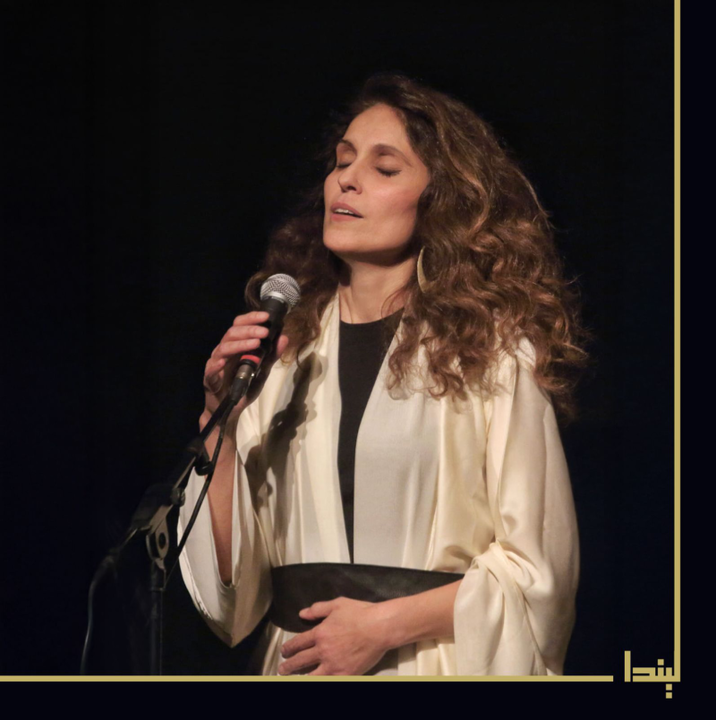
Syrian singer Linda al-Ahmad