

Books and publications
Index / Activities / Books and publications / The Spanish Constitution in Arabic
The Spanish Constitution in Arabic
December 02, 2025From 11:30 a.m. to 12:30 p.m.
MADRID
Casa Árabe headquarters (at Calle Alcalá, 62).
From 11:30 a.m. to 12:30 p.m.
Prior registration required.
In Spanish
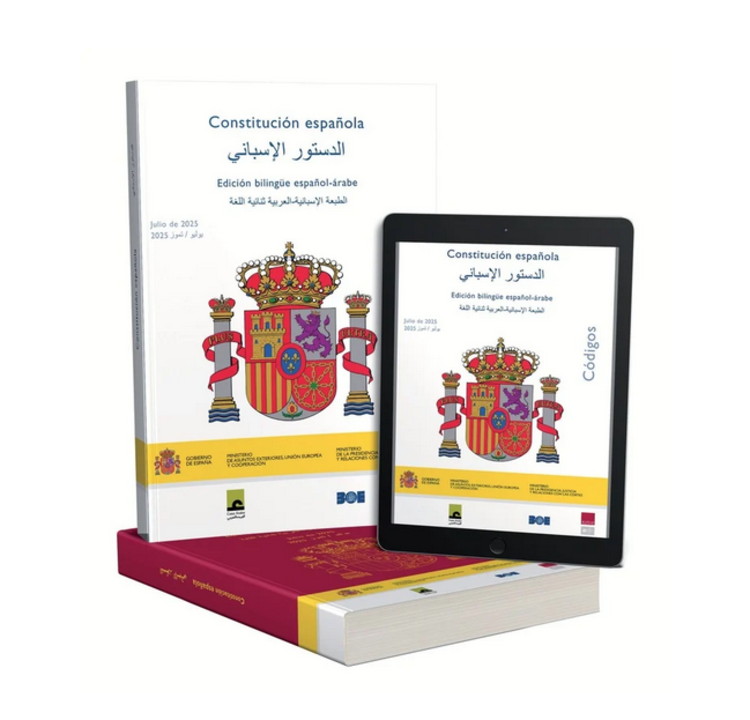
Casa Árabe, the Toledo School of Translators (UCLM) and the State Agency for Spain’s Official State Bulletin are presenting this new bilingual Spanish-Arabic edition of the Spanish Constitution, resulting from the cooperation between the three institutions, with a text revised by translators from different backgrounds and schools of Law. It will be taking place in Madrid on Tuesday, December 2. Please sign up to attend.
This edition is a revised version of the two previous editions produced by the Toledo School of Translators in 2012. With the help of its translator, Mourad Zarrouk, a professor of Hispanic Studies at the University of Casablanca, the legal terminology has been revised to adapt it to as broad and neutral a geographical spectrum as possible within the Arab countries, with the collaboration of a second translator, Fathi Mohammed Fathi Al-Hayani, a professor of Public International Law at the University of Mosul and director of the Center for Peacebuilding and Peaceful Coexistence at the same university, all under the coordination of Luis Miguel Pérez Cañada, a professor at the University of Castilla La Mancha and director of the Translation and Editing programs at the Toledo School of Translators.
The work, published within the Legal Codes Collection of the State Agency of Spain’s Official State Bulletin (BOE), is available in print on demand and can be downloaded free of charge in digital format (PDF) from the website of the aforementioned State Agency of Spain’s Official State Bulletin, with open access for all of the people.
In addition to the participation of the institutions that are endorsing this new edition, the presentation will feature speeches by Yolanda Gómez Sánchez is a professor of Constitutional Law and the Jean Monnet Chair ad personam of the EU at the UNED, and Tamara El Khoury, a professor of Comparative Constitutional Law at IE University and executive director of the Arab Association of Constitutional Law, who will be analyzing the value and relevance of the Spanish Constitution for Arab citizens, both in Spain and in other Arab countries, when addressing issues and problems common to the configuration of these States, including territorial management and linguistic minorities, in which it may serve as a point of reference to be taken into account.
The publication of this new revised bilingual Spanish-Arabic edition aims to offer the general and specialized public a useful tool for exercising comparative Constitutional Law and institutional cooperation, as well as sharing experiences between Spain and other countries.
Schedule
The work, published within the Legal Codes Collection of the State Agency of Spain’s Official State Bulletin (BOE), is available in print on demand and can be downloaded free of charge in digital format (PDF) from the website of the aforementioned State Agency of Spain’s Official State Bulletin, with open access for all of the people.
In addition to the participation of the institutions that are endorsing this new edition, the presentation will feature speeches by Yolanda Gómez Sánchez is a professor of Constitutional Law and the Jean Monnet Chair ad personam of the EU at the UNED, and Tamara El Khoury, a professor of Comparative Constitutional Law at IE University and executive director of the Arab Association of Constitutional Law, who will be analyzing the value and relevance of the Spanish Constitution for Arab citizens, both in Spain and in other Arab countries, when addressing issues and problems common to the configuration of these States, including territorial management and linguistic minorities, in which it may serve as a point of reference to be taken into account.
The publication of this new revised bilingual Spanish-Arabic edition aims to offer the general and specialized public a useful tool for exercising comparative Constitutional Law and institutional cooperation, as well as sharing experiences between Spain and other countries.
Schedule
PROGRAM
11:30 a.m. Opening event
Miguel Moro Aguilar, General Director of Casa Árabe
Manuel Tuero Secades, Director of the State Agency of Spain’s Official State Bulletin (BOE)
José Julián Garde López-Brea, Rector of the UCLM (to be confirmed)
Carmen Burguillo Burgos, Technical Secretary General of the Ministry of Foreign Affairs, European Union and Cooperation
12:00 p.m. The Spanish Constitution and Arab citizenship today
Yolanda Gómez Sánchez, a professor of Constitutional Law and the Jean Monnet Chair ad personam of the EU at the UNED.
Tamara El Khoury, a professor of Comparative Constitutional Law at IE University and executive director of the Arab Association of Constitutional Law.
11:30 a.m. Opening event
Miguel Moro Aguilar, General Director of Casa Árabe
Manuel Tuero Secades, Director of the State Agency of Spain’s Official State Bulletin (BOE)
José Julián Garde López-Brea, Rector of the UCLM (to be confirmed)
Carmen Burguillo Burgos, Technical Secretary General of the Ministry of Foreign Affairs, European Union and Cooperation
12:00 p.m. The Spanish Constitution and Arab citizenship today
Yolanda Gómez Sánchez, a professor of Constitutional Law and the Jean Monnet Chair ad personam of the EU at the UNED.
Tamara El Khoury, a professor of Comparative Constitutional Law at IE University and executive director of the Arab Association of Constitutional Law.
Yolanda Gómez Sánchez
Yolanda Gómez Sánchez is a professor of Constitutional Law and Jean Monnet Chair ad personam of the EU at the UNED. She holds a degree in Law from the Universidad Complutense de Madrid and a PhD in Law from the National Distance Education University (UNED), with an Extraordinary Doctorate Award. She has carried out her teaching and research work mainly in the fields of fundamental rights, the European Union, parliamentary monarchy, biomedicine and Law, as well as equality between women and men. She was the director of the Center for Political and Constitutional Studies from 2018 to 2023 and is a correspondent member of the Royal Academy of Jurisprudence and Legislation (RAJL). She has been a member of the Research Council of the European Institute University (based in Florence) and an evaluator for the European Research Council (EU), as well as other Spanish evaluation and quality agencies. Among other positions, she has been director of the journal “Derecho y Salud,” deputy director of the UNED journal “Revista de Derecho Político,” and belongs to numerous editorial boards and advisory boards for scientific publications. She has also advised for and taken part in various scientific committees forming part of public bodies and international institutions (EU, UNESCO).
Tamara El Khoury
Tamara El Khoury is a professor of Comparative Constitutional Law at IE University, executive director for the Arab Association for Constitutional Law (Lebanon), and a legal and constitutional expert (consultant) for the Max Planck Foundation for International Peace and the Rule of Law in Germany. As a consultant for this foundation, she is currently taking part in the ongoing process to draft the constitution of South Sudan. Her current professional interests and fields of research focus on the interaction between mechanisms to support democracy and development policy in transitional contexts. With a PhD in Constitutional Law from the Universidad Carlos III de Madrid, El Houry has been involved in constitutional and institutional reform processes in Libya, Jordan, Mali, Somalia and South Sudan, working extensively with both institutional role-players and civil society organizations, including women’s organizations. She has conducted research and training, as well as facilitating sessions for dialogue between the UNDP, UNOPS, the Max Planck Foundation for International Peace and the Rule of Law, and the Spanish Agency for International Development Cooperation (AECID), in addition to other entities.
Yolanda Gómez Sánchez is a professor of Constitutional Law and Jean Monnet Chair ad personam of the EU at the UNED. She holds a degree in Law from the Universidad Complutense de Madrid and a PhD in Law from the National Distance Education University (UNED), with an Extraordinary Doctorate Award. She has carried out her teaching and research work mainly in the fields of fundamental rights, the European Union, parliamentary monarchy, biomedicine and Law, as well as equality between women and men. She was the director of the Center for Political and Constitutional Studies from 2018 to 2023 and is a correspondent member of the Royal Academy of Jurisprudence and Legislation (RAJL). She has been a member of the Research Council of the European Institute University (based in Florence) and an evaluator for the European Research Council (EU), as well as other Spanish evaluation and quality agencies. Among other positions, she has been director of the journal “Derecho y Salud,” deputy director of the UNED journal “Revista de Derecho Político,” and belongs to numerous editorial boards and advisory boards for scientific publications. She has also advised for and taken part in various scientific committees forming part of public bodies and international institutions (EU, UNESCO).
Tamara El Khoury
Tamara El Khoury is a professor of Comparative Constitutional Law at IE University, executive director for the Arab Association for Constitutional Law (Lebanon), and a legal and constitutional expert (consultant) for the Max Planck Foundation for International Peace and the Rule of Law in Germany. As a consultant for this foundation, she is currently taking part in the ongoing process to draft the constitution of South Sudan. Her current professional interests and fields of research focus on the interaction between mechanisms to support democracy and development policy in transitional contexts. With a PhD in Constitutional Law from the Universidad Carlos III de Madrid, El Houry has been involved in constitutional and institutional reform processes in Libya, Jordan, Mali, Somalia and South Sudan, working extensively with both institutional role-players and civil society organizations, including women’s organizations. She has conducted research and training, as well as facilitating sessions for dialogue between the UNDP, UNOPS, the Max Planck Foundation for International Peace and the Rule of Law, and the Spanish Agency for International Development Cooperation (AECID), in addition to other entities.