

Seminars
Index / Activities / Seminars / Transculturality and medieval art in dialogue: negotiating new identities
Transculturality and medieval art in dialogue: negotiating new identities
From October 07, 2025 until October 08, 2025Check dates, opening times and entry conditions for each event.
MADRID
Casa Árabe headquarters (at Calle Alcalá, 62).
Check dates, opening times and entry conditions for each event.
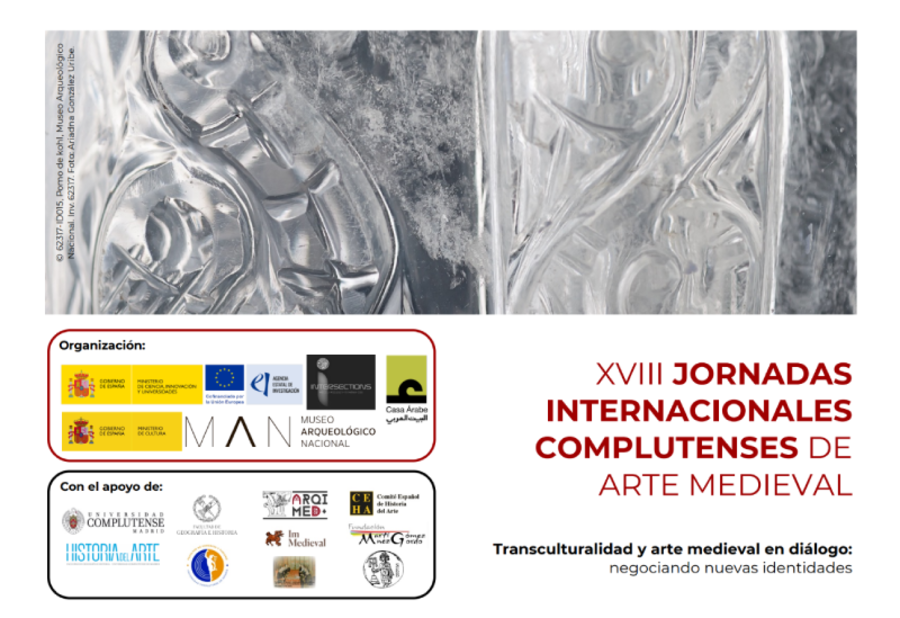
The eighteenth Complutense International Conference on Medieval Art will be taking place at the UCM, Casa Árabe and the National Archeology Museum on October 7 and 8, 2025. See the program below.
The challenges of our current world, with increasingly global, interconnected societies, have given rise to new forms of medievalism. These innovative narratives about the study of medieval art are embedded within a culturally rich and diverse horizon of expectations.
Transculturality investigates a constellation of experiences which help negotiate fluid artistic identities linked to the mobility of people, the circulation of objects and the transmission of ideas in varied social, geographical, ethnic and religious coordinates.
Often, however, a compact set of macro-histories or plausible contexts for transference (family relationships, diplomacy, trade, conflicts, and spiritual dynamics) have been theorized. Attention has focused on exchanging formal features and samples of themes and motifs and their impact on the creation of distinct decorative and monumental landscapes. And this essentialistic viewpoint has in the end emphasized the elitism, exoticism and sumptuary value conventionally associated with this visual language which flees from traditional taxonomies.
For this very reason, the eighteenth edition of the Complutense International Conference on Medieval Art is being held, to examine a broad social fabric that encompasses strata outside the luxury shared by the royal, aristocratic and ecclesiastical hierarchies. These events will seek to delve into the intersection of factors such as gender, class and ethnicity, and their ability to tell micro-stories that reveal a multifaceted perception of otherness, more in synch with the medieval thought system.
The architecture, objects and material culture of this time period, because of their exceptional ability to structure human relationships, modulated this dialogue between art and transculturality. Over time, their material nature has turned them into repositories of valuable memory, making them become historical documents which bear witness to contact with otherness. As a result of their performativity and endurance, they have been subject to repeated manipulation, recycling and reinterpretation, even after being given an ultimate status as treasure or museum piece. All these issues challenge our society’s interests and concerns, and in doing so they make it possible for debate to be extended from the academic world to the spheres of education and museums.
Under the scientific direction of Verónica Carla Abenza Soria, Diana Lucía Gómez-Chacón, and Helena Lahoz Kopiske, this new edition, planned for October 7-8, 2025, has been organized by the MICIU PID2023-151143NA-I00 Research Project: Intersections of gender, transculturality and identity in the peninsular Middle Ages: the recycling and endurance of objects and textiles-INTERSECTIONS,” on conjunction with the National Archeology Museum and Casa Árabe.
The congress will feature speakers such as María Elena Díez Jorge (UGR), Manuel Castiñeiras González (UAB), Beatriz Campderá Gutiérrez (MAN), Licia Buttà (URV), Raúl Estangüi Gómez (CSIC), Elvira Martín Contreras (CSIC), Alicia Miguélez Cavero (UNL), Theodora Konstantellou (DOaks), Ravinder Binning (DOaks), Julie Marquer (UdL), Herbert González Zymla (UCM), Víctor Rabasco García (ULE), María Puértolas Clavero (Barbastro-Monzón Diocesan Museum), Julia Perratore (MMA) and Helena Lahoz Kopiske (MAN). They will be supported by the special collaboration of the Universidad Complutense’s consolidated research group “Architecture and Integration of the Arts in the Middle Ages” (Ref. 941377), the that university’s consolidated research group “The Medieval Image: Transversality and Cultural Projection” (Ref. 941229), the Universidad Complutense’s consolidated research group “Cultural Heritage and Artistic Sociology. Makers, Works and Clients in the Territories of the Spanish Monarchy (1516-1898)” (Ref. 970866), Spain’s Art History Committee, and the Martínez Gómez-Gordo Foundation.
Further information at the UCM
Schedule
Transculturality investigates a constellation of experiences which help negotiate fluid artistic identities linked to the mobility of people, the circulation of objects and the transmission of ideas in varied social, geographical, ethnic and religious coordinates.
Often, however, a compact set of macro-histories or plausible contexts for transference (family relationships, diplomacy, trade, conflicts, and spiritual dynamics) have been theorized. Attention has focused on exchanging formal features and samples of themes and motifs and their impact on the creation of distinct decorative and monumental landscapes. And this essentialistic viewpoint has in the end emphasized the elitism, exoticism and sumptuary value conventionally associated with this visual language which flees from traditional taxonomies.
For this very reason, the eighteenth edition of the Complutense International Conference on Medieval Art is being held, to examine a broad social fabric that encompasses strata outside the luxury shared by the royal, aristocratic and ecclesiastical hierarchies. These events will seek to delve into the intersection of factors such as gender, class and ethnicity, and their ability to tell micro-stories that reveal a multifaceted perception of otherness, more in synch with the medieval thought system.
The architecture, objects and material culture of this time period, because of their exceptional ability to structure human relationships, modulated this dialogue between art and transculturality. Over time, their material nature has turned them into repositories of valuable memory, making them become historical documents which bear witness to contact with otherness. As a result of their performativity and endurance, they have been subject to repeated manipulation, recycling and reinterpretation, even after being given an ultimate status as treasure or museum piece. All these issues challenge our society’s interests and concerns, and in doing so they make it possible for debate to be extended from the academic world to the spheres of education and museums.
Under the scientific direction of Verónica Carla Abenza Soria, Diana Lucía Gómez-Chacón, and Helena Lahoz Kopiske, this new edition, planned for October 7-8, 2025, has been organized by the MICIU PID2023-151143NA-I00 Research Project: Intersections of gender, transculturality and identity in the peninsular Middle Ages: the recycling and endurance of objects and textiles-INTERSECTIONS,” on conjunction with the National Archeology Museum and Casa Árabe.
The congress will feature speakers such as María Elena Díez Jorge (UGR), Manuel Castiñeiras González (UAB), Beatriz Campderá Gutiérrez (MAN), Licia Buttà (URV), Raúl Estangüi Gómez (CSIC), Elvira Martín Contreras (CSIC), Alicia Miguélez Cavero (UNL), Theodora Konstantellou (DOaks), Ravinder Binning (DOaks), Julie Marquer (UdL), Herbert González Zymla (UCM), Víctor Rabasco García (ULE), María Puértolas Clavero (Barbastro-Monzón Diocesan Museum), Julia Perratore (MMA) and Helena Lahoz Kopiske (MAN). They will be supported by the special collaboration of the Universidad Complutense’s consolidated research group “Architecture and Integration of the Arts in the Middle Ages” (Ref. 941377), the that university’s consolidated research group “The Medieval Image: Transversality and Cultural Projection” (Ref. 941229), the Universidad Complutense’s consolidated research group “Cultural Heritage and Artistic Sociology. Makers, Works and Clients in the Territories of the Spanish Monarchy (1516-1898)” (Ref. 970866), Spain’s Art History Committee, and the Martínez Gómez-Gordo Foundation.
Further information at the UCM
Schedule