

Conferences and debates
Index / Activities / Conferences and debates / Where Is the Oil? Geopolitics and Economics in the Strait of Hormuz
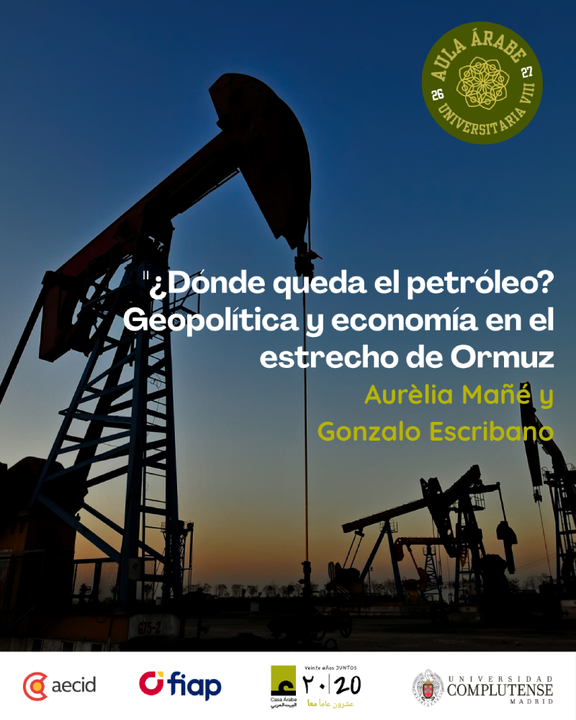
Where Is the Oil? Geopolitics and Economics in the Strait of Hormuz
November 18, 202612:30 p.m. 14:00 p.m.
MADRID (POZUELO DE ALARCÓN).
Faculty of Economics and Business Sciences, Complutense University of Madrid. Salón de Grados (Dean’s Office building).
12:30 p.m. 14:00 p.m.
Free entry until the event’s capacity is reached.
In Spanish.
On Wednesday, November 18, the fourth session of the “Aula Árabe Universitaria 8” series will take place in Madrid, focusing on the role of hydrocarbons in the war against Iran. Aurelia Mañé (University of Barcelona) and Gonzalo Escribano (Elcano Royal Institute) will participate in the event. Come join us or watch it live on YouTube!
After months of conflict—and although the results of the U.S. midterm elections seem to point toward de-escalation—the situation in the gas and oil markets remains highly uncertain, with neither Iran nor the U.S. having achieved their energy objectives. So far, Iran has been unable to destabilize the markets, raise oil prices to the levels it sought, or impose the transit regime through the Strait of Hormuz that it demands. In contrast, the U.S. has succeeded in completely blocking Iran’s crude oil exports through the Strait of Hormuz and inflicting severe damage on its economy. It has also managed to increase the transit of oil tankers and LNG carriers, but this occurs under conditions of high cost and risk, with traffic dropping dramatically when attacks such as those in September occur.
The instability surrounding the Strait of Hormuz raises a key question that goes beyond the current situation regarding prices and supplies: What role does oil play in the global energy system today? Although this sea route remains one of the main corridors for global hydrocarbon trade, the current crisis is unfolding in a context very different from that of the major oil crises of the 20th century.
Profound changes have taken place in recent decades: the U.S. has gone from being a major importer to becoming an energy exporter; Asia—and especially China—has established itself as the primary destination for oil and gas from the Middle East; and sanctions stemming from the war in Ukraine have reshaped global energy flows, fostering new alliances and greater interdependence between Russia and Asian markets. At the same time, the energy transition has given critical minerals and technological value chains growing importance.
Therefore, rather than merely a disruption in supply, the dispute over whether or not to close the Strait of Hormuz appears to be accelerating a redefinition of energy alliances and the geopolitical role of the Middle East, favoring the consolidation of a more multipolar world—or one organized into blocs—in which the region’s energy-exporting countries could explore new strategic balances and new alliances beyond their traditional Western partners.
These issues and their various scenarios will be analyzed in an open discussion with Aurelia Mañé Estrada, professor of Economic Policy at the University of Barcelona, and Gonzalo Escribano Francés, principal researcher and director of the Energy and Climate Program at the Elcano Royal Institute.
Organized in collaboration with the Master’s Program in International Economics and Development at the Complutense University of Madrid, the event will feature Juan M. Ramírez-Cendrero, a professor of economics at that university. Olivia Orozco, coordinator of Training and Economics at Casa Árabe, will moderate.
The session, part of the “Aula Árabe Universitaria 8” series, is organized with the support of Masar al’an / Masar Ahora, the regional program for cooperation with the Arab world run by the Spanish Agency for International Development Cooperation (AECID).
Aurelia Mañé Estrada
A tenured professor in the School of Economics and Business at the University of Barcelona (UB), where she teaches courses related to political economy and international energy relations, Aurelia Mañé is an honorary researcher at the School of History at the University of East Anglia in the United Kingdom, as well as a professor in the Master’s Program in Arab and Contemporary Studies at the Autonomous University of Madrid, among other master’s and doctoral programs at Spanish and international universities. She was previously an associate professor at the University of Denver (Colorado, USA). She is a member of the Geopolitics and Energy Security group at the Elcano Royal Institute, as well as the research groups on Economic Transition Analysis (GATE, UB) and on Contemporary Arab and Muslim Societies (GRESAM, UCLM). In 2008, she founded the Central Asia Observatory, serving as the project’s director and collaborating with Casa Asia on energy issues..
She holds a Ph.D. and a bachelor’s degree in Economics and Business from the University of Barcelona, as well as a master’s degree in International Studies from the same university. She has devoted much of her research to issues related to energy resources, focusing her work on Central Asia and Algeria. Among her most recent articles are “From Energy Security to Strategic Autonomy: The Mediterranean in EU Energy Policy” (IEMed: Mediterranean Yearbook, 2026), “The Influence of Neoliberal Thought on the Internationalization of Oil from the Middle East and North Africa” (Journal of Mediterranean International Studies (REIM), 2024), “The REPowerEU Plan through the Lens of the Fundamentals of European Energy Policy” (ICE: Journal of Economics, 2023); and the books: The Global Energy Business (RBA Libros, 2016), and, co-authored with Laurence Thieux and Miguel Hernando de Larramendi, Algeria in Transition Toward a Second Republic (Icaria, 2019).
Gonzalo Escribano Francés
Professor of Economic Policy in the Department of Economics at the UNED and principal investigator and director of the Energy and Climate Change Program at the Elcano Royal Institute. He regularly teaches graduate-level courses at numerous Spanish and international universities on the geopolitics of energy and the political economy of North Africa. His research focuses on international energy issues, the external dimension of both Spanish and European energy policy, the geopolitics of energy, energy security, and renewable energy, among other topics.
He holds a Ph.D. in Economics and Business Administration from the Complutense University of Madrid and has served as a visiting researcher at Florida State University and the Autonomous University of Madrid, as well as an associate researcher at the Spanish Center for International Relations of the Ortega y Gasset Foundation. He has participated in various Spanish and international research projects, notably the EU’s Seventh Framework Program and Horizon 2020, as well as several Euro-Mediterranean FEMISE projects of the European Commission, and has received the research award from the Economic and Social Council.
His most recent publications include “New Energy Scenarios in Light of the Latest Escalation in the Middle East,” with Félix Arteaga (Real Instituto Elcano Analysis, 2026); “The European Energy Crisis and the Reconfiguration of Transatlantic Relations,” with Federico Steinberg and Ignacio Urbasos (Journal of World Economics, 2025); the book *Spain and the Geopolitics of Renewable Energy*, with Enrique San Martín and Juan Diego Paredes (Colegio Libre de Eméritos, 2025), and the edited volume *Energy Security for the EU in the 21st Century: Markets, Geopolitics, and Corridors*, with José María Marín and Javier García-Verdugo (Routledge, 2012).