

News
Casa Árabe’s headquarters in Cordoba, a candidate Site of Cultural Interest
A resolution issued by the Spanish Ministry of Culture’s Directorate General of Cultural Heritage and Fine Arts, published in today’s Official Spanish State Gazette (BOE), has announced the opening of proceedings to classify the complex as a “Site of Cultural Interest (BIC)” with the official category of a “Monument.”
May 04, 2026
CÓRDOBA
According to the document, “the property meets the necessary historical and artistic criteria [...] to be designated a Site of Cultural Interest,” and therefore, if the designation is approved, the appropriate steps will be taken to ensure “its legal protection, increase public awareness about the property and implement the measures required for its proper conservation.”
In this way, the two Casa Árabe locations would enjoy the same level of protection, as the building housing the institution in Madrid (the former “Aguirre Schools” building), received the same designation just over a year ago, in February 2025.
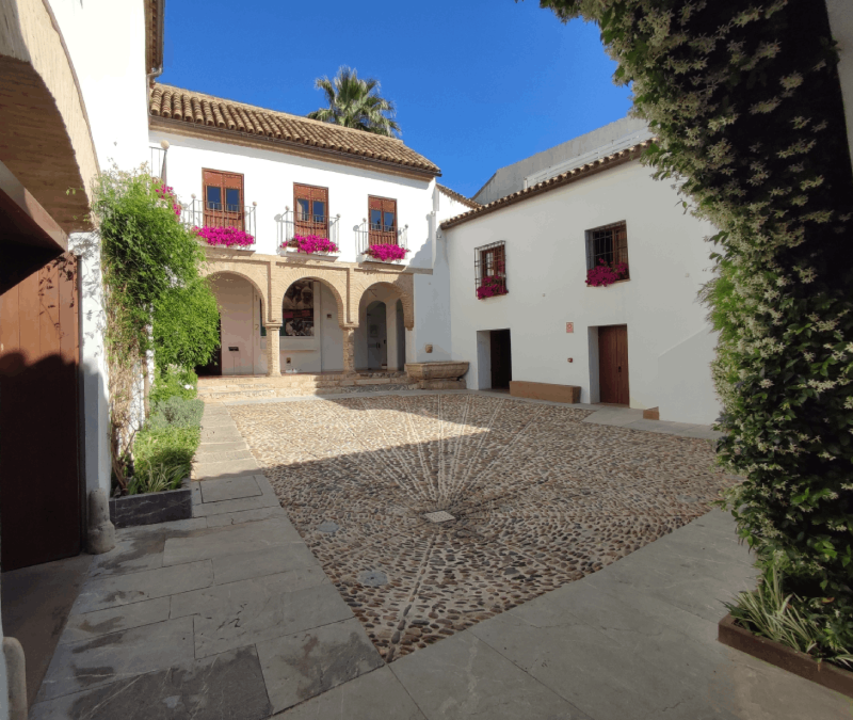
Casa Árabe’s headquarters in Cordoba, located in the building known as the “Casa Mudéjar” (located at Calle Samuel de los Santos Gener, 9), is situated in the southern part of the Historical Center of Cordoba, near the Mosque-Cathedral,within the area designated a UNESCO World Heritage Site. The original building dates back to the fourteenth century, although most of the current structures date from the fifteenth to sixteenth centuries. The complex comprises five different houses connected by galleries, passageways and staircases, with four courtyards and a tower that rises above one of the main houses, providing a panoramic view of the historical center.
A maze-like complex with clear Muslim origins
The Heritage resolution highlights the building’s “typical Mudéjar architecture”: a labyrinthine structure characterized by its layout around four courtyards with fountains. Surrounding the courtyards are narrow houses and main rooms with rectangular floor layouts, as well as small rooms with square floor plans, all of which serve different functions and have a clear origin in the Muslim world.
The building also features “notable stylistic elements characteristic of Mudéjar art,” according to the document, such as semicircular poly-lobed arches made of flat-tiled brickwork, capitals in the Caliphate tradition and decorations featuring arabesques (plant motifs), Arabic calligraphy and tracery.
Also noteworthy are its fifteenth-century Christian figurative murals, attributed to the painters Pedro Romana and Pedro Fernández, which constitute one of the finest examples of the few remaining works of Mudejar painting to be found in the city. This is a relatively recent discovery, made in 1928 by Samuel de los Santos Gener, then director of the Cordoba Archaeology Museum, when the house was being renovated to house this institution (from 1921 to 1961).
Its location, a symbol of distinction
The location of this house in the so-called “Santa María borough” is no coincidence. At the time, it was customary for the plots of land closest to the Mosque-Cathedral to be assigned to the most powerful personages and those closest to the king so that they could serve the Crown. According to architects and researchers, this building served as a residence for figures of local importance between the fourteenth and fifteenth centuries. In this sense, the property is “a reflection of a historical era and the transfer of knowledge within a society made up of a mosaic of diverse populations and religions,” which “constitutes a historical and cultural testimonial about the development of societies on political, social and cultural levels,” the resolution concludes.
The Mudéjar House in the twentieth and twenty-first centuries
Throughout the twentieth century, several refurbishment and renovation works were carried out on the complex. In 1921, the building became home to the Cordoba Archaeology Museum. Half a century later, in 1972, Spain’s then Ministry of Education and Science acquired the building for the State. The General Directorate of State Heritage ceded this historical building to Casa Árabe for use as its headquarters in Cordoba when the institution was created in 2006. The refurbishment and adaptation work on Casa Mudéjar to become Casa Árabe’s headquarters, directed by the Municipal Government of Cordoba itself, was awarded the first 2011 World Heritage Cities Prize, granted by Spain’s Ministry of Education, Culture and Sports, for representing “the conservation of a key and unique example of the city’s Mudéjar architecture.”
In 2021, Casa Árabe celebrated its tenth anniversary at the Casa Mudéjar with a special series of activities which included such events as a conference devoted to this wonderful building, given by María Dolores Baena, director of the Cordoba Archaeology Museum, as well as guided and dramatized tours.