1. Conferences and debates

Index / Videos / 1. Conferences and debates

Lecture by the Gazan journalist Wael Al Dahdouh at Casa Árabe in Cordoba Play

Lecture by the Gazan journalist Wael Al Dahdouh at Casa Árabe in Cordoba

Published at 37 09,,, 24 2024
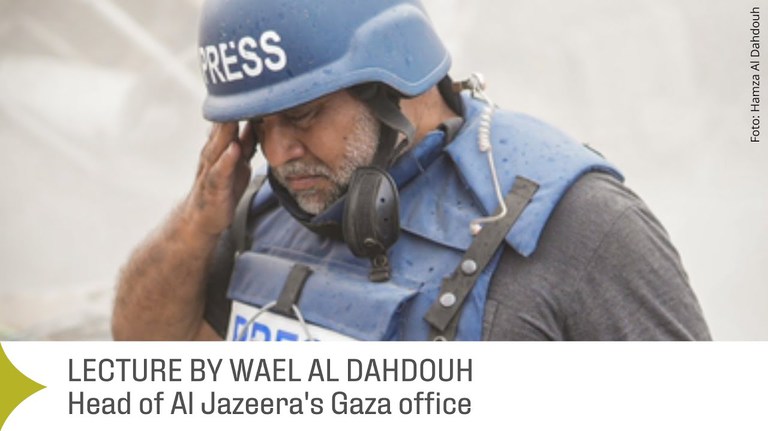
The Gazan journalist Wael Al Dahdouh, head of the Al Jazeera office in the city of Gaza and a point of reference for Palestinian and Arab world journalists, will be giving a conference on Monday, April 8 at Casa Árabe's headquarters in Cordoba. The session, organised by the Chair of Conflict Resolution at the University of Cordoba with the support of the Cordoba Provincial Council, will take place on the occasion of Al Dahdouh being awarded the 17th Julio Anguita Parrado International Journalism Prize in the city of Cordoba. The session can be followed live on Youtube in Spanish and Arabic. The jury of the 17th Julio Anguita Parrado International Journalism Prize, organised by the Andalusian Union of Journalists, meeting at the Rectorate of the University of Cordoba, has unanimously decided to award this prize to the Gazan journalist Wael Al Dahdouh. With this award, as well as distinguishing Wael Al Dahdouh's professional career and commitment to the defence of human rights, the jury wishes to give explicit recognition to Gazan journalists, who are suffering extreme violence in the Israeli offensive. In this regard, the jury highlighted that 75% of the journalists killed in 2023 worldwide were from Gaza. Wael Al Dahdouh became known worldwide as a result of his coverage for Al Jazeera after his family was intentionally bombed by Israel on 25 October 2023, killing his wife, son, daughter and 18-month-old grandson. Al Dahdou was in Gaza City on the same day to report on the latest developments when he was informed of his family's death. Hours after that attack, al-Dahdou was back on the air, despite the pain, this time to be interviewed by a colleague, just as he had interviewed so many others before. Dahdouh was also injured in December, when an Israeli strike hit a school in Khan Younis where he and his colleague, Al Jazeera cameraman Samer Abu Daqqa, were reporting. Abu Daqqa was killed in the attack. On 7 January, Dahdouh's eldest son, Hamza Dahdouh, also a journalist and cameraman for the Qatari television network, was with other journalists on a road between Khan Younis and Rafah when he was killed by Israeli drone strikes. Just a day before his death, Hamza had shared a post on X praising his father's perseverance. "You are patient, so don't despair." Wael Al Dahdou has since become an icon of the resistance of the Palestinian population of Gaza and how journalism has been a key element in showing the resilience and dignity of a people suffering a massacre unprecedented in history. They call him "Al-Jabal", which in Arabic means "the mountain", for standing tall as tragedy descends on him in the course of the war. Al Dahdouh, 53, was born and raised in the al-Zaytoun neighbourhood of Gaza City. He comes from a Palestinian farming family, according to Al Jazeera. He was still in high school in 1988 when he was arrested by Israeli forces for his involvement in the first Palestinian intifada that broke out in Gaza before spreading to other Palestinian territories. He received his high school diploma inside prison. After spending seven years in Israeli prisons, Al Dahdouh graduated from the Islamic University of Gaza in 1998 with a degree in journalism and media. He tried to travel abroad to complete higher studies, but Israel repeatedly prevented him from leaving Gaza. Eventually, he was able to enter Al-Quds University in Abu Dis in the West Bank, where he obtained a master's degree in Regional Studies in 2007. Dahdouh worked for several local media outlets, including the daily Al-Quds, the Voice of Palestine radio channel and the Sahar satellite channel. In 2003 he joined regional broadcasters, working briefly for Al-Arabiya before joining Al Jazeera. Since 2004 he has reported for the pan-Arab network and runs its Gaza bureau. Dahdouh has reported extensively during each successive Israeli war against the besieged enclave. In 2013, he received the Peace Through Media award at the International Media Awards in London. Photo: Wael Al Dahdouh

ALL VIDEOS IN THIS CATEGORY

  • Conference by Ilan Pappé: The Semblance of Peace in PalestineShow video

    Conference by Ilan Pappé: The Semblance of Peace in Palestine

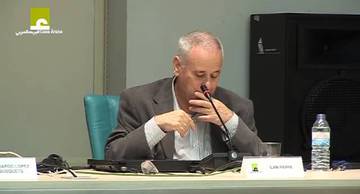
    On Monday, May 13, 2013, Ilan Pappe, Director of the European Center for Palestine Studies at the University of Exeter (United Kingdom) gave a conference at Casa Árabe's headquarters in Madrid. The event was presented by Musa Odeh, the Ambassador of Palestine in Spain, and Eduardo López Busquets, the General Director of Casa Árabe. During his conference, Professor Ilan Pappe analyzed the efforts which have been made in the peace process since 1967, focusing his hypothesis on the idea that these efforts have been based on a false paradigm which has ignored the Israeli strategy concerning the Palestinian Territories. Pappe analyzed this viewpoint and the implications it has for the future of the region. This conference, held with the cooperation of the Diplomatic Mission of Palestine in Spain, has been organized on the day of the Nakba (May 15), the date on which Palestinians commemorate the partition of the Palestinians' territories under the British Mandate in 1948, and their indigenous population was dispersed until today. Ilan Pappe Born in Haifa in 1954, Mr. Pappe is the Director of the European Center for Palestine Studies at the University of Exeter in the United Kingdom. He forms part of a group of Israeli academics known for their work on historic revisionism, especially in relation with the events that took place in 1948. He is the author of 15 books, several of which have been translated into Spanish, with the titles La limpieza étnica de Palestina (The Ethnic Cleansing of Palestine, Crítica, 2008); Historia de la Palestina moderna: un territorio, dos pueblos (History of Modern Palestine: One Territory, Two Peoples, Akal, 2007); Gaza en Crisis (Gaza in Crisis, with Noam Chomsky, Taurus, 2011). For more information: http://en.casaarabe.es/news/the-semblance-of-peace-in-palestine-2
    Published at 52 23,,, 13 2013
  • La escasez de agua en Palestina y Jordania / The Water Shortage in Palestine and JordanShow video

    La escasez de agua en Palestina y Jordania / The Water Shortage in Palestine and Jordan

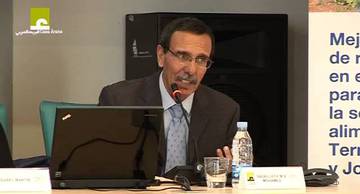
    Conferencia celebrada el 8 de abril de 2013 en la sede de Casa Árabe en Madrid bajo el título "Afrontar la escasez de agua en los Territorios Palestinos y Jordania: el uso de las fuentes de agua no convencionales en la agricultura". El acto contó con la participación de Abdellatif M.A Mohamed, vicedirector de la Palestinian Agricultural Relief Committees (PARC) en Territorios Palestinos; Basem Shamoun, director de Proyectos de la Jordan Hashemite Fund for Human Development (JOHUD) de Jordania; Isabel Martín, responsable del Área de Calidad del Agua del Centro de las Nuevas Tecnologías del Agua; e Inmaculada Paniagua, jefe de área de Agua y Saneamiento del Departamento de Cooperación Sectorial de la Agencia Española de Cooperación internacional al Desarrollo. Más información: http://www.casaarabe.es/noticias-arabes/show/la-escasez-de-agua-en-palestina-y-jordania On Monday, April 8 in Madrid, a round table discussion was held on the topic of "Facing the Water Shortage in the Palestinian Territories and Jordan: the use of unconventional water sources in agriculture." The Fundación Promoción Social de la Cultura has organized this round table discussion of the problems related with water shortages in the Middle East, and more specifically in Jordan and Palestine. For more information: http://en.casaarabe.es/news/the-water-shortage-in-palestine-and-jordan
    Published at 43 10,,, 13 2013