AAU 8.3: Shar, Genocide and anticolonial resistance in Libya
Published at 15 04,,, 26 2026
ALL VIDEOS IN THIS CATEGORY
-

AAU 8.3: Shar, Genocide and anticolonial resistance in Libya
The third lecture in the “Aula Árabe Universitaria 8” series will be presented by Ali Abdullatif Ahmida, professor of political science at the University of New England (U.S.). It will take place on Tuesday, November 3, in Madrid, and on Thursday, November 5, in Seville. Come attend or watch it live on YouTube. The conference, which will be held in Madrid and Seville and broadcast live from Madrid, will examine a little-known genocide—the one that took place in Libya during the 1920s and 1930s and is referred to in the country’s oral history as “Shar” (evil or wickedness). Professor Ali Abdullatif Ahmida will present insights from his groundbreaking book “Genocide in Libya” (Routledge, 2021). The talk explores what constitutes genocide under international law, using Italy's policy in Libya during the 1920s and 1930s as a case study. The book focuses on the impact of the anti-colonial resistance, the making of genocide called Shar, and the reliability of oral testimonies and the use of engineered famine as a weapon of genocide, challenging Eurocentric and colonial scholarship by presenting a new subaltern narrative grounded in primary sources, fieldwork, oral history, survivor interviews and testimonies, and Arab and European scholarship on genocide. His recent book draws on newly uncovered archival and oral evidence to examine a little-recognized phase of Italian Fascism and explores the reasons behind the profound silence surrounding its memory. In this work, Professor Ahmida analyzes public perceptions and academic discourse, investigates the historical and political contexts that shaped them, and engages with alternative critical scholarship. Central to his research are the voices of Libyan survivors of the Fascist concentration camps between 1929 and 1934, as well as the politics of official and unofficial memory in Libya, Italy, and the United States. Spanning three continents and conducted in multiple languages between 2000 and 2010, his fieldwork establishes a paradigm shift and a new research agenda. The book offers a critical model of Italian Fascism with far-reaching implications for genocide studies, area studies, and modern Libyan history. Ali Abdullatif Ahmida Professor Ali Abdullatif Ahmida was born in Waddan, Libya, and educated at Cairo University in Egypt and the University of Washington, Seattle. He is the founding chair and professor in the Department of Political Science at the University of New England, Biddeford, Maine, USA. His areas of expertise are political theory, comparative politics, and historical sociology. His scholarship focuses on power, agency, and anti-colonial resistance, and genocide in North Africa, especially in modern Libya. Further information: https://en.casaarabe.es/eventos-arabes/show/shar-genocide-and-anticolonial-resistance-in-libyaPublished at 15 04,,, 26 2026 -
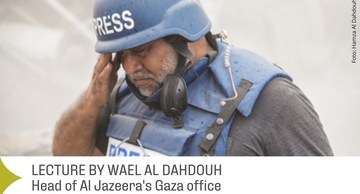
Lecture by the Gazan journalist Wael Al Dahdouh at Casa Árabe in Cordoba
The Gazan journalist Wael Al Dahdouh, head of the Al Jazeera office in the city of Gaza and a point of reference for Palestinian and Arab world journalists, will be giving a conference on Monday, April 8 at Casa Árabe's headquarters in Cordoba. The session, organised by the Chair of Conflict Resolution at the University of Cordoba with the support of the Cordoba Provincial Council, will take place on the occasion of Al Dahdouh being awarded the 17th Julio Anguita Parrado International Journalism Prize in the city of Cordoba. The session can be followed live on Youtube in Spanish and Arabic. The jury of the 17th Julio Anguita Parrado International Journalism Prize, organised by the Andalusian Union of Journalists, meeting at the Rectorate of the University of Cordoba, has unanimously decided to award this prize to the Gazan journalist Wael Al Dahdouh. With this award, as well as distinguishing Wael Al Dahdouh's professional career and commitment to the defence of human rights, the jury wishes to give explicit recognition to Gazan journalists, who are suffering extreme violence in the Israeli offensive. In this regard, the jury highlighted that 75% of the journalists killed in 2023 worldwide were from Gaza. Wael Al Dahdouh became known worldwide as a result of his coverage for Al Jazeera after his family was intentionally bombed by Israel on 25 October 2023, killing his wife, son, daughter and 18-month-old grandson. Al Dahdou was in Gaza City on the same day to report on the latest developments when he was informed of his family's death. Hours after that attack, al-Dahdou was back on the air, despite the pain, this time to be interviewed by a colleague, just as he had interviewed so many others before. Dahdouh was also injured in December, when an Israeli strike hit a school in Khan Younis where he and his colleague, Al Jazeera cameraman Samer Abu Daqqa, were reporting. Abu Daqqa was killed in the attack. On 7 January, Dahdouh's eldest son, Hamza Dahdouh, also a journalist and cameraman for the Qatari television network, was with other journalists on a road between Khan Younis and Rafah when he was killed by Israeli drone strikes. Just a day before his death, Hamza had shared a post on X praising his father's perseverance. "You are patient, so don't despair." Wael Al Dahdou has since become an icon of the resistance of the Palestinian population of Gaza and how journalism has been a key element in showing the resilience and dignity of a people suffering a massacre unprecedented in history. They call him "Al-Jabal", which in Arabic means "the mountain", for standing tall as tragedy descends on him in the course of the war. Al Dahdouh, 53, was born and raised in the al-Zaytoun neighbourhood of Gaza City. He comes from a Palestinian farming family, according to Al Jazeera. He was still in high school in 1988 when he was arrested by Israeli forces for his involvement in the first Palestinian intifada that broke out in Gaza before spreading to other Palestinian territories. He received his high school diploma inside prison. After spending seven years in Israeli prisons, Al Dahdouh graduated from the Islamic University of Gaza in 1998 with a degree in journalism and media. He tried to travel abroad to complete higher studies, but Israel repeatedly prevented him from leaving Gaza. Eventually, he was able to enter Al-Quds University in Abu Dis in the West Bank, where he obtained a master's degree in Regional Studies in 2007. Dahdouh worked for several local media outlets, including the daily Al-Quds, the Voice of Palestine radio channel and the Sahar satellite channel. In 2003 he joined regional broadcasters, working briefly for Al-Arabiya before joining Al Jazeera. Since 2004 he has reported for the pan-Arab network and runs its Gaza bureau. Dahdouh has reported extensively during each successive Israeli war against the besieged enclave. In 2013, he received the Peace Through Media award at the International Media Awards in London. Photo: Wael Al DahdouhPublished at 37 09,,, 24 2024 -
Día de la Ciencia 2022: "Desde las figuras de polvo a las Matemáticas en al-Ándalus"
El miércoles 9 de noviembre, acogemos en nuestra sede en Córdoba esta conferencia a cargo del matemático Rafael Pérez Gómez, en la que abordaremos el papel fundamental de las ciencias en al-Ándalus. Ṣā‘id al-Andalusī (1029-1070) dejó escrito en su obra Kitāb Ṭabaqātal-umam (‘Libro de las categorías de las naciones’) que, tras el periodo inicial de conquistas musulmanas en la península Ibérica: «el país se despreocupó de todas las ciencias, excepto del Derecho y la Lengua Árabe, hasta el día en el que el poder pasó definitivamente a manos de los Omeyas…». Cada día son más las aportaciones hechas desde la investigación sobre la evolución de las ciencias en al-Ándalus. Poco a poco van completándose los huecos que en su historia existen y facilitándose la identificación de quienes la protagonizaron. La creencia de que al-Ándalus actuó meramente como puente de la cultura árabe hacia Europa, se desvanece. Ahora sabemos de aportaciones originales andalusíes en Astronomía, Geometría y Álgebra que sirvieron a los Fibonacci, Escoto, Regiomontano, Ceva, Vieta… para desarrollar “sus” teorías. La aparente sencillez de herramientas astronómicas o de la arquitectura desarrollada en al-Ándalus explican el altísimo nivel de conocimiento alcanzado. De todo esto hablará el profesor Rafael Pérez Gómez en su conferencia, que celebramos con motivo del Día de la Ciencia y que será presentada por Javier Rosón, coordinador de Casa Árabe en Córdoba. Rafael Pérez Gómez Rafael Pérez Gómez es matemático y profesor colaborador extraordinario en la Escuela Técnica Superior de Arquitectura de la Universidad de Granada. Es autor de varios libros, entre los que destacan Alhambra. Belleza abstracta (2019), editado por el Patronato de la Alhambra y Generalife, en el que se analiza matemáticamente el monumento nazarí y Granada, la Nueva Jerusalén, última obra (inacabada) de Alonso Cano, editada por la Editorial de la Universidad de Granada. Además, Rafael Pérez Gómez a publicado más de 30 capítulos de libro, 10 prólogos, 37 artículos en revistas y 16 publicaciones como editor. Desde el 2000, ha impartido alrededor de 200 conferencias en España y extranjero siendo profesor invitado en Smith College de Massachussets, la Fundación Olimpiada Matemática Argentina y la School Of Engineering de Bogotá. Más información: https://www.casaarabe.es/eventos-arabes/show/desde-las-figuras-de-polvo-a-las-matematicas-en-al-andalusPublished at 02 09,,, 22 2022 -
AAU 4.3 The Corporeal Life of Commerce at Sea
On Monday, November 7th, Casa Árabe will present the conference "The Corporeal Life of Commerce at Sea", given by Laleh Khalili, professor of International Politics at Queen Mary University of London with the participation of Ángel Rodríguez García-Brazales, coordinator of the Degree in Philosophy, Politics and Economics at the UAM and director of the Master's Degree in Economic Intelligence and Geopolitics at the same university, Berta Álvarez-Miranda, lecturer in Sociology at the UCM, and Olivia Orozco, Casa Árabe's Training and Economics coordinator, who will moderate the session. The conference is being held in collaboration with with the Bachelor in International Relations and the Master in European Union and the Mediterranean: historical, cultural, political, economic and social basis of the Complutense University Madrid and the Degree in Philosophy, Politics and Economics of the Autonomous University of Madrid. It is the third session of the Aula Árabe Universitaria 4 program, which can be seen live on our YouTube channel. The everyday life of seafarers steaming across Arab seas and serving Arab ports today is shaped not only by their daily interactions with one another and with their officers (who are often of other nationalities), but also by the corporeal transformations they experience in their sensory relationship with the sea and the stars, the weather, and the technology around them. The body of the seafarer is the fulcrum upon which global and workplace asymmetries of power, long traditions and conventions of seafaring, and gendered and racialised subjectivities all conjoin in complex and unexpected ways. The conference will speak not only of wages stolen and hunger ships managed by rapacious and unregulated shipping companies or the affective power of loneliness and loss at sea, but also the ephemeral moments of joy and solidarity forged aboard ships, and of the pleasures of arrival at ports. In focusing on the corporeal life of commerce at sea, we’ll pay heed to exhortations of feminists and scholars of racial capitalism to centre the lives of those forgotten or dismissed at the conjuncture of capital accumulation and raced and gendered hierarchies. Laleh Khalili is a professor of international politics at Queen Mary University of London. In her first two books, Laleh has examined the representations and practices of violence. These two books are titled "Heroes and Martyrs of Palestine: the Politics of National Commemoration" (Cambridge 2007) and "Time in the Shadows: Confinement in Counterinsurgency" (Stanford 2013). She has also co-edited a volume with Jillian Schwedler titled "Policing and Prisons in the Middle East: Formations of Coercion" (Hurst 2010) that also analyses the role of state violence in Middle Eastern politics. Her most recent book, "Sinews of War and Trade" (Verso 2020) examines the role of maritime infrastructures as conduits of movement of technologies, capital, people and cargo. She is currently working on a larger project about the lifeworlds of petroleum. The project will range across the decades and continents to examine how the production of and trade in oil and gas has transformed regimes of labour and property, international law, insurance and finance, and science and technology. Further information: https://en.casaarabe.es/event/the-corporeal-life-of-commerce-at-seaPublished at 47 07,,, 22 2022 -
AAU 4.2 La cobertura de los conflictos de Oriente Medio en los medios españoles
El jueves 20 de octubre, Casa Árabe organiza un encuentro con las periodistas Lola Bañón (Universidad de Valencia) y Cristina Sánchez (RNE). Se trata de la segunda sesión de Aula Árabe Universitaria, emitida en directo en nuestro canal en Youtube. Oriente Medio es un territorio en continua disputa estratégica. Paradójicamente, a pesar de los intereses compartidos y la proximidad geográfica y cultural, los medios españoles han venido disminuyendo sus coberturas sobre la zona. Una de las razones ha sido la crisis económica que provocó la disminución de corresponsalías estables en la mayoría de los medios, a excepción de algunos públicos. Oriente Medio únicamente vuelve al foco con los ciclos de agudización de conflicto, en muchas ocasiones con las narraciones de periodistas freelance a los que sólo se les compra la crónica cuando tiene elementos de violencia y espectáculo. Lola Bañón, periodista y profesora de la Universidad de Valencia, nos hablará de como las consecuencias que se derivan de esto concluyen con un sesgo evidente en la representación de los países de la zona, una mirada parcial y descontextualizada que se traduce en la pervivencia del prejuicio hacia las poblaciones y en una alineación progresiva de los relatos sobre el mundo árabe no siempre con criterios periodísticos profesionales y sí con las líneas de la política exterior española y europea. Por su parte, Cristina Sánchez, periodista de RNE y corresponsal en la zona, nos contará desde su experiencia las dificultades logísticas y el coste económico que supone cubrir los conflictos en Oriente Medio sobre el terreno, en particular en Siria, Iraq y Gaza como ejemplos en primera persona. De aquí, la relación entre la difusión en medios de comunicación españoles y la presencia de periodistas desplegados, dado que sin inversión en profesionales sobre el terreno no hay coberturas. Tras esto, hablará de los distintos formatos audiovisuales con los que ha trabajado para abordar distintas temáticas en Oriente Medio, con el docuweb en formato podcast "Vivir Gaza" como ejemplo, y sobre la importancia de los testimonios personales para explicar el contexto. Se trata de la segunda sesión del programa Aula Árabe Universitaria 4, organizada en colaboración con el Máster Universitario de Periodismo Internacional de la Universidad Rey Juan Carlos (URJC), a cargo de Lola Bañón, periodista y profesora de la Universidad de Valencia, y Cristina Sánchez, periodista de RNE, y que contará con la participación de Amal Abu-Warda Pérez, profesora de dicho máster, que las presentará, y Olivia Orozco, coordinadora de Formación y Economía de Casa Árabe, que hará la moderación. Lola Bañón Doctora en Ciencias de la Comunicación, Lola Bañón es profesora en el Departamento de Teoría de los Lenguajes de la Facultad de Filología, Traducción y Comunicación de la Universidad de Valencia. Ha trabajado durante 25 años en la redacción de informativos de Radiotelevisión Valenciana y es autora de diversas publicaciones relacionadas con la comunicación y el mundo árabe. Participa sobre estos temas en diversos foros internacionales y es jurado del Festival Internacional de Documentales de la cadena Al Jazeera. Cristina Sánchez Cristina Sánchez Hernández es licenciada en Periodismo por la Universidad Complutense de Madrid y Máster en Comunicación y Conflictos Armados. Periodista de la Sección de Internacional de RNE desde 2007, ha sido enviada Especial en más de 20 países, cubriendo acontecimientos históricos como las elecciones presidenciales en Afganistán y Egipto, el terremoto de Haití, la Primavera Árabe en Túnez y Libia, las guerras en Gaza, Siria e Iraq, la Plaza Maydan en Ucrania, la llegada de personas refugiadas en Grecia, Hungría y Argelia, entre otros. Directora durante casi una década del espacio "Países en Conflicto" de Radio 5, fue corresponsal para Oriente Próximo con sede en Jerusalén durante 4 años (2017-2021). Ha recibido numerosos premios a lo largo de su carrera periodística, entre ellos el Premio Emilio Castelar de Comunicación 2014, el Premio Cirilo Rodríguez 2017 y el Premio Prensa Mujer Ameco 2019. Más información: https://www.casaarabe.es/eventos-arabes/show/la-cobertura-de-los-conflictos-de-oriente-medio-en-los-medios-espanolesPublished at 09 20,,, 22 2022