

Conferences and debates
Index / Activities / Conferences and debates / Alphabets, talismans, identity and resistance
Alphabets, talismans, identity and resistance
September 24, 20257:00 p.m.
MADRID
Casa Árabe Auditorium (at Calle Alcalá, 62).
7:00 p.m.
Free entry until the event’s capacity is reached.
In English, with simultaneous translation into Spanish.
To mark the official opening of the group exhibition From Alif to Zain: Calligraphic Art in Motion, Casa Árabe has organized a round table discussion with four artists and the exhibition curator in Madrid on Wednesday, September 24.
The round table discussion is being held in conjunction with the exhibition From Alif to Zain: Calligraphic Art in Motion, a collective exhibition that reveals how the Arabic language, in constant transformation, has become fertile ground for contemporary creation. Through practices ranging from calligraphy to experimental typesetting and hybrid aesthetics, the participating artists explore the potential of letters as symbols of identity, vehicles of memory and tools of resistance.
At this crossroads between tradition and experimentation, Arabic writing is revealed to be a space for dialogue that transcends borders and challenges today’s cultural dynamics in the Middle East and North Africa, as well as those of the international diaspora, underscoring the relevance and universal power of the written word.
With the participation of: Mosa One, Sarah Smahane, Shareef Sarhan, Samir Abdalla and curator Toufik Douib. The event will be introduced by Karim Hauser, coordinator of Casa Árabe’s Cultural Programs.
The conference will be broadcast live on Casa Árabe’s YouTube channel.
Once it has ended, visitors may enter the exhibition halls for the official opening of the exhibition.
At this crossroads between tradition and experimentation, Arabic writing is revealed to be a space for dialogue that transcends borders and challenges today’s cultural dynamics in the Middle East and North Africa, as well as those of the international diaspora, underscoring the relevance and universal power of the written word.
With the participation of: Mosa One, Sarah Smahane, Shareef Sarhan, Samir Abdalla and curator Toufik Douib. The event will be introduced by Karim Hauser, coordinator of Casa Árabe’s Cultural Programs.
The conference will be broadcast live on Casa Árabe’s YouTube channel.
Once it has ended, visitors may enter the exhibition halls for the official opening of the exhibition.
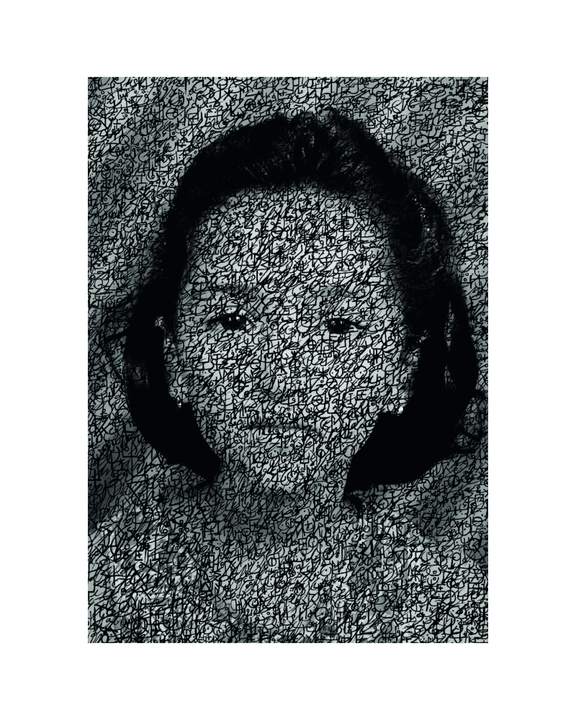
Image: Bent El Ghorba (Sarah Smahane)
Toufik Douib (Algiers, 1980) is a curator and creative director whose multidisciplinary practice explores Maghreb-Algerian identities from contemporary and eclectic perspectives, connecting artists from the diaspora with creative scenes in the East and West. After earning his Master’s degree in Cultural Event Management, he held his first exhibition, Algerianism, in 2015. From 2017 to 2018, he collaborated with London’s P21 Gallery on projects such as Dhikr Pictural, {Un}Told Stories, and Pop Art from North Africa, the latter also exhibited at Casa Árabe (2019-2020). He has worked twice with the Shubbak Festival, and most notably on Belonging Sideways (2021) and Soundclash (2023). He is the coordinator of DIGI-MENA, a platform that promotes digital artists from the MENA region, and in 2019 he received an AFAC grant to develop DIGI-DZ in Algiers. He has also collaborated with British universities and international cultural programs. Since 2024, he has been the international creative producer of the Liverpool Arab Arts Festival. The exhibition From Alif to Zain marks a decade of cultural engagement and reflects his commitment to showcasing the richness and boldness of contemporary Arab art stories.
Sarah Smahane (France, 1995) grew up in a suburban town, the daughter of Moroccan immigrant parents. Her artistic name holds strong symbolic value: Smahane is the middle name given to her by her paternal grandfather, inspired by the Golden Age of Arabic music, including figures such as Abdelhalim El Hafiz, Fairuz and Umm Kulthum, as well as paying homage to the Syrian singer Asmahan. From an early age, she experienced cultural tensions and conflicts that led her to question her identity. At the age of eight, she began her education in art by working with a local painter, an experience that lasted seven years. She later studied Art and Design in Paris, where she worked for prestigious agencies serving clients in the West and the MENA region. Within this context, she collaborated with artisans from North Africa, the Middle East and Europe, rediscovering and fully embracing the richness of her multiple heritages: French, Moroccan, Amazigh and Arab. French, Moroccan, Amazigh and Arab.
Shareef Sarhan (Gaza, 1976) is a visual artist and photographer. He is a founding member of Shababeek for Contemporary Art and a member of the Palestinian Artists Association. Sarhan earned his university degree in Art. He attended the Darat Al Funun Academy in Jordan. He received the Bronze Award at the Arab Photographers Festival in 2008 and the Recognition Award in 2007. Sarhan produced an illustrated book titled “Gaza Live.” His work has been exhibited in Gaza, Ramallah, Jerusalem, Amman, the United States, France, Germany and Italy.
Mosa One (Rome, 1997) is a multidisciplinary artist whose work ranges from hand-sewn textiles to murals and installations. Originally from the suburbs of Rome, he began his journey in art at the age of 13 through graffiti, placing his first signatures on the streets of his neighborhood. At 19, he was invited to paint a mural at MACRO, the Museum of Contemporary Art in Rome, which marked a turning point in his career. Since then, he has collaborated with institutions and brands such as UNICEF, Netflix and Nike, having put on exhibitions in Italy and abroad. The son of an Egyptian family, the two-fold nature of his identity is central to his artistic research, in which he explores the richness of belonging to two cultures and two seemingly opposite ways of life. His work also addresses social criticism and the struggle against injustices affecting our planet.
Samir Abdallah (Copenhagen, 1959) is the son of pioneering Egyptian modern artist Hamed Abdalla and a Danish nurse. After studying drama and film at the University of Nanterre in the 1980s, he co-founded the IM’média agency with his brother, producing reports and documentaries on immigration for French television channel FR3 (1988–1991). As a filmmaker, he has directed numerous documentaries addressing social and political issues, including L’Islam de France (1990), La Révolte de Vaulx-en-Velin (1991), La Ballade des sans-papiers (1996), Chronique d’un siège (2003), Écrivains des frontières (2004), Gaza-Strophe, Palestine (2010) and Au Caire de la Révolution. In 1991, he founded L’Yeux Ouverts, an organization that promotes workshops in neighborhoods and coordinates the Cinemeteque, an international network of over 3,000 collectives in Europe, the Arab world and the Americas, devoted to disseminating critical cinema showing contemporary reality.
Shareef Sarhan (Gaza, 1976) is a visual artist and photographer. He is a founding member of Shababeek for Contemporary Art and a member of the Palestinian Artists Association. Sarhan earned his university degree in Art. He attended the Darat Al Funun Academy in Jordan. He received the Bronze Award at the Arab Photographers Festival in 2008 and the Recognition Award in 2007. Sarhan produced an illustrated book titled “Gaza Live.” His work has been exhibited in Gaza, Ramallah, Jerusalem, Amman, the United States, France, Germany and Italy.
Mosa One (Rome, 1997) is a multidisciplinary artist whose work ranges from hand-sewn textiles to murals and installations. Originally from the suburbs of Rome, he began his journey in art at the age of 13 through graffiti, placing his first signatures on the streets of his neighborhood. At 19, he was invited to paint a mural at MACRO, the Museum of Contemporary Art in Rome, which marked a turning point in his career. Since then, he has collaborated with institutions and brands such as UNICEF, Netflix and Nike, having put on exhibitions in Italy and abroad. The son of an Egyptian family, the two-fold nature of his identity is central to his artistic research, in which he explores the richness of belonging to two cultures and two seemingly opposite ways of life. His work also addresses social criticism and the struggle against injustices affecting our planet.
Samir Abdallah (Copenhagen, 1959) is the son of pioneering Egyptian modern artist Hamed Abdalla and a Danish nurse. After studying drama and film at the University of Nanterre in the 1980s, he co-founded the IM’média agency with his brother, producing reports and documentaries on immigration for French television channel FR3 (1988–1991). As a filmmaker, he has directed numerous documentaries addressing social and political issues, including L’Islam de France (1990), La Révolte de Vaulx-en-Velin (1991), La Ballade des sans-papiers (1996), Chronique d’un siège (2003), Écrivains des frontières (2004), Gaza-Strophe, Palestine (2010) and Au Caire de la Révolution. In 1991, he founded L’Yeux Ouverts, an organization that promotes workshops in neighborhoods and coordinates the Cinemeteque, an international network of over 3,000 collectives in Europe, the Arab world and the Americas, devoted to disseminating critical cinema showing contemporary reality.
Related content
Anterior
Siguiente
From Alif to Zayn. Calligraphic Art in Motion
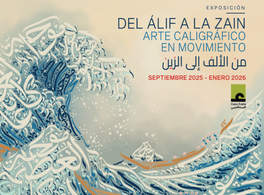
From September 25 in Madrid, Casa Árabe is organizing this exhibition dedicated to avant-garde Arabic calligraphy, curated by Toufik Douib. The exhibition brings together the work of ten artists from the region and the diaspora whose works highlight the versatility and richness of contemporary Arabic representation.
From September 25, 2025 until February 15, 2026
MADRID