

Exhibitions
Index / Activities / Exhibitions / From Alif to Zayn. Calligraphic Art in Motion
From Alif to Zayn. Calligraphic Art in Motion
From September 25, 2025 until February 15, 2026Mondays through Sundays, from 10 a.m. to 8 p.m.
MADRID
Casa Árabe exhibition halls.
Mondays through Sundays, from 10 a.m. to 8 p.m.
Free entry.
From September 25 in Madrid, Casa Árabe is organizing this exhibition dedicated to avant-garde Arabic calligraphy, curated by Toufik Douib. The exhibition brings together the work of ten artists from the region and the diaspora whose works highlight the versatility and richness of contemporary Arabic representation.
From Alif to Zain is a collective exhibition that celebrates the creative force and constant evolution of the Arabic language in contemporary culture, in the Middle East and North Africa, and internationally. While calligraphy remains their most emblematic visual reference point, more and more artists are transcending the codes of traditional illustration to experiment with poetic letters, radical typesets and bold hybrid aesthetics. In this process of ongoing reinvention, the use of Arabic
in art addresses critical and universal issues: letters become gestures of cultural positioning, words unfold as social or political manifestos, and design opens up new territories for dialogue. Featuring ten artists from the region and the diaspora, whose works address the multifaceted notion of “Arabness,” this multidisciplinary exhibition reflects the diversity of voices and perspectives that shape Arabic expression and the legacy of its writing. From Alif to Zain highlights the versatility and richness of contemporary Arabic representation, revealing language not only as a link to heritage, but also as a dynamic tool for creation, transmission, and resistance in a world marked by complex geopolitical tensions, today more than ever.
The artists featured in the exhibition are:
Hamed Abdallah
Idriss Azougaye
Nasreddine Bennacer
Akram Idris
Anissa Lalahoum
Mosa One
Shareef Sarhan
Bahia Shehab
Sarah Smahane
Haythem Zakaria
Curated by Toufik Douib.
in art addresses critical and universal issues: letters become gestures of cultural positioning, words unfold as social or political manifestos, and design opens up new territories for dialogue. Featuring ten artists from the region and the diaspora, whose works address the multifaceted notion of “Arabness,” this multidisciplinary exhibition reflects the diversity of voices and perspectives that shape Arabic expression and the legacy of its writing. From Alif to Zain highlights the versatility and richness of contemporary Arabic representation, revealing language not only as a link to heritage, but also as a dynamic tool for creation, transmission, and resistance in a world marked by complex geopolitical tensions, today more than ever.
The artists featured in the exhibition are:
Hamed Abdallah
Idriss Azougaye
Nasreddine Bennacer
Akram Idris
Anissa Lalahoum
Mosa One
Shareef Sarhan
Bahia Shehab
Sarah Smahane
Haythem Zakaria
Curated by Toufik Douib.
On Wednesday, September 24, the curator and several of the artists featured in the exhibition will be taking part in the round table discussion “Alphabets, Talismans, Identity and Resistance.” It will be taking place at 7:00 p.m. in the institution’s Auditorium.
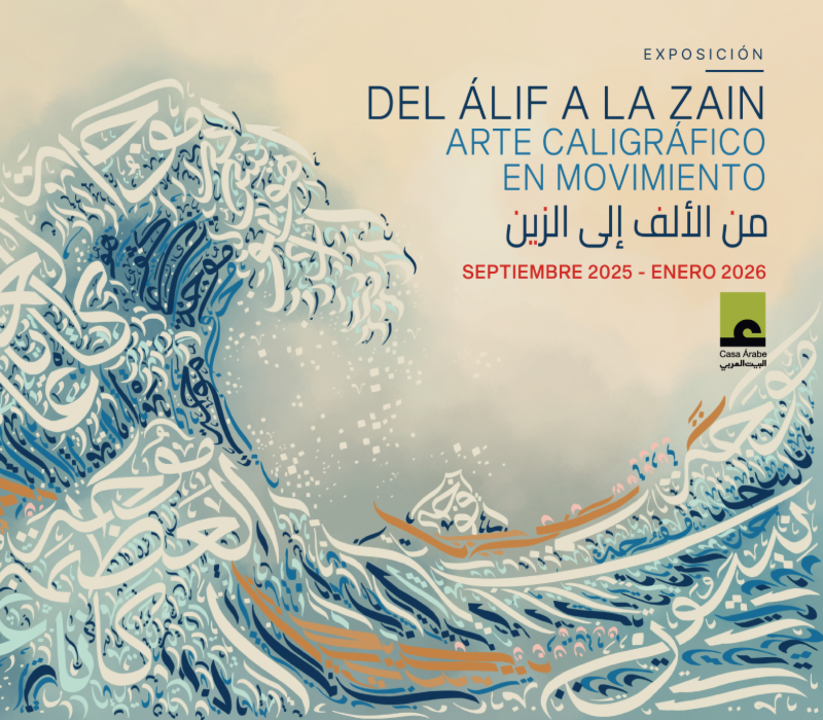
Image: Idriss Azougaye
Toufik Douib (Algiers, 1980) is a curator and creative director whose multidisciplinary practice explores Maghreb-Algerian identities from contemporary and eclectic perspectives, connecting artists from the diaspora with creative scenes in the East and West. After earning his Master’s degree in Cultural Event Management, he held his first exhibition, Algerianism, in 2015. Between 2017 and 2018, he collaborated with London’s P21 Gallery on projects such as Dhikr Pictural, {Un}Told Stories, and Pop Art from North Africa, the last of which was also exhibited at Casa Árabe (2019–2020). He has worked twice with the Shubbak Festival, and most notably on Belonging Sideways (2021) and Soundclash (2023). He is the coordinator of DIGI-MENA, a platform that promotes digital artists from the MENA region, and in 2019 he received an AFAC grant to develop DIGI-DZ in Algiers. He has also collaborated with British universities and international cultural programs. Since 2024, he has been the international creative producer of the Liverpool Arab Arts Festival. The exhibition “From Alif to Zain” marks a decade of cultural engagement and reflects his commitment to showcasing the richness and boldness of contemporary Arab art stories.
Hamed Abdalla (1917–1985, Cairo–Paris) was one of the pioneers in Egyptian and Arab modernism. Self-taught and from a humble background in Upper Egypt, he began painting at the age of ten, inspired by the world of peasant farmers (“fellah”). He developed the concept of “the creative word,” in which written words were transformed into painting, merging abstraction and human forms. His first solo exhibition was in 1941, and in 1949 he presented his work at the Museum of Modern Art in Cairo, where he was acknowledged as the founder of a new artistic school. At his studio, he trained artists of the stature of Tahia Halim, Gazbia Serri, Inji Efflatoun and Georges Bahgory. From 1950 on, he exhibited in Paris, London, New York and other cities across Europe, the United States and Asia, maintaining his commitment to the pan-Arab movement. His work forms part of international collections, including the Tate Modern, the Metropolitan Museum, Mathaf and the Arab World Institute.
Idriss Azougaye (Rabat, 1983) is a German-Moroccan artist, designer, and calligrapher whose work encompasses painting, sculpture, calligraphy, digital media and the installation. Rooted in the Andalusian-Moroccan tradition, with a family heritage linked to mosque architecture, stucco and zellij, he combines historical craftsmanship with contemporary design, creating pieces that form a dialogue between cultures and eras. His career builds bridges between international publishing, fashion and visual culture, as well as deeply traditional artistic practices. The founder, editor-in-chief and publisher of You’n’Us magazine, he melds art, culture, and spiritual discourse into his own unique creative vision. In series such as “Orient meets Occident,” he has transformed iconic European works through Arabic texts, cryptographic elements and immersive digital interpretations. His work thus becomes a dialogue between history and modernity, East and West, tradition and experimentation, offering a bold and multifaceted look at identity, memory and the universality of human experience.
Nasreddine Bennacer (Guelma, Algeria, 1967) is a French-Algerian artist. Born in Guelma and raised in Algiers, he currently lives and works in Paris. His aesthetic research questions the concepts of culture, civilization and identity. Through various media, including sculpture, painting on Plexiglas and installations, he has explored the dynamics of power, combining sensitivity and irony to dismantle contemporary ideologies and denounce the irrationality of today’s world. In his most recent work, marked by a fresh technical approach, Bennacer avoids obvious statements and leans toward minimalist lyricism. His works on Japanese paper, straddling the abstract and figurative, emerge from the dialogue between medium and technique, embracing the unexpected and transcending the artist’s own gesture to give rise to memories and flashes of recollection.
Akram Idris (Omdurman, Sudan, 1992) is a Sudanese visual artist, calligrapher and designer based in Saudi Arabia. He holds a degree in Visual Arts with a specialization in Arabic calligraphy and Islamic decoration from the Faculty of Fine Arts and Applied Arts at the Sudan University of Science and Technology (2016). He has actively participated in art competitions and exhibitions across several Arab countries. In 2015, he won the Afrabia Award for Arab and African Youth, and then exhibited in Khartoum, Cairo and at the Sharjah Calligraphy Biennial (2018), in addition to other collective spaces. His work focuses on the development and affirmation of Arab identity by designing lines and decorative motifs, experimenting with various contemporary materials and media. In doing so, he seeks to build a bridge between tradition and modernity, integrating the legacy of calligraphy into current artistic languages.
Anissa Lalahoum (Montreuil, France, 1980) grew up between France and Algeria, with a career marked by displacement and renewal. After fifteen years in the banking sector, a life-changing shift led her to painting: first as a language of healing and then as a path to revelation. Her practice, which she calls “Calligratitude,” consists of creating paintings in states of trance, conceived as multidimensional portals. These works translate frequencies of love into matter, resonating with spaces and the people who contemplate them. Rooted in simiya, which is related to ʿilm al-ḥurūf (the science of Arabic letters), and inspired by the gestural abstraction of artists such as Georges Mathieu, her work transforms writing into prayer, breath and energy. Her canvases function as visual mantras: vibrations rather than legible signs. She has exhibited worldwide at institutions such as UNESCO, Abu Dhabi, Dubai, Japan and London. At the heart of her work lies one essential principle: consciousness experiences itself through love.
Mosa One (Rome, 1997) is a multidisciplinary artist whose work ranges from hand-sewn textiles to murals and installations. Originally from the suburbs of Rome, he began his journey in art at the age of 13 through graffiti, placing his first signatures on the streets of his neighborhood. At 19, he was invited to paint a mural at MACRO, the Museum of Contemporary Art in Rome, which marked a turning point in his career. Since then, he has collaborated with institutions and brands such as UNICEF, Netflix and Nike, having put on exhibitions in Italy and abroad. The son of an Egyptian family, the two-fold nature of his identity is central to his artistic research, in which he explores the richness of belonging to two cultures and two seemingly opposite ways of life. His work also addresses social criticism and the struggle against injustices affecting our planet.
Shareef Sarhan (Gaza, 1976) is a visual artist and photographer. He is a founding member of Shababeek for Contemporary Art and a member of the Palestinian Artists Association. Sarhan earned his university degree in Art. He attended the Darat Al Funun Academy in Jordan. He received the Bronze Award at the Arab Photographers Festival in 2008 and the Recognition Award in 2007. Sarhan produced an illustrated book titled “Gaza Live.” His work has been exhibited in Gaza, Ramallah, Jerusalem, Amman, the United States, France, Germany and Italy.
Bahia Shehab (Beirut, 1980) is a Cairo-based artist and author based whose work explores identity and the preservation of cultural heritage. Through her research into Islamic art, she reinterprets contemporary Arab politics, feminist discourse and a range of social issues. Her work has been presented at museums, galleries and public spaces in more than 35 cities, and she has been acknowledged with many international awards, including the TED Senior Fellowship, the BBC 100 Women list, a residency at Bellagio and the Prince Claus Award. She was also the first Arab woman to receive the UNESCO-Sharjah Prize for Arab Culture. Her publications include You Can Crush the Flowers: A Visual Memoir of the Egyptian Revolution, At the Corner of a Dream, A Thousand Times NO: The Visual History of Lam-Alif, and the award-winning co-authored book A History of Arab Graphic Design.
Sarah Smahane (France, 1995) grew up in a suburban town, the daughter of Moroccan immigrant parents. Her artistic name holds strong symbolic value: Smahane is the middle name given to her by her paternal grandfather, inspired by the Golden Age of Arabic music, including figures such as Abdelhalim El Hafiz, Fairuz and Umm Kulthum, as well as paying homage to the Syrian singer Asmahan. From an early age, she experienced cultural tensions and conflicts that led her to question her identity. At the age of eight, she began her education in art by working with a local painter, an experience that lasted seven years. She later studied Art and Design in Paris, where she worked for prestigious agencies serving clients in the West and the MENA region. Within this context, she collaborated with artisans from North Africa, the Middle East and Europe, rediscovering and fully embracing the richness of her multiple heritages: French, Moroccan, Amazigh and Arab.
Haythem Zakaria (Tunisia, 1983) is a transdisciplinary artist and sound performer based in France. His practice, influenced by cosmology and spirituality, explores the crossroads between different systems of thought and disciplines such as Sociology, Economics and Ethnography. Using a hybrid approach, he combines contemporary technologies such as interactive programming, sensors and installations, with traditional media such as photography, video, drawing and sculpture. Driven by the search for archetypal forms, his work draws on philosophical, mythological and theological references and is characterized by minimalist and refined methods, always infused with a strong digital dimension. In 2015, he received the Grand Prize at the Japan Media Arts Festival for Interstices. He has held exhibitions in Tunisia, France, Belgium, the United Kingdom, Japan, Egypt and Morocco. In 2022, he was invited to take part in Documenta 15, one of the world’s most important contemporary art exhibitions, held in Kassel, Germany.
Idriss Azougaye (Rabat, 1983) is a German-Moroccan artist, designer, and calligrapher whose work encompasses painting, sculpture, calligraphy, digital media and the installation. Rooted in the Andalusian-Moroccan tradition, with a family heritage linked to mosque architecture, stucco and zellij, he combines historical craftsmanship with contemporary design, creating pieces that form a dialogue between cultures and eras. His career builds bridges between international publishing, fashion and visual culture, as well as deeply traditional artistic practices. The founder, editor-in-chief and publisher of You’n’Us magazine, he melds art, culture, and spiritual discourse into his own unique creative vision. In series such as “Orient meets Occident,” he has transformed iconic European works through Arabic texts, cryptographic elements and immersive digital interpretations. His work thus becomes a dialogue between history and modernity, East and West, tradition and experimentation, offering a bold and multifaceted look at identity, memory and the universality of human experience.
Nasreddine Bennacer (Guelma, Algeria, 1967) is a French-Algerian artist. Born in Guelma and raised in Algiers, he currently lives and works in Paris. His aesthetic research questions the concepts of culture, civilization and identity. Through various media, including sculpture, painting on Plexiglas and installations, he has explored the dynamics of power, combining sensitivity and irony to dismantle contemporary ideologies and denounce the irrationality of today’s world. In his most recent work, marked by a fresh technical approach, Bennacer avoids obvious statements and leans toward minimalist lyricism. His works on Japanese paper, straddling the abstract and figurative, emerge from the dialogue between medium and technique, embracing the unexpected and transcending the artist’s own gesture to give rise to memories and flashes of recollection.
Akram Idris (Omdurman, Sudan, 1992) is a Sudanese visual artist, calligrapher and designer based in Saudi Arabia. He holds a degree in Visual Arts with a specialization in Arabic calligraphy and Islamic decoration from the Faculty of Fine Arts and Applied Arts at the Sudan University of Science and Technology (2016). He has actively participated in art competitions and exhibitions across several Arab countries. In 2015, he won the Afrabia Award for Arab and African Youth, and then exhibited in Khartoum, Cairo and at the Sharjah Calligraphy Biennial (2018), in addition to other collective spaces. His work focuses on the development and affirmation of Arab identity by designing lines and decorative motifs, experimenting with various contemporary materials and media. In doing so, he seeks to build a bridge between tradition and modernity, integrating the legacy of calligraphy into current artistic languages.
Anissa Lalahoum (Montreuil, France, 1980) grew up between France and Algeria, with a career marked by displacement and renewal. After fifteen years in the banking sector, a life-changing shift led her to painting: first as a language of healing and then as a path to revelation. Her practice, which she calls “Calligratitude,” consists of creating paintings in states of trance, conceived as multidimensional portals. These works translate frequencies of love into matter, resonating with spaces and the people who contemplate them. Rooted in simiya, which is related to ʿilm al-ḥurūf (the science of Arabic letters), and inspired by the gestural abstraction of artists such as Georges Mathieu, her work transforms writing into prayer, breath and energy. Her canvases function as visual mantras: vibrations rather than legible signs. She has exhibited worldwide at institutions such as UNESCO, Abu Dhabi, Dubai, Japan and London. At the heart of her work lies one essential principle: consciousness experiences itself through love.
Mosa One (Rome, 1997) is a multidisciplinary artist whose work ranges from hand-sewn textiles to murals and installations. Originally from the suburbs of Rome, he began his journey in art at the age of 13 through graffiti, placing his first signatures on the streets of his neighborhood. At 19, he was invited to paint a mural at MACRO, the Museum of Contemporary Art in Rome, which marked a turning point in his career. Since then, he has collaborated with institutions and brands such as UNICEF, Netflix and Nike, having put on exhibitions in Italy and abroad. The son of an Egyptian family, the two-fold nature of his identity is central to his artistic research, in which he explores the richness of belonging to two cultures and two seemingly opposite ways of life. His work also addresses social criticism and the struggle against injustices affecting our planet.
Shareef Sarhan (Gaza, 1976) is a visual artist and photographer. He is a founding member of Shababeek for Contemporary Art and a member of the Palestinian Artists Association. Sarhan earned his university degree in Art. He attended the Darat Al Funun Academy in Jordan. He received the Bronze Award at the Arab Photographers Festival in 2008 and the Recognition Award in 2007. Sarhan produced an illustrated book titled “Gaza Live.” His work has been exhibited in Gaza, Ramallah, Jerusalem, Amman, the United States, France, Germany and Italy.
Bahia Shehab (Beirut, 1980) is a Cairo-based artist and author based whose work explores identity and the preservation of cultural heritage. Through her research into Islamic art, she reinterprets contemporary Arab politics, feminist discourse and a range of social issues. Her work has been presented at museums, galleries and public spaces in more than 35 cities, and she has been acknowledged with many international awards, including the TED Senior Fellowship, the BBC 100 Women list, a residency at Bellagio and the Prince Claus Award. She was also the first Arab woman to receive the UNESCO-Sharjah Prize for Arab Culture. Her publications include You Can Crush the Flowers: A Visual Memoir of the Egyptian Revolution, At the Corner of a Dream, A Thousand Times NO: The Visual History of Lam-Alif, and the award-winning co-authored book A History of Arab Graphic Design.
Sarah Smahane (France, 1995) grew up in a suburban town, the daughter of Moroccan immigrant parents. Her artistic name holds strong symbolic value: Smahane is the middle name given to her by her paternal grandfather, inspired by the Golden Age of Arabic music, including figures such as Abdelhalim El Hafiz, Fairuz and Umm Kulthum, as well as paying homage to the Syrian singer Asmahan. From an early age, she experienced cultural tensions and conflicts that led her to question her identity. At the age of eight, she began her education in art by working with a local painter, an experience that lasted seven years. She later studied Art and Design in Paris, where she worked for prestigious agencies serving clients in the West and the MENA region. Within this context, she collaborated with artisans from North Africa, the Middle East and Europe, rediscovering and fully embracing the richness of her multiple heritages: French, Moroccan, Amazigh and Arab.
Haythem Zakaria (Tunisia, 1983) is a transdisciplinary artist and sound performer based in France. His practice, influenced by cosmology and spirituality, explores the crossroads between different systems of thought and disciplines such as Sociology, Economics and Ethnography. Using a hybrid approach, he combines contemporary technologies such as interactive programming, sensors and installations, with traditional media such as photography, video, drawing and sculpture. Driven by the search for archetypal forms, his work draws on philosophical, mythological and theological references and is characterized by minimalist and refined methods, always infused with a strong digital dimension. In 2015, he received the Grand Prize at the Japan Media Arts Festival for Interstices. He has held exhibitions in Tunisia, France, Belgium, the United Kingdom, Japan, Egypt and Morocco. In 2022, he was invited to take part in Documenta 15, one of the world’s most important contemporary art exhibitions, held in Kassel, Germany.
Related content
Anterior
Siguiente
Alphabets, talismans, identity and resistance
To mark the official opening of the group exhibition From Alif to Zain: Calligraphic Art in Motion, Casa Árabe has organized a round table discussion with four artists and the exhibition curator in Madrid on Wednesday, September 24.
September 24, 2025
MADRID