

Conferences and debates
Index / Activities / Conferences and debates / Official opening of the Palestinian Film Festival and conference on Palestine and the United Nations
Official opening of the Palestinian Film Festival and conference on Palestine and the United Nations
October 15, 2025Official opening event at 5:30 p.m. Conference starting at 6:00 p.m.
CORDOBA
Casa Árabe Auditorium (at Calle Samuel de los Santos Gener, 9).
Official opening event at 5:30 p.m. Conference starting at 6:00 p.m.
Free entry until the event’s capacity is reached.
The conference will be in English with simultaneous live translation into Spanish.
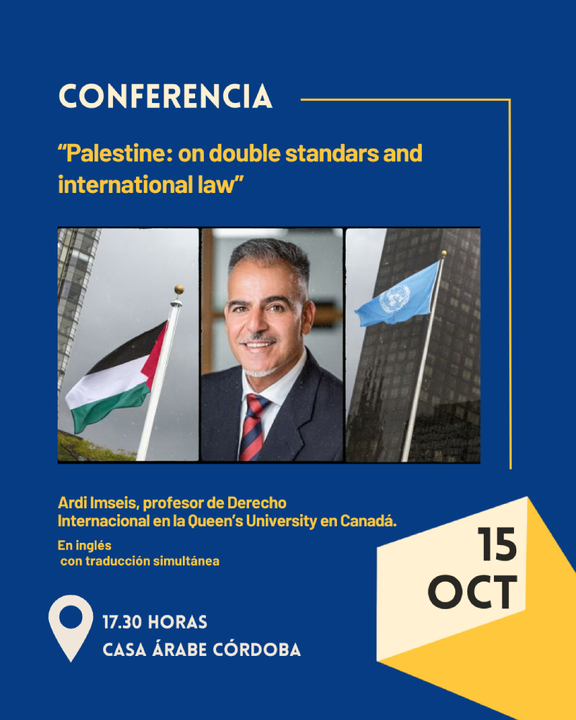
On Wednesday, October 15 will be the opening session of the Palestinian Film Festival which we have organized for October through December. It will be taking place in Córdoba, with a conference given by Ardi Imseis, a professor of International Law at Queen’s University in Canada.
The purpose of this Palestinian film series is to enrich the dialogue surrounding the multifaceted, diverse cultural heritage of the Palestinian people, who are constantly being pulled in different directions by resistance, identity and belonging. The program consists of fifteen sessions in all. They will be taking place during the months of October, November and December at the Casa Árabe headquarters, the Filmoteca de Andalucía and the University of Cordoba’s School of Philosophy and Letters.
Following the opening ceremony, there will be a conference titled “Palestine: On Double Standards and International Law” given by Ardi Imseis, a professor of International Law at Queen’s University in Canada.
This conference will address the different stages that the Palestinian question has gone through at the United Nations. The reflection by Ardi Imseis is that we can only consider international law to be as good as our ability to apply it universally. What does the situation in Palestine tell us about today’s international legal order? Has the international legal order as we know it come to an end, or can it be salvaged?
Ardi Imseis
Ardi Imseis is an associate professor of International Law at Queen’s University in Canada, as well as a prominent legal expert in International Public Law and an acknowledged specialist on the issue of Palestine in international law. From 2002 to 2014, he held various positions at the United Nations, including the UN Relief and Works Agency for Palestine Refugees (UNRWA) and the High Commissioner for Refugees (UNHCR), covering operations in Egypt, Jordan, Lebanon, Palestine and Syria. On several occasions, he has also been invited as a guest to address the UN Security Council and Human Rights Council. He has also worked as a senior legal advisor to the President of the Court of Appeals of Alberta (Canada) and later as a member of the UN Commission of Eminent Experts on Yemen (2019-2021), in addition to serving as a legal advisor and attorney in cases before the International Court of Justice.
Ardi Imseis earned his PhD in Politics and International Relations from Cambridge University, a Master’s degree in Law from Columbia University and a bachelor’s degree in Law from Dalhousie University (Canada), as well as a further degree in International Relations and History from the University of Toronto.
He has had various works published on international law and the Palestine question, placing an emphasis on the role played by the United Nations, prolonged occupation and self-determination. He authored the book The United Nations and the Question of Palestine (Cambridge University Press, 2023), in which he critically examined the UN’s role in this conflict. He was also the editor of the Palestine Yearbook of International Law, establishing himself as one of the most important legal voices on Palestine and contemporary international law.
Following the opening ceremony, there will be a conference titled “Palestine: On Double Standards and International Law” given by Ardi Imseis, a professor of International Law at Queen’s University in Canada.
This conference will address the different stages that the Palestinian question has gone through at the United Nations. The reflection by Ardi Imseis is that we can only consider international law to be as good as our ability to apply it universally. What does the situation in Palestine tell us about today’s international legal order? Has the international legal order as we know it come to an end, or can it be salvaged?
Ardi Imseis
Ardi Imseis is an associate professor of International Law at Queen’s University in Canada, as well as a prominent legal expert in International Public Law and an acknowledged specialist on the issue of Palestine in international law. From 2002 to 2014, he held various positions at the United Nations, including the UN Relief and Works Agency for Palestine Refugees (UNRWA) and the High Commissioner for Refugees (UNHCR), covering operations in Egypt, Jordan, Lebanon, Palestine and Syria. On several occasions, he has also been invited as a guest to address the UN Security Council and Human Rights Council. He has also worked as a senior legal advisor to the President of the Court of Appeals of Alberta (Canada) and later as a member of the UN Commission of Eminent Experts on Yemen (2019-2021), in addition to serving as a legal advisor and attorney in cases before the International Court of Justice.
Ardi Imseis earned his PhD in Politics and International Relations from Cambridge University, a Master’s degree in Law from Columbia University and a bachelor’s degree in Law from Dalhousie University (Canada), as well as a further degree in International Relations and History from the University of Toronto.
He has had various works published on international law and the Palestine question, placing an emphasis on the role played by the United Nations, prolonged occupation and self-determination. He authored the book The United Nations and the Question of Palestine (Cambridge University Press, 2023), in which he critically examined the UN’s role in this conflict. He was also the editor of the Palestine Yearbook of International Law, establishing himself as one of the most important legal voices on Palestine and contemporary international law.