

Conferences and debates
Index / Activities / Conferences and debates / Sufism and Thought: Ibn Barrayān and Ibn ’Arabī
Sufism and Thought: Ibn Barrayān and Ibn ’Arabī
June 10, 20267:00 p.m.
CORDOBA
Casa Árabe Auditorium (at Calle Samuel de los Santos Gener, 9).
7:00 p.m.
Free entry until the event’s capacity is reached.
In Spanish.
On Wednesday, June 10, Prof. Gracia López Anguita from the University of Seville will be giving this conference as part of the event series “Seven Women Talk About Al-Andalus.” During her presentation, we will get to explore some of the most significant issues in Sufi thought and the challenges these thinkers faced. Come listen to her.
The Al-Andalus of the Almoravid and Almohad periods witnessed the emergence of a mysticism whose originality was unparalleled in the Islamic East, despite being rooted there. The most notable contribution by Seville’s Ibn Barrayan (d. 1141) was his innovative Qur’anic exegesis, which proposed a correspondence between the stages of the spiritual path and the elements of nature and cosmos, as well as an interesting dialogue with Christian scriptural sources. As for Ibn Arabi of Murcia (d. 1240), he would become a role model for later Sufism in both East and West, not only because of the consensus regarding his spiritual status as the “highest master,” but also because of his systematization of a speculative mysticism that ranged from the description of his experience of spiritual realization and Islamic prophetology to reflections on the order of the universe and God’s relationship with the world. It is in this realm—that of cosmology—where the influence of his teacher Ibn Barrayan can be perceived.
In this talk, Professor Gracia López Anguita from the University of Seville will be providing us with an overview of a few of the most significant themes found in these Sufis’ thought and the problems which these ideas may have caused for them among political and religious authorities.
Gracia López Anguita is a professor at the University of Seville’s Department of Arabic and Islamic Studies, where she teaches Classical Arabic and Islamic Thought and also serves as an instructor in the Master’s Program in Literary, Linguistic and Cultural Studies. She has been a visiting researcher at Allameh Tabatabai University in Tehran and the École Pratique des Hautes Études in Paris. She currently forms part of the research team for the research, development and innovation project “Cultural and Religious Identity in Moroccan and Senegalese Sufism: Hagiographies, gender issues, and symbolism.” Her research and writing focus in particular on Ibn Arabi’s thought and his school of philosophy, as well as hagiographic sources from the Maghreb. Her latest publication was El nodo de los sabios. `Uqlat al-mustawfiz y otros textos cosmológicos de Ibn Arabi (The Hub of Sages:`Uqlat al-mustawfiz and Other Cosmological Texts by Ibn Arabi”), published by Trotta, 2026.
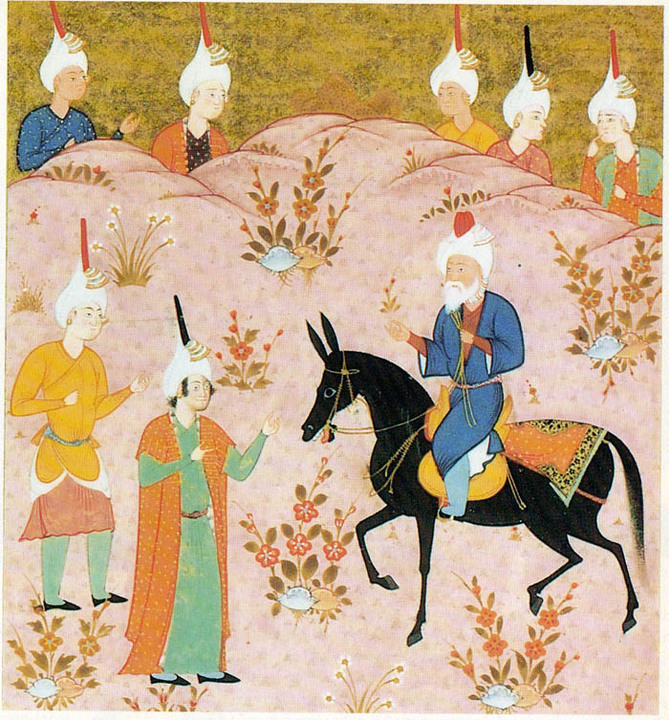
Image: Late sixteenth-century Persian miniature from the Safavid period, depicting Ibn ‘Arabi on horseback with two students (scribe: Farīd al-Kātib). Courtesy of the Bodleian Library, Oxford.
In this talk, Professor Gracia López Anguita from the University of Seville will be providing us with an overview of a few of the most significant themes found in these Sufis’ thought and the problems which these ideas may have caused for them among political and religious authorities.
Gracia López Anguita is a professor at the University of Seville’s Department of Arabic and Islamic Studies, where she teaches Classical Arabic and Islamic Thought and also serves as an instructor in the Master’s Program in Literary, Linguistic and Cultural Studies. She has been a visiting researcher at Allameh Tabatabai University in Tehran and the École Pratique des Hautes Études in Paris. She currently forms part of the research team for the research, development and innovation project “Cultural and Religious Identity in Moroccan and Senegalese Sufism: Hagiographies, gender issues, and symbolism.” Her research and writing focus in particular on Ibn Arabi’s thought and his school of philosophy, as well as hagiographic sources from the Maghreb. Her latest publication was El nodo de los sabios. `Uqlat al-mustawfiz y otros textos cosmológicos de Ibn Arabi (The Hub of Sages:`Uqlat al-mustawfiz and Other Cosmological Texts by Ibn Arabi”), published by Trotta, 2026.
Image: Late sixteenth-century Persian miniature from the Safavid period, depicting Ibn ‘Arabi on horseback with two students (scribe: Farīd al-Kātib). Courtesy of the Bodleian Library, Oxford.