

Courses and Workshops
Index / Activities / Courses and Workshops / New workshops to stitch Palestinian embroidery on your clothes
New workshops to stitch Palestinian embroidery on your clothes
From September 26, 2025 until October 05, 2025The workshops will be taking place on Saturday, October 4 and Sunday, October 5, from 11:00 a.m. to 1:30 p.m.
MADRID
Casa Árabe headquarters (at Calle Alcalá, 62).
The workshops will be taking place on Saturday, October 4 and Sunday, October 5, from 11:00 a.m. to 1:30 p.m.
5 euros for each workshop. Sign up for the event through our ticket sales.
No more than 12 attendees per workshop. Materials included, you just have to bring your own clothing items with you.
In Spanish.
If you missed out on our Palestinian embroidery (tatreez) workshops, you will be getting two new opportunities to learn how to personalize your clothes and accessories, using this traditional technique, on October 4 and 5. Sign up now!
We will continue to make embroidery together to fight for the Palestinian cause. As part of the project “Threads of the Diaspora: Weaving scraps of Palestinian Heritage,” we have set up two new workshops on Palestinian embroidery to be placed in your clothing, art, traditional pieces and designs, so that you can learn how to hand-embroider garments using the technique and motifs of Palestinian embroidery, known as tatreez.
Tatreez, traditional Palestinian embroidery, placed on record since 2021 as a form of Intangible Cultural Heritage of Humanity by UNESCO, is a folk art traditionally practiced by women which has now become a symbol of Palestinian culture, identity and resistance. A form of interaction shared with similar customary arts and practices in other regions of the Arab world and Mediterranean, tatreez was used to decorate dresses, with specific shapes, colors and motifs that helped identify the region and place in historic Palestine where the pieces were woven.
During this two and a half-hour practical workshop, participants will get the opportunity to dive deep into the art of traditional Palestinian embroidery and learn about the essential techniques of hand embroidery, with a special emphasis on the patterns and colors typical of Palestinian culture, telling age-old stories through their geometric and symbolic shapes.
Each participant will work on a garment or accessory of their own choosing (linen, cotton or denim fabrics only) to customize it with a unique design that reflects the richness of Palestinian embroidery.
During the workshop, they will receive guidance on how to adapt these traditional designs to modern garments, keeping this cultural heritage alive while creating contemporary pieces.
At the end of the workshop, those who took part will have learned the basic techniques for creating Palestinian embroidery and applied this knowledge to a personalized garment with an original, traditionally inspired design.
Organized with the cooperation of The Tatreez Collective, the workshops will be taught by Spanish-Palestinian cultural embroiderer Dina Asfour.
Workshop calendar:
October 4, 2025, 11:00 a.m. - 1:30 p.m. -- Palestinian embroidery on your own clothes 3 - SIGN UP HERE
October 10, 2025, 11:00 a.m. - 1:30 p.m. -- Palestinian embroidery on your own clothes 4 - SIGN UP HERE
Workshop objectives:
- Introducing participants to the art of Palestinian embroidery.
- Teaching the basic stitches used in this type of embroidery.
- Guiding participants as they design and customize their own garments, using traditional patterns and colors.
- To promote an appreciation for Palestinian textile techniques and the history behind them.
Requirements for participants:
- Embroidery materials included
- You must bring a piece of clothing or an accessory which you would like to have embroidered (linen, cotton or denim fabrics only)
- No prior embroidery experience required.
This program has been given support by the Spanish Agency for International Development Cooperation (AECID).

Tatreez, traditional Palestinian embroidery, placed on record since 2021 as a form of Intangible Cultural Heritage of Humanity by UNESCO, is a folk art traditionally practiced by women which has now become a symbol of Palestinian culture, identity and resistance. A form of interaction shared with similar customary arts and practices in other regions of the Arab world and Mediterranean, tatreez was used to decorate dresses, with specific shapes, colors and motifs that helped identify the region and place in historic Palestine where the pieces were woven.
During this two and a half-hour practical workshop, participants will get the opportunity to dive deep into the art of traditional Palestinian embroidery and learn about the essential techniques of hand embroidery, with a special emphasis on the patterns and colors typical of Palestinian culture, telling age-old stories through their geometric and symbolic shapes.
Each participant will work on a garment or accessory of their own choosing (linen, cotton or denim fabrics only) to customize it with a unique design that reflects the richness of Palestinian embroidery.
During the workshop, they will receive guidance on how to adapt these traditional designs to modern garments, keeping this cultural heritage alive while creating contemporary pieces.
At the end of the workshop, those who took part will have learned the basic techniques for creating Palestinian embroidery and applied this knowledge to a personalized garment with an original, traditionally inspired design.
Organized with the cooperation of The Tatreez Collective, the workshops will be taught by Spanish-Palestinian cultural embroiderer Dina Asfour.
Workshop calendar:
October 4, 2025, 11:00 a.m. - 1:30 p.m. -- Palestinian embroidery on your own clothes 3 - SIGN UP HERE
October 10, 2025, 11:00 a.m. - 1:30 p.m. -- Palestinian embroidery on your own clothes 4 - SIGN UP HERE
Workshop objectives:
- Introducing participants to the art of Palestinian embroidery.
- Teaching the basic stitches used in this type of embroidery.
- Guiding participants as they design and customize their own garments, using traditional patterns and colors.
- To promote an appreciation for Palestinian textile techniques and the history behind them.
Requirements for participants:
- Embroidery materials included
- You must bring a piece of clothing or an accessory which you would like to have embroidered (linen, cotton or denim fabrics only)
- No prior embroidery experience required.
This program has been given support by the Spanish Agency for International Development Cooperation (AECID).

Dina Asfour
A cultural embroiderer and the founder of the The Tatreez Collective, Dina Asfour was born and raised in Spain, with a Palestinian refugee father and a Spanish mother, and has always been very committed to the Palestinian cause. She moved to London in 2016, where she found herself in a diverse environment that gave her the chance to explore and share her identity with others through the art of tatreez. The Tatreez Collective is made up of diaspora women of Middle Eastern descent who are ultimately united to one another by their love for tatreez. The word “tatreez” means embroidery in Arabic, and although the term is used to refer to embroidery in general, in the Palestinian context it is understood as referring to cross-stitching. She sees her practice as a way of documenting and promoting Palestinian heritage, as well as an act of resistance.
linktr.ee/thetatreezcollective
@thetatreezcollective
A cultural embroiderer and the founder of the The Tatreez Collective, Dina Asfour was born and raised in Spain, with a Palestinian refugee father and a Spanish mother, and has always been very committed to the Palestinian cause. She moved to London in 2016, where she found herself in a diverse environment that gave her the chance to explore and share her identity with others through the art of tatreez. The Tatreez Collective is made up of diaspora women of Middle Eastern descent who are ultimately united to one another by their love for tatreez. The word “tatreez” means embroidery in Arabic, and although the term is used to refer to embroidery in general, in the Palestinian context it is understood as referring to cross-stitching. She sees her practice as a way of documenting and promoting Palestinian heritage, as well as an act of resistance.
linktr.ee/thetatreezcollective
@thetatreezcollective
Related content
Anterior
Siguiente
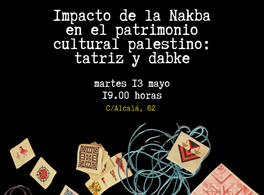
Impact of the Nakba on Palestine’s cultural heritage: tatreez (embroidery) and dabke (dance)
Within the framework of the commemoration of the seventy-seventh anniversary of the Nakba, Casa Árabe and the Spanish International Cooperation Agency (AECID) are organizing this round table discussion in Madrid on Tuesday, May 13. The talk will be followed by the presentation of the results found in the collective work from the project “Threads of the Diaspora.” Sign up and come find out all about it!
May 13, 2025
MADRID

Threads of the Diaspora: Weaving scraps of Palestinian heritage
This fall we will be hosting workshops and meetings to discover tatreez,
Palestinian embroidery, to create a work that weaves together the
threads of the diaspora. From October 11 to November 30, come “Embroider
Palestine” with us.
From September 24, 2024 until November 30, 2024
MADRID AND CORDOBA

New Palestinian embroidery workshops
Throughout the months of January and March 2025, we are organizing new tatreez workshops in Madrid as part of the “Threads of the Diaspora” project, under the title “Embroidering dreams of a Palestinian garden,” with the support of AECID. You may start reserving your spaces as of Monday, January 13. Don’t miss out.
From January 10, 2025 until March 22, 2025
MADRID

Steps for Palestine: Dabke through the Diaspora
Casa
Árabe is hosting this series of workshops to discover the traditional
Palestinian dance known as the dabke, to be held at its Madrid
headquarters on Saturday mornings from May 24 through July 5. Sign up
now!
From May 14, 2025 until July 5, 2025
MADRID