

Conferences and debates
Index / Activities / Conferences and debates / Impact of the Nakba on Palestine’s cultural heritage: tatreez (embroidery) and dabke (dance)
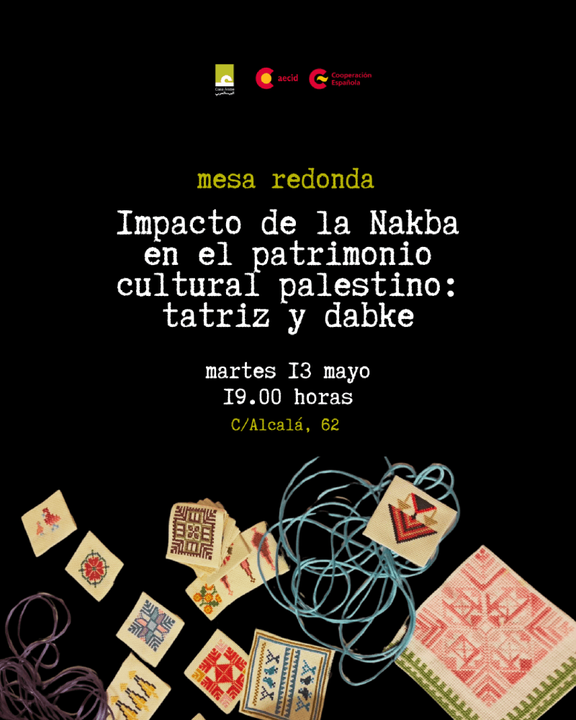
Impact of the Nakba on Palestine’s cultural heritage: tatreez (embroidery) and dabke (dance)
May 13, 20257:00 p.m.
MADRID
Casa Árabe Auditorium (at Calle Alcalá, 62).
7:00 p.m.
Free entry after registering.
Register using this form.
In Spanish.
Within the framework of the commemoration of the seventy-seventh anniversary of the Nakba, Casa Árabe and the Spanish International Cooperation Agency (AECID) are organizing this round table discussion in Madrid on Tuesday, May 13. The talk will be followed by the presentation of the results found in the collective work from the project “Threads of the Diaspora.” Sign up and come find out all about it!
In order to mark the occasion of the day to commemorate the Nakba (“Catastrophe” in Arabic), which will be remembered on May 15 on its seventy-seventh anniversary, and as part of the project Threads of the Diaspora: Weaving together pieces of Palestinian heritage, with the support of the Spanish International Development Cooperation Agency (AECID), Casa Árabe is organizing this round table discussion about the impact of the Nakba, both the one that took place in 1948 and the one occurring right now, in terms of Palestinian cultural heritage, with special emphasis on the practice and historical development of tatreez (embroidery) and dabke (traditional Middle Eastern dance), as examples of the Palestinians’ intangible cultural heritage, as well as being symbols of identity and forms of resistance by the Palestinian people, in both Palestine and the diaspora.
Participating in the event will be Maysun Cheikh Ali Mediavilla, a Spanish-Palestinian teacher and artist who has been collaborating with Casa Árabe on projects related with Palestinian embroidery over the last two years (Living Tatreez and Threads of the Diaspora), Laura Martínez del Pozo, the designer and director of the PeSeta clothing brand and developer with UNRWA of the project Tatreez, and Francisco Montero Lahsen, a Chilean-Palestinian researcher and dabke teacher, who in the upcoming months will be giving workshops with us called Steps for Palestine: Dabke from the Diaspora.
The round table will be followed by a meeting with participants and collaborators on the occasion of the opening of the collective exhibition “Threads of the Diaspora”, with the frontal panel of a dress from Gaza created using scraps embroidered by participants in the tatreez workshops held last year, along with the pieces sent in by the public, all connected as threads of the diaspora.
The conference will include talks by Miguel Moro, the General Director of Casa Árabe, Eloisa Vaello Marco, Assistant Director of Cooperation and Cultural Action for Sustainable Development at the AECID’s Directorate for Cultural and Scientific Relations, and Maysun Cheikh Ali Mediavilla, a Spanish-Palestinian teacher and artist.
Tatreez, or traditional Palestinian embroidery, placed on record by UNESCO since 2021 as a form of Intangible Cultural Heritage, is a folk art traditionally created by women and has become a symbol of Palestinian culture, identity and resistance. A space for interaction shared along with similar customs and artistic practices from other regions in the Arab world and Mediterranean. Tatreez was used to decorate dresses, with specific shapes, colors and motifs that helped identify the region and place where they were woven in historic Palestine. A map of symbols and memories that was completely turned upside-down after the Nakba, it acquired new forms and uses during the different stages of the Palestinian struggle to recover and return to their land, including a means of subsistence for many women and refugee families. In much the same way, traditional Palestinian dance, ordabke, became one of the most representative cultural expressions of Palestine, connecting people to their land, traditions and community. Both in Palestine and among the diaspora, it has thus reinforced its role in the preservation of cultural identity over the last few decades, acquiring new features and forms of expression as a form of cultural resistance, as well.
The day of the Nakba commemorates May 15, 1948, when the State of Israel declared its independence over nearly eighty percent of what had historically been Palestine. In the process, over 800,000 Palestinians were expelled from their homes and land, while 531 Palestinian villages were wiped off the map. The trauma it caused is known as the Nakba, the Arabic word for “catastrophe.” However, Palestinians also refer to al-nakba al-mustamirra, the “ongoing Nakba,” beyond a historical event, to a still continuing process of dispossession and ethnic cleansing, as the last nineteen months of military campaign as has been made apparent by the last 19 months of military campaigns and bombings against Gaza, leading to more than 52,000 Palestinians being killed and 120,000 injured directly by the attacks, as well as 2.3 million displaced persons, all this coming with new threats of expulsion of the local population involving unprecedented levels of violence and impunity, which have already led to talk of a new Nakba right in the middle of the twenty-first century.
Participating in the event will be Maysun Cheikh Ali Mediavilla, a Spanish-Palestinian teacher and artist who has been collaborating with Casa Árabe on projects related with Palestinian embroidery over the last two years (Living Tatreez and Threads of the Diaspora), Laura Martínez del Pozo, the designer and director of the PeSeta clothing brand and developer with UNRWA of the project Tatreez, and Francisco Montero Lahsen, a Chilean-Palestinian researcher and dabke teacher, who in the upcoming months will be giving workshops with us called Steps for Palestine: Dabke from the Diaspora.
The round table will be followed by a meeting with participants and collaborators on the occasion of the opening of the collective exhibition “Threads of the Diaspora”, with the frontal panel of a dress from Gaza created using scraps embroidered by participants in the tatreez workshops held last year, along with the pieces sent in by the public, all connected as threads of the diaspora.
The conference will include talks by Miguel Moro, the General Director of Casa Árabe, Eloisa Vaello Marco, Assistant Director of Cooperation and Cultural Action for Sustainable Development at the AECID’s Directorate for Cultural and Scientific Relations, and Maysun Cheikh Ali Mediavilla, a Spanish-Palestinian teacher and artist.
Tatreez, or traditional Palestinian embroidery, placed on record by UNESCO since 2021 as a form of Intangible Cultural Heritage, is a folk art traditionally created by women and has become a symbol of Palestinian culture, identity and resistance. A space for interaction shared along with similar customs and artistic practices from other regions in the Arab world and Mediterranean. Tatreez was used to decorate dresses, with specific shapes, colors and motifs that helped identify the region and place where they were woven in historic Palestine. A map of symbols and memories that was completely turned upside-down after the Nakba, it acquired new forms and uses during the different stages of the Palestinian struggle to recover and return to their land, including a means of subsistence for many women and refugee families. In much the same way, traditional Palestinian dance, ordabke, became one of the most representative cultural expressions of Palestine, connecting people to their land, traditions and community. Both in Palestine and among the diaspora, it has thus reinforced its role in the preservation of cultural identity over the last few decades, acquiring new features and forms of expression as a form of cultural resistance, as well.
The day of the Nakba commemorates May 15, 1948, when the State of Israel declared its independence over nearly eighty percent of what had historically been Palestine. In the process, over 800,000 Palestinians were expelled from their homes and land, while 531 Palestinian villages were wiped off the map. The trauma it caused is known as the Nakba, the Arabic word for “catastrophe.” However, Palestinians also refer to al-nakba al-mustamirra, the “ongoing Nakba,” beyond a historical event, to a still continuing process of dispossession and ethnic cleansing, as the last nineteen months of military campaign as has been made apparent by the last 19 months of military campaigns and bombings against Gaza, leading to more than 52,000 Palestinians being killed and 120,000 injured directly by the attacks, as well as 2.3 million displaced persons, all this coming with new threats of expulsion of the local population involving unprecedented levels of violence and impunity, which have already led to talk of a new Nakba right in the middle of the twenty-first century.
Maysun Cheikh Ali Mediavilla
A
Spanish-Palestinian teacher and artist, she studied Fine Arts in Madrid
and completed a year of studies at the University of Fine Arts in
Athens, as well as a Master’s degree in Sociocultural Analysis of
Communication and Knowledge at the Universidad Complutense de Madrid.
Since 1994, she has taken part in exhibitions and art shows, as well as
various competitions and festivals. Within the wide range of artistic
practices she takes part in, including embroidery, she has been given
three awards for her digital animations (Getxo Jury Prize, 2011; First
Prize for Digital Animation, Lúmen Ex Digital Art Festival, 2010 and
Third Prize for Digital Animation, Cadiz City Council, 2010).
Since 2023, she has created the projects for workshops and the
collective creation of Palestinian embroidery Living Tatreez and Threads
of the Diaspora with Casa Árabe.
Laura Martínez del Pozo
Laura Martínez
del Pozo, also known as Laura peSeta, is a designer and the founder of
the peSeta brand, renowned for its sustainable handmade textile
products. She has collaborated with brands and entities like Marc
Jacobs, Berlinale and the Reina Sofía Museum. She has also hosted
television programs on clothing and space customization. She has brought
her experience to international workshops and authored the book Mi
primer libro peSeta (My First peSeta Book). Along with UNRWA, she has
developed the “Tatreez” project, which promotes traditional Palestinian
embroidery as a symbol of identity and cultural resistance. This
collaborative project, in which refugee women in Gaza took part, is
seeking to empower these women through their embroidery, breaking the
blockade through creativity and tradition.
Francisco Montero Lahsen
A
professor of Philosophy at the Universidad Metropolitana de Ciencias de
la Educación and in the Master’s degree in Philosophy at the University
of Chile, he is currently pursuing his PhD in Social Anthropology at the
Universidad Autónoma de Madrid. His research work seeks to understand
the role of dabke (traditional Palestinian dance) in new forms of
politics, within the context of the Iberian-American diaspora. A dancer
of dabke since 2018, he formed the Popular Dabke School project of the
General Union of Palestinian Students and the Dabke Ensemble “Muftah” in
Santiago, Chile. He currently conducts workshops on dabke in Andalusia
and Madrid.
Related content
Anterior
Siguiente

Threads of the Diaspora: Weaving scraps of Palestinian heritage
This fall we will be hosting workshops and meetings to discover tatreez,
Palestinian embroidery, to create a work that weaves together the
threads of the diaspora. From October 11 to November 30, come “Embroider
Palestine” with us.
From September 24, 2024 until November 30, 2024
MADRID AND CORDOBA

New Palestinian embroidery workshops
Throughout the months of January and March 2025, we are organizing new tatreez workshops in Madrid as part of the “Threads of the Diaspora” project, under the title “Embroidering dreams of a Palestinian garden,” with the support of AECID. You may start reserving your spaces as of Monday, January 13. Don’t miss out.
From January 10, 2025 until March 22, 2025
MADRID
“Gaza: Chronicle of a Nakba foretold”
Casa Árabe, with the cooperation of the Catarata publishing house, is organizing the presentation of this book by Ignacio Álvarez-Ossorio and José Abu-Tarbush. The event will be moderated by Leila Nachawati. You may now register to attend.
May 28, 2024
MADRID / ONLINE

From the Nakba to the theater
On Tuesday, May 27, Casa Árabe and Spain's Ministry of Culture have
organized a talk on cultural resistance, accompanied by a dramatized
reading between playwright Ismail Khalidi and performers Samy Khalil and
Beatriz Mbula. You won't want to miss it!
May 27, 2025
MADRID
Anterior
Siguiente

New workshops to stitch Palestinian embroidery on your own clothes
As part of the project Threads of the Diaspora: Weaving scraps of Palestinian heritage, we have organized two new workshops to teach you how to stitch Palestinian embroidery on your own clothing items (art, tradition and design) and customize your favorite garments using the technique and motifs employed in Palestinian embroidery, known as tatreez. Sign up now!
From June 12, 2025 until June 13, 2025
MADRID AND CORDOBA

Sampling of “dabke” music after the “Steps for Palestine” workshops
On Friday, July 4, come watch the choreographic performance prepared by the participants in our workshops titled “Steps for Palestine: Dabke Through the Diaspora,” taught by Francisco Montero Lahsen.
July 4, 2025
MADRID
New workshops to stitch Palestinian embroidery on your clothes
If you missed out on our Palestinian embroidery (tatreez) workshops, you
will be getting two new opportunities to learn how to personalize your
clothes and accessories, using this traditional technique, on October 4
and 5. Sign up now!
From September 26, 2025 until October 5, 2025
MADRID